(347) 625-1246
 hello@brooklynchirocare.com
 112 Greenpoint Ave #1B, Brooklyn, NY 11222
Plantar fasciitis in Greenpoint is the kind of thing patients put up with for months before they walk into my clinic. You roll out of bed, take three steps toward the kitchen, and feel that sharp stab in your heel like you stepped on a tack. By mid-morning it eases up. By the end of a long shift on your feet, it’s back. You’ve been telling yourself it’s nothing. It’s something.
I see it constantly in this neighborhood. Restaurant servers from Manhattan Avenue. Runners coming off the McCarren track. Warehouse workers on concrete eight hours a day. The pattern is almost always the same, and the fix is rarely as complicated as people fear. You don’t need surgery. You usually don’t need a cortisone shot. What you need is the right diagnosis and a treatment plan that addresses why the tissue is overloaded, not just the pain it’s producing.
Key Takeaways
- Plantar fasciitis affects roughly 1 in 10 people at some point and is the most common cause of heel pain in adults
- The classic sign is sharp pain with your first steps in the morning that eases as you move around
- The root cause is almost always a mechanical issue further up the chain, tight calves, restricted ankle, or hip imbalance
- A 2009 randomized trial found that manual therapy plus exercise outperformed standard care for plantar heel pain
- Dr. Patel evaluates and treats plantar fasciitis at Brooklyn Chiropractic Care, 112 Greenpoint Ave.
Table of Contents
What Plantar Fasciitis in Greenpoint Actually Looks Like
The plantar fascia is a thick band of connective tissue that runs from your heel bone to the base of your toes. It works like a bowstring under your arch, storing and releasing energy with every step. When that tissue gets overloaded past what it can handle, the fibers near the heel get irritated and inflamed. That’s plantar fasciitis.
The signature symptom is sharp pain with your first steps in the morning, or when you stand up after sitting for a while. It eases as you move around because the fascia warms up and lengthens. By the end of a long day, it’s usually back. If you’ve been Googling “heel pain that hurts in the morning Greenpoint,” you’ve probably already read this part. The harder question is what to do about it.
Plantar fasciitis affects roughly 10% of people during their lifetime, with peak prevalence in adults aged 40 to 60 [1]. It’s not a tear, it’s not a fracture, and it’s not arthritis. It’s an overuse problem. Which means the path out is mechanical, not pharmaceutical.
Why I See So Much of It in Greenpoint
This neighborhood has a specific risk profile and I see it walk through my door every week.
Restaurant and bar workers. Greenpoint’s hospitality scene is huge. Servers, bartenders, line cooks, baristas. Eight to twelve hours on hard floors in shoes that aren’t built for it. The plantar fascia takes constant low-grade load and never fully recovers between shifts. Restaurant workers in Greenpoint are some of the most predictable plantar fasciitis cases I treat.
Runners. McCarren Park, the East River Greenway, the Brooklyn Half training crowd. Repetitive impact on a fascia that’s already chronically tight from sitting at a desk all week. The mileage spike in spring is when I see runners crash. North Brooklyn runners often arrive in April and May with heel pain that started during base training.
Warehouse and trade workers. Greenpoint’s industrial waterfront still has plenty of warehouse, dock, and construction work. Steel toes on concrete is a brutal combination for the arch.
People who lift heavy and sit a lot. The CrossFit and powerlifting crowd in the neighborhood. Tight posterior chain from squatting heavy plus eight hours at a desk equals an Achilles and calf complex that pulls on the heel insertion all day.
Different jobs, same final pathway. The tissue is loaded harder than it can recover from.
What’s Really Causing Your Heel Pain
Most patients come in convinced their heel is the problem. The heel is where you feel it. The cause is almost always somewhere else.
Tight calves and restricted ankle dorsiflexion. If your ankle can’t bend forward enough during gait, the foot rolls in (overpronates) to find the range. That puts a tensile load on the plantar fascia with every step. This is the single biggest driver I see, and it’s the one most patients have never had checked.
Hip weakness or restriction. The hip controls how the leg lands. If the glute medius isn’t firing or the hip is stuck, the knee collapses inward, the arch flattens, and the fascia takes the hit. People are always surprised when I tell them their heel pain starts at their hip.
Sudden load changes. A new running program. A switch from sit-down work to a job on your feet. Starting a barre or HIIT class after years off. The tissue can adapt, but only to gradual increases. Spike the load and it inflames.
Footwear. Worn-out runners. Flat ballet flats. Standing on concrete in dress shoes with no support. Footwear is rarely the only cause but it’s almost always part of the picture.
Weight gain. Even ten pounds adds meaningful load through the fascia at every step. I bring this up gently because nobody wants to hear it, but the math is the math.
How Dr. Patel Treats Plantar Fasciitis
The first thing I do is figure out where the load is actually coming from. I check ankle dorsiflexion with the knee bent and straight (gastrocnemius vs. soleus). I check first MTP extension. Hip internal rotation. Glute activation. Single-leg balance. The exam tells me which joints aren’t moving the way they should and which muscles aren’t doing their job.
Once I have that, the treatment plan usually has four pieces.
Joint mobilization. Adjustments to the ankle, subtalar joint, and midfoot to restore mobility. If the ankle gains five degrees of dorsiflexion, the load on the fascia drops significantly. Mobilization of the lumbar spine and hip if those are contributing.
Soft tissue work. Targeted release of the gastrocnemius, soleus, and the plantar fascia itself. Trigger points in the calf refer pain straight to the heel and arch. Address those and a lot of patients report immediate change. A 2009 randomized clinical trial published in the Journal of Orthopaedic and Sports Physical Therapy found that manual therapy plus exercise produced better outcomes for plantar heel pain than electrophysical modalities alone [2].
Specific stretching. Not generic calf stretches. A 2003 study in the Journal of Bone and Joint Surgery showed that tissue-specific plantar fascia stretching produced significantly better outcomes than Achilles stretching alone in patients with chronic plantar heel pain [3]. I teach the specific protocol on the first visit.
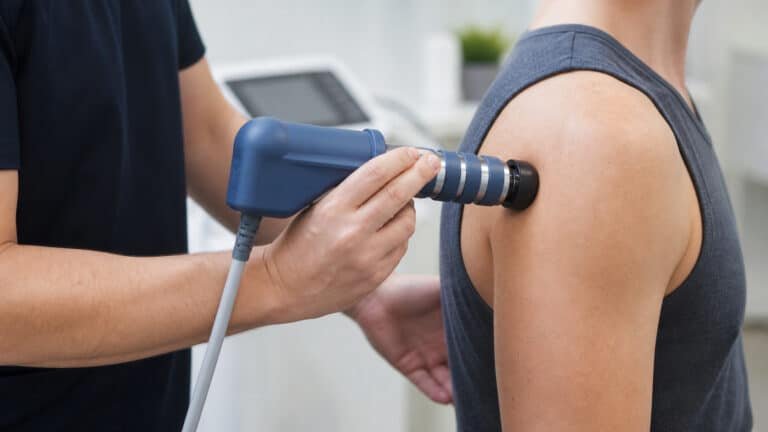
Shockwave therapy when appropriate. For cases that have been going on more than three months or that don’t respond to conservative care in four to six weeks, radial shockwave is the next step. It works. We have a full guide on shockwave therapy for plantar fasciitis if you want the deep dive on outcomes and what to expect.
Most plantar fasciitis cases I see resolve in four to eight weeks with conservative care. The chronic cases that have been going for six months or more take longer, sometimes three months, and are usually the ones that benefit from adding shockwave to the plan.
Your First Visit for Heel Pain
The first visit runs about 45 to 60 minutes. We start with a conversation. When did this start. What makes it worse. What you’ve already tried. I want to know about your job, your shoes, your training, your sleep. All of it matters.
Then a hands-on exam. I’ll watch you walk barefoot. Check ankle and big toe range. Test hip strength and glute firing. Palpate the fascia, the calf, the heel insertion. If imaging would change the plan, I’ll order it. Most plantar fasciitis cases don’t need imaging on the first visit.
If the exam fits a clear plantar fasciitis pattern and there are no red flags, I usually start treatment that day. Some manual work, an adjustment if indicated, and the home program. You leave with a clear plan and the specific stretches you need to start that night.
What You Can Do at Home
Home care isn’t optional with plantar fasciitis. The clinic work and the home work are partners. Skip the home program and progress stalls.
- Tissue-specific plantar fascia stretching. Sit with one leg crossed over the other. Pull your toes back toward your shin until you feel a stretch along the arch. Hold 10 seconds, repeat 10 times. Do this 3 times per day, and most importantly, before your first steps in the morning while still sitting on the bed. The DiGiovanni protocol that this is based on cut pain scores significantly in patients with chronic heel pain [3].
- Calf stretching, both straight and bent knee. Stand facing a wall, one foot back. Keep the back leg straight to target the gastrocnemius. Then bend the back knee to target the soleus. 30 seconds each side, 2-3 rounds, twice a day. The soleus stretch is the one most people skip and it matters.
- Frozen water bottle roll. Roll the arch over a frozen water bottle for 5-10 minutes after long days on your feet. The cold helps the inflammation, the rolling mobilizes the fascia. Cheap and effective.
- Pick up a pair of supportive shoes for work and rotate them daily so the foam can decompress. If your job requires standing all shift, a cushioned over-the-counter insert (the basic ones at any pharmacy) helps. A 2018 systematic review in the British Journal of Sports Medicine found that foot orthoses provide modest pain reduction and functional improvement in plantar heel pain, particularly in the short term [4].
- Don’t push through it on long runs. If you’re a runner, drop your mileage 30-50% for the first two weeks of treatment. Add it back gradually once the morning pain is gone for a full week. Pushing through plantar fasciitis is how acute cases turn into chronic ones.
Plantar Fasciitis: When to See a Doctor
Most heel pain is mechanical and chiropractic care handles it well. A few situations need a different conversation.
Sudden, severe heel pain after a hard impact or sprint. That can be a calcaneal stress fracture or a partial plantar fascia tear, not standard plantar fasciitis. It needs imaging.
Numbness, tingling, or burning in the heel that radiates into the foot. That points more toward nerve entrapment (tarsal tunnel) than fasciitis.
Heel pain with swelling, redness, warmth, or fever. That’s not plantar fasciitis. Could be infection, gout, or inflammatory arthritis. Get to a primary care doctor.
Pain that hasn’t responded at all to six to eight weeks of focused conservative care. Time for imaging and a different look at what’s going on.
For everything else, mechanical heel pain that fits the classic plantar fasciitis pattern, you have options that don’t involve injections or surgery.
Frequently Asked Questions
Can a chiropractor really treat plantar fasciitis?
Yes, and the evidence supports it. Chiropractic care for plantar fasciitis combines joint mobilization (especially of the ankle and foot), soft tissue work on the calf and fascia, and specific stretching protocols. A 2009 randomized trial showed manual therapy plus exercise outperformed standard electrophysical care for plantar heel pain.
How long does plantar fasciitis take to heal with chiropractic treatment?
Most patients see meaningful improvement in 4-8 weeks of consistent treatment plus home care. Acute cases (less than three months of symptoms) often resolve faster. Chronic cases that have been going six months or more sometimes take three months and may benefit from adding shockwave therapy to the plan.
Why does my heel hurt worst in the morning?
The plantar fascia tightens overnight while you’re not loading it. Your first steps suddenly stretch a stiff, irritated tissue, which is why those first ten or twenty steps are sharp. Once the fascia warms up, the pain eases. The morning stretch and a short warm-up before standing helps a lot.
Do I need a cortisone shot for plantar fasciitis?
Usually no. Cortisone provides short-term relief but doesn’t fix the mechanical cause and carries a small risk of plantar fascia rupture or fat pad atrophy with repeat use. Most plantar fasciitis cases resolve with manual therapy, stretching, and footwear changes. Injections are typically reserved for cases that fail several months of conservative care.
Should I keep running with plantar fasciitis?
Reduce volume, don’t stop entirely unless the pain is sharp during the run. Drop your weekly mileage 30-50% for the first two weeks of treatment, then build back gradually as the morning pain resolves. Cross-train with cycling or swimming if you need cardio without the impact. Pushing through is the most reliable way to turn an acute case into a chronic one.
Is plantar fasciitis the same as a heel spur?
Not exactly. Heel spurs are bony growths visible on X-ray. Plantar fasciitis is inflammation of the fascia. The two often appear together, but the spur usually isn’t the source of pain. Many people have heel spurs and no pain. Treating plantar fasciitis effectively rarely requires doing anything about the spur itself.
Restaurant workers are one of the groups we see plantar fasciitis in most — read how we help Greenpoint restaurant workers handle long shifts on their feet.
Ready to find relief? Schedule an appointment online or visit us at Brooklyn Chiropractic Care, 112 Greenpoint Ave. STE 1B, Brooklyn, NY 11222.
References
- Riddle DL, Schappert SM. “Volume of ambulatory care visits and patterns of care for patients diagnosed with plantar fasciitis: a national study of medical doctors.” Foot Ankle Int. 2004;25(5):303-310.
- Cleland JA, Abbott JH, Kidd MO, et al. “Manual physical therapy and exercise versus electrophysical agents and exercise in the management of plantar heel pain: a multicenter randomized clinical trial.” J Orthop Sports Phys Ther. 2009;39(8):573-585.
- DiGiovanni BF, Nawoczenski DA, Lintal ME, et al. “Tissue-specific plantar fascia-stretching exercise enhances outcomes in patients with chronic heel pain.” J Bone Joint Surg Am. 2003;85(7):1270-1277.
- Rasenberg N, Riel H, Rathleff MS, et al. “Efficacy of foot orthoses for the treatment of plantar heel pain: a systematic review and meta-analysis.” Br J Sports Med. 2018;52(16):1040-1046.
Not Sure What's Causing Your Pain?
Take our 60-second pain assessment and get a personalized care recommendation from Dr. Patel.
Take the Assessment