(347) 625-1246
 hello@brooklynchirocare.com
 112 Greenpoint Ave #1B, Brooklyn, NY 11222
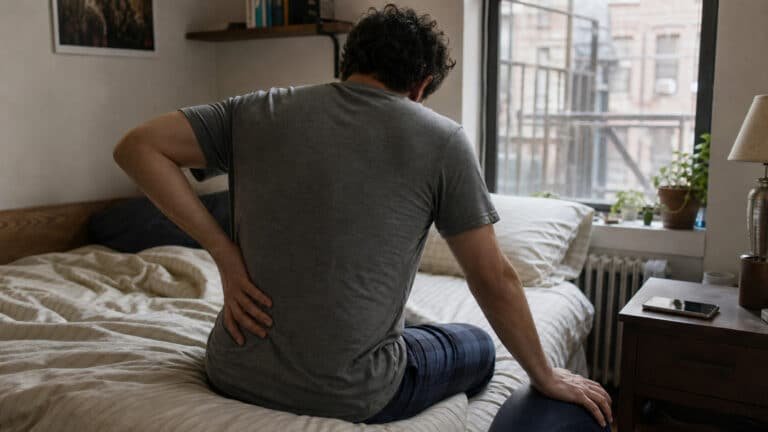
You booked the flight weeks ago. Packed light (or tried to). Got through TSA without losing your mind. And now you’re home in Brooklyn with a back that feels like it aged ten years in five hours. Back pain after flying in Brooklyn is one of those things I hear about constantly in the summer, right around the July 4th travel rush. Patients walk in stiff, crooked, sometimes barely able to bend forward. The flight didn’t cause a new injury. It just compressed everything that was already borderline.
Key Takeaways
- Sitting in an airplane seat for 3+ hours increases pressure on your lumbar discs by up to 40% compared to standing.
- Lifting a carry-on into an overhead bin at an awkward angle is one of the most common ways travelers hurt their low back.
- Simple in-flight posture adjustments and a rolled-up jacket behind your low back can cut your post-flight pain in half.
- A pre-trip or post-trip chiropractic tune-up realigns your spine before the damage sets in or clears it out after.
- Most patients who come in after a long flight feel significantly better within one or two visits.
Table of Contents
- Why Flying Wrecks Your Back
- Back Pain After Flying in Brooklyn: The Airport and Luggage Factor
- In-Flight Posture Fixes That Actually Work
- How Dr. Patel Treats Travel Back Pain
- What You Can Do at Home After You Land
- The Pre-Trip Tune-Up: Why Smart Travelers Book Before They Fly
- When to See a Doctor About Post-Flight Back Pain
- Frequently Asked Questions
Why Flying Wrecks Your Back
Airplane seats are designed for airline profit margins, not your spine. The seat pan tilts you backward. The lumbar curve flattens out. And your pelvis tucks under in a way that loads the front of your discs with way more pressure than they’re built for.
A 2022 systematic review in Life Sciences found that intradiscal pressure in the lumbar spine increases significantly in a seated position compared to standing. When you’re sitting in a cramped economy seat with no lumbar support for three, four, five hours straight, that sustained compression dehydrates your discs. They lose height. The surrounding muscles tighten to compensate. By the time you stand up at baggage claim, your spine has been locked in flexion long enough for everything around it to stiffen.
And it’s not just the sitting. Cabin pressure changes, low humidity, and dehydration all contribute. Your muscles and connective tissue get stiff when you’re dehydrated. A study published in the International Journal of Occupational Medicine confirmed that prolonged sitting causes measurable changes in lumbar disc morphology. Those changes don’t always reverse on their own once you stand up.
Back Pain After Flying in Brooklyn: The Airport and Luggage Factor
The flight itself is only part of the problem. I’d argue the airport does more damage than the plane for a lot of people.
You’re dragging a suitcase through JFK or LaGuardia, usually on one side. Your shoulder hikes up. Your trunk rotates. You do this for twenty, thirty minutes through terminals, down escalators, across those long connector hallways. That repetitive one-sided pull creates an asymmetric load on your lumbar spine that your body remembers for days.
Then there’s the overhead bin. Lifting a 30-pound bag from chest height to above your head while standing in a narrow aisle with people bumping past you. That’s a recipe for a disc issue. A cohort study of airport baggage handlers found that repetitive overhead lifting was a significant predictor of low back injury serious enough to require hospital care. You’re doing a lighter version of that same motion every time you shove your carry-on into the bin.
The American Academy of Orthopaedic Surgeons recommends lifting luggage in two stages: bag to the seat, then seat to the bin. Most people don’t do that. They muscle it up in one heave, round their back, twist, and hope for the best.
In-Flight Posture Fixes That Actually Work
You don’t need a $200 travel pillow. You need a few simple habits.
Use lumbar support. Roll up your jacket, a blanket, or even a hoodie and place it in the curve of your low back. This keeps your lumbar spine in a neutral position instead of letting the seat flatten it out. Biggest single thing you can do.
Move every 45 minutes. Get up. Walk to the back of the plane. Do a few standing extensions where you put your hands on your hips and lean back gently. Your discs need the change in load direction. You don’t need a full stretching routine, just enough movement to break the compression cycle.
Ankle pumps in your seat. Pump your ankles up and down, 20 reps every half hour. This keeps blood flowing through your lower legs and reduces that heavy, stiff feeling in your low back and hips when you land.
Feet flat on the floor. Knees at roughly 90 degrees. If the seat is too deep for you (common if you’re under 5’8″), put your bag under the seat in front and rest your feet on it to bring your knees up to hip height. Small adjustment, big difference for your pelvis.
Hydrate. Cabin air runs about 10-20% humidity. Your muscles and discs need water to stay pliable. Drink more than you think you need. Skip the alcohol until you land.
How Dr. Patel Treats Travel Back Pain
Patient came in last Tuesday, day after a redeye from LA. Could barely sit down in the waiting room. Classic post-flight presentation: tight hip flexors, locked-up SI joints, upper back rounded forward like he’d been stuffed into a box.
First thing I do is check mobility. Where are you stuck? With travel back pain, it’s almost always the lumbar spine and pelvis. The thoracic spine locks up too because you’ve been hunched for hours. I’ll check your hip flexors, your piriformis, your thoracolumbar junction.
Then we adjust. A 2024 review in the European Journal of Medical Research confirmed that spinal manipulation is recommended in multiple clinical guidelines for acute and chronic low back pain. For post-flight patients, I’m usually working on the lumbar spine, the SI joint, and the mid-back. Three areas that get compressed and fixated during a long flight.
If there’s significant muscle guarding, we’ll add soft tissue work to release the paraspinals and hip flexors before the adjustment. Tight muscles fight the correction. Loosening them first means the adjustment holds better.
Most patients walk out of that first visit moving 70-80% better. The guy from LA? He texted me the next morning saying he felt like a different person. That’s pretty typical for travel-related back pain when there’s no underlying disc issue.
What You Can Do at Home After You Land
- Walk for 15-20 minutes before you go home. Don’t collapse on the couch the second you get in. Walk around your Greenpoint block, even slowly. Your spine needs gentle movement to rehydrate your discs and release the compression from the flight.
- Cat-cow stretches, 10 reps. Get on all fours. Arch your back up like a cat, then drop your belly toward the floor. This cycles your lumbar spine through flexion and extension, which is exactly what it’s been missing for the last several hours. Do them slowly.
- Hip flexor stretch, 60 seconds each side. Kneel on one knee with the other foot in front. Shift your weight forward until you feel a pull in the front of your back hip. Your hip flexors shorten during a long flight and they pull on your lumbar spine when you stand back up. This counteracts that.
- Ice if you’re sore, heat if you’re stiff. Acute soreness with a sharp edge to it responds better to ice, 15 minutes on and off. If it’s more of a general stiffness and tightness, use a heating pad for 20 minutes. Don’t guess. If you’re not sure, ice first.
- Hydrate aggressively. You lost more fluid than you realize during the flight. Drink water steadily for the rest of the day. Add electrolytes if you can. Your muscles and discs recover faster when they’re properly hydrated.
The Pre-Trip Tune-Up: Why Smart Travelers Book Before They Fly
Here’s something I recommend to every patient who tells me they’ve got a trip coming up. Come in for a tune-up adjustment a few days before you fly.
If your spine is already slightly misaligned or your SI joint is a little stuck before you get on the plane, five hours of compression is going to make it worse. A lot worse. But if everything is moving well before you board, your body handles the stress of travel much better.
I see this pattern every summer. Patients who come in before their July 4th trip come back feeling fine. Patients who skip it come back bent sideways. Same flight, same seat, completely different outcome.
The post-trip visit works too. If you didn’t get in before your trip, come in within a day or two of landing. The sooner we address the compression and misalignment, the faster it resolves. Waiting a week lets everything settle into a compensation pattern that takes longer to unwind.
You can learn more about how we treat back pain on our services page, or just book directly if you know what you need.
When to See a Doctor About Post-Flight Back Pain
Most post-flight back pain is mechanical. Compression, stiffness, muscle guarding. It responds well to movement, chiropractic care, and the home exercises above.
But some symptoms after flying aren’t just stiffness. Pay attention if you notice:
- Pain, numbness, or tingling shooting down one or both legs
- Sudden weakness in your foot or leg (you’re tripping, dragging your toe)
- Loss of bladder or bowel control (this is an emergency, go to the ER)
- Severe pain that doesn’t change with any position and keeps you up at night
- Swelling, redness, or warmth in one calf (could indicate a blood clot from the flight, not a back issue)
If your back pain after flying lasts more than a week without improvement, or if it’s getting worse instead of better, don’t wait it out. Come in so we can figure out what’s going on. Sometimes a flight exposes a disc problem that was brewing quietly. Better to catch it early.
Frequently Asked Questions
How long does back pain after flying usually last?
Most travel-related back pain resolves within 2-5 days with gentle movement and stretching. If your spine was already compromised before the flight, it could take a week or more without treatment. A chiropractic adjustment typically speeds recovery to 1-2 days.
Should I see a chiropractor before or after my flight?
Both, ideally. A pre-flight tune-up makes sure your spine handles the compression well. A post-flight visit clears out whatever the trip did to you. If you can only do one, come in after, within a day or two of landing.
Which airplane seat is best for avoiding back pain after flying?
Aisle seat, every time. You can get up and move without climbing over people. That access to movement matters more than any fancy seat cushion. The ability to stand and walk every 45 minutes is the single biggest factor in whether you land in pain.
Can flying cause a herniated disc?
Flying alone rarely causes a herniation from scratch. But it can absolutely aggravate a disc that’s already bulging or weakened. The sustained compression and dehydration from a long flight pushes a borderline disc over the edge. If you have a history of disc issues, a pre-flight adjustment is especially important.
What’s the best way to lift my carry-on without hurting my back?
Lift it in two stages. First, bring the bag to seat height. Then lift from there into the overhead bin. Keep the bag close to your body, don’t twist, and use your legs. If it’s too heavy, ask for help. No bag is worth a disc injury.
Does Dr. Patel treat back pain from travel at Brooklyn Chiropractic Care?
Yes. Travel-related back pain is one of the most common things I see, especially during summer. Our Greenpoint office is a short walk from the G train. Most patients feel major improvement after one visit.
Ready to find relief? Schedule an appointment online or visit us at Brooklyn Chiropractic Care, 112 Greenpoint Ave. STE 1B, Brooklyn, NY 11222.
References
- Amin RM, Andrade NS, Neuman BJ. Lumbar Disc Herniation. Curr Rev Musculoskelet Med. 2017;10(4):507-516. PMC4152382
- Castanharo R, et al. Comparison of In Vivo Intradiscal Pressure between Sitting and Standing in Human Lumbar Spine: A Systematic Review and Meta-Analysis. Life (Basel). 2022;12(3):460. PMC8950176
- Stochkendahl MJ, et al. Chiropractic and Spinal Manipulation: A Review of Research Trends, Evidence Gaps, and Guideline Recommendations. Eur J Med Res. 2024;29:518. PMC11476883
- Andersen LL, et al. Occupational lifting predicts hospital admission due to low back pain in a cohort of airport baggage handlers. Int Arch Occup Environ Health. 2020;93(1):111-118. PMC6989598
- American Academy of Orthopaedic Surgeons. Tips for Lifting and Carrying Luggage. OrthoInfo/AAOS
Not Sure What's Causing Your Pain?
Take our 60-second pain assessment and get a personalized care recommendation from Dr. Patel.
Take the Assessment