(347) 625-1246
 hello@brooklynchirocare.com
 112 Greenpoint Ave #1B, Brooklyn, NY 11222
The 2026 RBC Brooklyn Half is less than a month out. May 16, 7 AM, starting at the Brooklyn Museum, through Prospect Park, down Ocean Parkway, finishing at the Coney Island Boardwalk. If you’re deep into your training block right now, you’re running more weekly miles than you have all year. And that’s exactly when Brooklyn Half marathon training injuries start showing up.
I see it every spring in our Greenpoint clinic. Runner comes in four to six weeks before the race with pain they’ve been ignoring for two weeks. They don’t want to hear they should scale back. But almost every time, the injury didn’t come from one bad run. It was building for weeks.
This post covers the four injuries that pull half marathon runners off the road most often, what’s going on in your body, and what you can do right now to make it to that starting line healthy.
Key Takeaways
- Runner’s knee, shin splints, Achilles tendinopathy, and plantar fasciitis are the top Brooklyn Half marathon training injuries
- Most build gradually over weeks of increasing mileage, not from a single bad run
- Spinal and pelvic misalignment changes how impact force travels through your legs every stride
- Shockwave therapy speeds recovery for stubborn tendon injuries like Achilles and plantar fascia
- BCC is a 10-minute ride from Prospect Park and treats Brooklyn runners year-round
In This Article
What the Brooklyn Half Course Does to Your Body
The Brooklyn Half course is 13.1 miles of varied terrain. The first couple miles loop through Prospect Park with rolling hills that demand more from your quads and calves than flat pavement. Then you hit Ocean Parkway, flat and fast for about five miles. The finish takes you onto the Coney Island Boardwalk, and boardwalk running is a different beast. Wooden planks shift your foot strike and put extra stress on your ankles and Achilles.
About 27,000 runners do this race every year. Training for it means most people ramp from 20-25 miles per week up to 30-40 in the final training block. That jump is where the trouble starts. Your cardiovascular system adapts faster than your tendons, bones, and joints. You feel ready for more miles. Your connective tissue disagrees.
Runner’s Knee: The Most Common Brooklyn Half Marathon Training Injury
Patellofemoral pain syndrome, the clinical name for runner’s knee, shows up in about 6-7% of all running injuries according to a 2021 systematic review in the Journal of Sport and Health Science [1]. You’ll feel it as a dull ache behind or around your kneecap. Worse going downhill. Worse after sitting with your knee bent for a while.
What I see in the clinic: runner increases mileage by 15-20% in a week, starts noticing a vague ache at the front of the knee around mile five, keeps going because it doesn’t feel “that bad.” Two weeks later they can barely do stairs.
The issue usually isn’t your knee. It’s upstream. Weak glutes, tight hip flexors, or a pelvis that’s rotated even slightly. When your pelvis sits crooked, your kneecap doesn’t track straight through its groove. Every stride grinds it a little more.
An adjustment to restore normal pelvic alignment, combined with targeted glute activation, can change how your kneecap tracks within one or two visits. I’ve had patients go from painful five-mile runs to finishing 10-milers pain-free in under three weeks. The knee was never the problem. The pelvis was.
Shin Splints and Medial Tibial Stress Syndrome
Shin splints affect 13-20% of runners during heavy training blocks [1]. You feel them along the inner edge of your shinbone, usually in the lower third. Pain starts during your run, fades when you stop, and eventually hangs around even when you’re just walking to the subway.
The problem is inflammation where muscle and tendon attach to the tibia. But why that muscle is overworking matters more than the inflammation itself.
Patient came in last week training for the Brooklyn Half. Shin pain for three weeks, getting worse. Her ankle dorsiflexion on the painful side was about half of normal. Limited ankle motion meant her calf was doing double duty on every step. We adjusted her ankle and lower leg, she did specific calf stretches for a week, and the shin pain dropped about 80%.
If you’re icing your shins every night and they’re not improving, the restriction is probably somewhere else. Ankle. Knee. Sometimes even a stiff joint in the foot that’s not allowing normal pronation.
Achilles Tendinopathy: The Sneaky One
Achilles injuries account for 9-11% of running injuries [1]. You’ll feel stiffness and pain at the back of your ankle, usually worst in the first few steps of the morning or right at the start of a run. It loosens up after a mile or two, which tricks you into thinking it’s getting better.
It’s not getting better. That loosening is just the tendon warming up under load. The damage keeps accumulating.
What makes the Achilles tricky during Brooklyn Half training: most of your training runs are probably on flat ground. Flat running loads the Achilles in one pattern. Then you hit the Prospect Park loop on race day with its rolling elevation changes, and your tendon gets a load it hasn’t been conditioned for. That mismatch is where things break down.
For Achilles tendinopathy that hasn’t responded to rest and eccentric heel drops, we use radial shockwave therapy. Acoustic pressure waves stimulate blood flow and trigger the body’s healing response in the damaged tendon. A 2013 review in Knee Surgery, Sports Traumatology, Arthroscopy found that extracorporeal shockwave produced significant pain reduction in chronic Achilles cases where other conservative treatments had plateaued [2]. Most patients notice real improvement within 3-5 sessions, and you can keep running during treatment.
Plantar Fasciitis: That First Step Out of Bed
Plantar fasciitis hits 5-18% of runners depending on the study [1]. The classic sign: sharp, stabbing pain in the bottom of your heel when you take your first steps in the morning. Walk around for 10 minutes and it calms down. Go for a run and it flares again afterward.
The plantar fascia is a thick band of tissue running from your heel to your toes. It acts like a bowstring supporting your arch. Add 30-40 miles a week of running to a foot that doesn’t have great arch mechanics, and something gives.
I don’t treat plantar fasciitis as just a foot problem. Nine times out of ten, the patient also has restricted ankle mobility and something going on in their low back or SI joint that’s changing how they load that foot. Fix what’s upstream, and the fascia gets a chance to actually heal instead of getting re-irritated every run.
For stubborn cases, shockwave therapy for plantar fasciitis is one of our most reliable tools. A clinical trial published in the Journal of Bone and Joint Surgery showed up to 72% reduction in heel pain with radial shockwave [3]. We pair it with adjustments and targeted stretching, and most runners are back to pain-free training within four to six weeks.
How Dr. Patel Treats Brooklyn Half Marathon Training Injuries
The approach is different for a runner in the middle of a training cycle. You don’t have months to take off. You have weeks. Every treatment decision needs to move you closer to race day, not just manage symptoms.
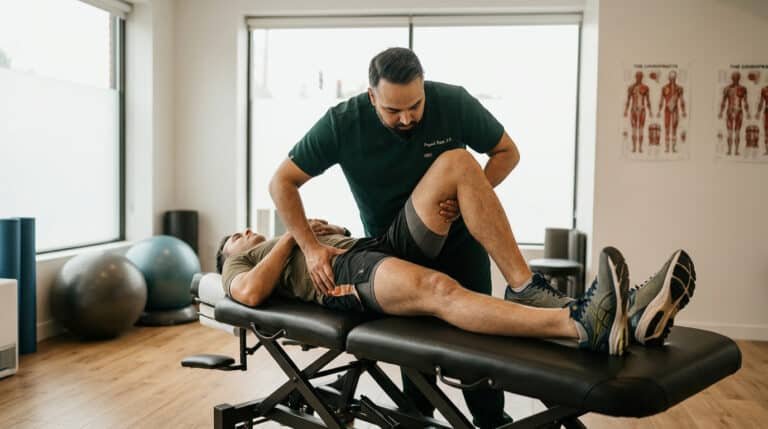
Your first visit takes about 45 minutes. I look at how you move first, not just where it hurts. Squat depth, single-leg balance, hip hinge, ankle range of motion. Then a full spinal and joint exam to find what’s restricted and what’s compensating.
What I typically find with Brooklyn Half marathon training injuries:
- Pelvic tilt or SI joint dysfunction affecting how force transfers through your legs
- Restricted thoracic spine reducing arm swing efficiency (your legs compensate, which costs you energy and changes your gait)
- Ankle joints that have lost dorsiflexion from weeks of pounding hard pavement
- Tight hip flexors pulling the pelvis forward and shortening your natural stride
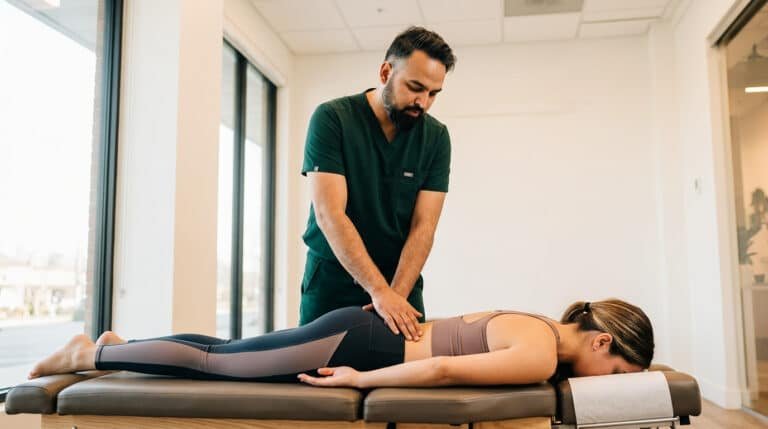
I adjust the restricted joints, work the soft tissue around them, and give you specific drills to do between visits. Most runners in active Brooklyn Half training do well with weekly visits until race day, then drop to every two to four weeks for maintenance after.
4 Things to Do Between Now and May 16
- Don’t increase mileage more than 10% per week from here. You’re four weeks out. The fitness you have right now is what you’re racing with. Cramming in extra long runs at this point just increases injury risk without meaningful fitness gains. Taper smart.
- Eccentric heel drops, 3 sets of 15, every day. Stand on the edge of a step. Rise up on both feet, then slowly lower on one foot over 3-4 seconds. This is the single best thing you can do for your Achilles and calf complex during a training block. Takes five minutes.
- Roll a frozen water bottle under your foot for 10 minutes after every run. Icing plus plantar fascia massage in one move. Use enough pressure that you feel it, not so much that you’re wincing. Both feet, even if only one hurts.
- Get assessed before it becomes a real problem. If something feels “off” but isn’t painful yet, that’s your window. One or two visits can prevent a full-blown injury that costs you the race. Runners who come in during the “something’s not right” phase recover in days. The ones who wait until they’re limping are looking at weeks. Come by our sports chiropractic clinic in Greenpoint before race week, not after.
Brooklyn Half marathon training injuries are almost always preventable if you catch the early warning signs. Your body tells you something’s wrong before the injury becomes serious. The question is whether you listen.
Running Injuries: When to See a Doctor
Not every ache during training needs clinical attention. Muscle soreness after a long run is normal and should fade within 48 hours.
But you should see a doctor if:
- Pain is sharp, sudden, and localized to one spot on a bone (possible stress fracture)
- Swelling that doesn’t go down with rest and ice after 72 hours
- You can’t bear weight on the affected leg
- Numbness or tingling running down your leg or into your foot
- Pain that gets progressively worse each run despite scaling back mileage
Stress fractures are the real concern during high-mileage blocks. If you have point tenderness on a bone that hurts when you hop on that foot, get imaging. Don’t try to run through a stress fracture. That’s how a hairline crack becomes a full break, and now you’re out for months instead of weeks.
For everything else, chiropractic care for Brooklyn runners is the fastest path back to training. We work with your training plan, not against it.
Frequently Asked Questions
How common are Brooklyn Half marathon training injuries?
Very common. A systematic review found that about 40% of distance runners experience at least one injury during a training cycle [1]. The knee, lower leg, ankle, and foot are the most frequently affected areas. The 6-8 week ramp-up before a half marathon is the highest-risk window.
Should I stop running if something hurts during training?
Not necessarily. Dull muscle soreness that fades after warm-up is usually fine to run through. Sharp, localized pain that gets worse during a run is a signal to stop. Come in for an assessment before you lose weeks of training to something that could be fixed in a visit or two.
Can I get adjusted the week before the Brooklyn Half?
Yes, and many runners do. Getting adjusted three to five days before the race restores any restrictions that built up during your final training block. If you’ve been getting regular care throughout training, a race-week tune-up is standard practice.
Does shockwave therapy help with running injuries?
It’s very effective for chronic tendon injuries like Achilles tendinopathy and plantar fasciitis. Clinical evidence supports meaningful pain reduction within 3-5 sessions [2][3]. It’s not the right fit for acute muscle tears or stress fractures, but for overuse tendon injuries that won’t quit, it’s one of the best non-surgical options we have.
How far is Brooklyn Chiropractic Care from the Brooklyn Half starting line?
About 10 minutes by car from Prospect Park where the race starts. We’re at 112 Greenpoint Ave in Greenpoint, Brooklyn. Many of our runner patients train on the McCarren Park track or along the East River waterfront path, then come by for treatment the same day. Open Monday through Saturday.
Ready to find relief? Schedule an appointment online or visit us at Brooklyn Chiropractic Care, 112 Greenpoint Ave. STE 1B, Brooklyn, NY 11222.
References
- Kakouris N, Yener N, Fong DTP. A systematic review of running-related musculoskeletal injuries in runners. Journal of Sport and Health Science. 2021;10(5):513-522. doi:10.1016/j.jshs.2021.04.001
- van der Worp H, van den Akker-Scheek I, van Schie H, Zwerver J. ESWT for tendinopathy: technology and clinical implications. Knee Surgery, Sports Traumatology, Arthroscopy. 2013;21(6):1451-1458. doi:10.1007/s00167-012-2009-3
- Rompe JD, Cacchio A, Weil L Jr, et al. Plantar fascia-specific stretching versus radial shock-wave therapy as initial treatment of plantar fasciopathy. Journal of Bone and Joint Surgery. 2010;92(15):2514-2522. doi:10.2106/JBJS.I.01651
Not Sure What's Causing Your Pain?
Take our 60-second pain assessment and get a personalized care recommendation from Dr. Patel.
Take the Assessment