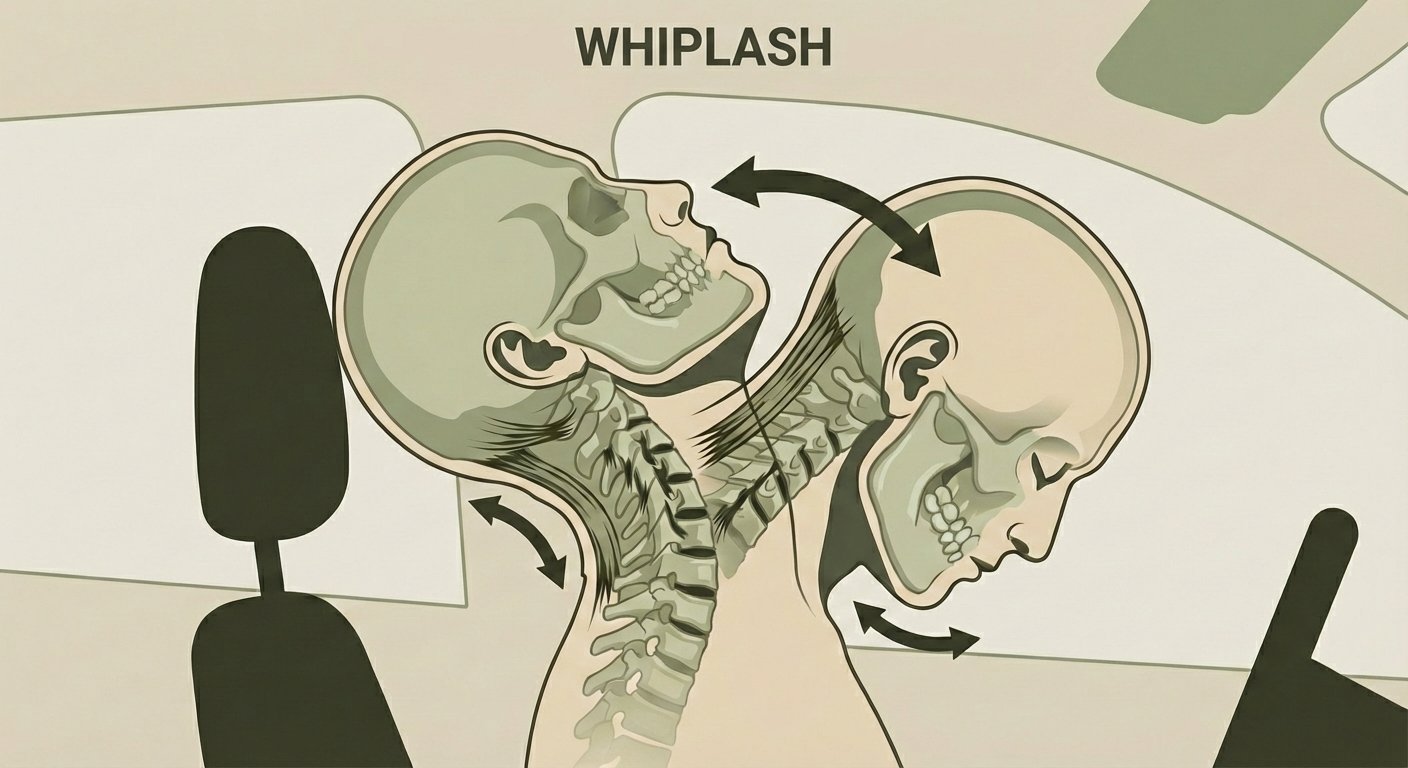
Whiplash is a neck injury that happens when your head snaps forward and backward suddenly. Think of it like cracking a whip. That rapid back-and-forth motion strains the muscles, ligaments, and soft tissues in your neck.
Most people associate whiplash with car accidents. And they’re right. Rear-end collisions are the most common cause. But you can also get whiplash from sports impacts, falls, or even aggressive amusement park rides.
Here’s what makes it tricky: you might not feel pain right away. Some people walk away from an accident feeling fine, only to wake up the next morning unable to move their neck. That delayed onset happens because inflammation and muscle spasms take time to develop.
Several situations can create the rapid acceleration-deceleration force that causes whiplash:
Even low-speed impacts can cause whiplash. When another car hits you from behind, your body gets pushed forward while your head lags, then snaps back. This happens in a fraction of a second, but it’s enough to damage soft tissues in your neck.
Football tackles, hockey checks, and other contact sports create similar forces. Getting hit from behind or side-checked can whip your head around violently.
Being pushed, shoved, or struck can cause whiplash-type injuries. The mechanism is the same: sudden, forceful movement of the head and neck.
Slipping on ice, falling down stairs, or any accident where your head moves rapidly can strain neck structures. You don’t need to hit your head to get whiplash.


Whiplash symptoms often don’t show up right away. You might feel fine at the accident scene, then wake up the next morning in serious pain. This delayed onset is one of whiplash’s defining characteristics.
Common symptoms include:
Red flag warning: If you experience severe neck pain, loss of bladder or bowel control, numbness in both arms, or difficulty walking after an injury, seek emergency medical care immediately. These could indicate a more serious spinal injury.
The evidence supporting chiropractic treatment for whiplash is solid. A systematic review published in the Journal of Orthopaedic & Sports Physical Therapy found that manual therapy and exercise are more effective than passive treatments like rest and medication for reducing pain and improving function in whiplash patients.
Another study in Spine journal followed whiplash patients for 12 months and found that those who received early chiropractic care had better outcomes and lower rates of chronic pain compared to those who received standard medical care alone.
What makes chiropractic particularly effective for whiplash is the combination approach. You’re not just getting adjustments. You’re getting soft tissue work, rehabilitation exercises, and education about proper posture and body mechanics. That complete approach addresses all the ways whiplash affects your neck.


When you come in for your first visit, expect to spend about 45 minutes with Dr. Patel. This isn’t a rushed appointment. He needs time to understand your injury and examine you thoroughly.
You’ll fill out paperwork about your accident, symptoms, and medical history. Then Dr. Patel performs a comprehensive examination: checking your posture, testing your neck’s range of motion in all directions, palpating for areas of tenderness and muscle spasm, and doing neurological tests to assess nerve function.
Based on what he finds, Dr. Patel explains what’s going on with your neck and develops a treatment plan. Most whiplash patients need care 2-3 times per week initially, tapering off as you improve. Acute cases often respond within 4-6 weeks. More severe injuries might take 8-12 weeks of consistent treatment.
Between your chiropractic appointments, these strategies can help manage your symptoms and speed healing:
Your first visit starts with a thorough examination. Dr. Patel checks your neck’s range of motion, tests for nerve involvement, and identifies areas of muscle spasm and joint restriction.
He’ll ask about your accident: how it happened, when symptoms started, and how they’ve progressed. This timeline matters because it helps determine the severity of soft tissue damage.
Orthopedic and neurological tests help rule out more serious injuries like fractures or disc herniations. If needed, Dr. Patel can refer you for imaging studies.
Once your neck has been properly evaluated, Dr. Patel uses targeted spinal adjustments to restore normal joint motion. Whiplash often causes cervical vertebrae to become restricted or misaligned.
These adjustments are modified for whiplash patients. No aggressive twisting or forceful manipulation. Instead, Dr. Patel uses gentle, controlled movements that respect your pain level and the stage of healing.
Restoring proper alignment reduces pressure on nerves and allows your neck muscles to relax. Most patients feel some immediate relief in range of motion.
Whiplash isn’t just about bones and joints. The muscles, ligaments, and fascia take a beating too. That’s why soft tissue work is critical.
Dr. Patel uses manual therapy techniques to address muscle spasms, reduce inflammation, and break up scar tissue that can form as you heal. This includes trigger point therapy for stubborn knots and myofascial release to improve tissue flexibility.
Some patients also benefit from assisted stretching to gently restore normal muscle length without aggravating injured tissues.
As your pain decreases and range of motion improves, Dr. Patel introduces specific exercises to strengthen your neck and prevent future problems.
These aren’t generic stretches. They’re tailored to your injury pattern and progress. Early on, you might just do gentle range-of-motion exercises. As you heal, you’ll add strengthening movements for your deep neck flexors and postural muscles.
The goal isn’t just to get you out of pain. It’s to restore full function and reduce your risk of chronic neck problems down the road.

Don’t wait to see if whiplash will just go away on its own. While some mild cases do resolve without treatment, many don’t. And the longer you wait, the more likely you are to develop chronic pain and disability.
Research shows that patients who receive early treatment for whiplash have better outcomes and lower rates of long-term problems. Scar tissue starts forming within days of injury. If restricted joints and tight muscles aren’t addressed early, they can create lasting movement problems.
Plus, there’s a practical reason to get evaluated soon after an accident: documentation. If your whiplash resulted from a car accident, having a record of your injuries and treatment is important for insurance purposes. Don’t let delayed symptoms mean delayed care.
• Recent whiplash injury from car accident or sports
• Neck pain and stiffness after an impact
• Headaches starting at the base of your skull
• Reduced neck mobility affecting daily activities
• Preference for non-drug treatment approach
• Want to avoid chronic neck problems long-term
• Tingling or numbness in arms or hands
• Difficulty sleeping due to neck discomfort
Most acute whiplash cases improve significantly within 4-6 weeks of consistent chiropractic care. You'll likely come in 2-3 times per week initially, then taper off as you heal. More severe injuries or cases where treatment was delayed might take 8-12 weeks. Everyone heals at their own pace, and Dr. Patel adjusts your treatment plan based on your progress.
Yes, when performed by a qualified chiropractor like Dr. Patel. He modifies techniques specifically for whiplash patients, using gentle, controlled movements instead of aggressive manipulation. Before any treatment, he does a thorough examination to rule out fractures or other serious injuries that would require medical referral. Chiropractic care is one of the safest, most effective treatments for whiplash.
If left untreated, yes. Some people develop chronic neck pain, persistent headaches, or reduced range of motion that lasts months or even years. That's why early treatment matters. Chiropractic care helps prevent chronic whiplash syndrome by addressing joint restrictions, muscle imbalances, and scar tissue formation before they become permanent problems.
Stay gently active. Complete bed rest isn't recommended for whiplash. Light activity actually promotes healing by maintaining blood flow and preventing muscle stiffness. Just avoid activities that aggravate your pain. Dr. Patel will give you specific guidance on what movements are safe and which ones to avoid during each stage of healing.
If your whiplash resulted from a car accident, your auto insurance's personal injury protection (PIP) or med pay coverage typically covers chiropractic treatment. Dr. Patel's office is out-of-network with health insurance, but many patients use auto insurance, HSA/FSA accounts, or self-pay. We can provide superbills for reimbursement if your plan allows out-of-network benefits.
 Emergency No. : (347) 625-1246
For Any Additional Inquiries : hello@brooklynchirocare.com
Book Appointment: (347) 625-1246
Working Hours : Mon, Wed, Fri: 9:30AM - 6:00PM, Tue, Thurs: 10:00AM - 8:00PM
Emergency No. : (347) 625-1246
For Any Additional Inquiries : hello@brooklynchirocare.com
Book Appointment: (347) 625-1246
Working Hours : Mon, Wed, Fri: 9:30AM - 6:00PM, Tue, Thurs: 10:00AM - 8:00PM
Emergency No. : (347) 625-1246
For Any Additional Inquiries : hello@brooklynchirocare.com
Book Appointment: (347) 625-1246
Working Hours : Mon, Wed, Fri: 9:30AM - 6:00PM, Tue, Thurs: 10:00AM - 8:00PM
Emergency No. : (347) 625-1246
For Any Additional Inquiries : hello@brooklynchirocare.com
Book Appointment: (347) 625-1246
Working Hours : Mon, Wed, Fri: 9:30AM - 6:00PM, Tue, Thurs: 10:00AM - 8:00PM
 (347) 625-1246
 hello@brooklynchirocare.com
 112 Greenpoint Ave. STE 1B, Brooklyn, NY 11222