(347) 625-1246
 hello@brooklynchirocare.com
 112 Greenpoint Ave #1B, Brooklyn, NY 11222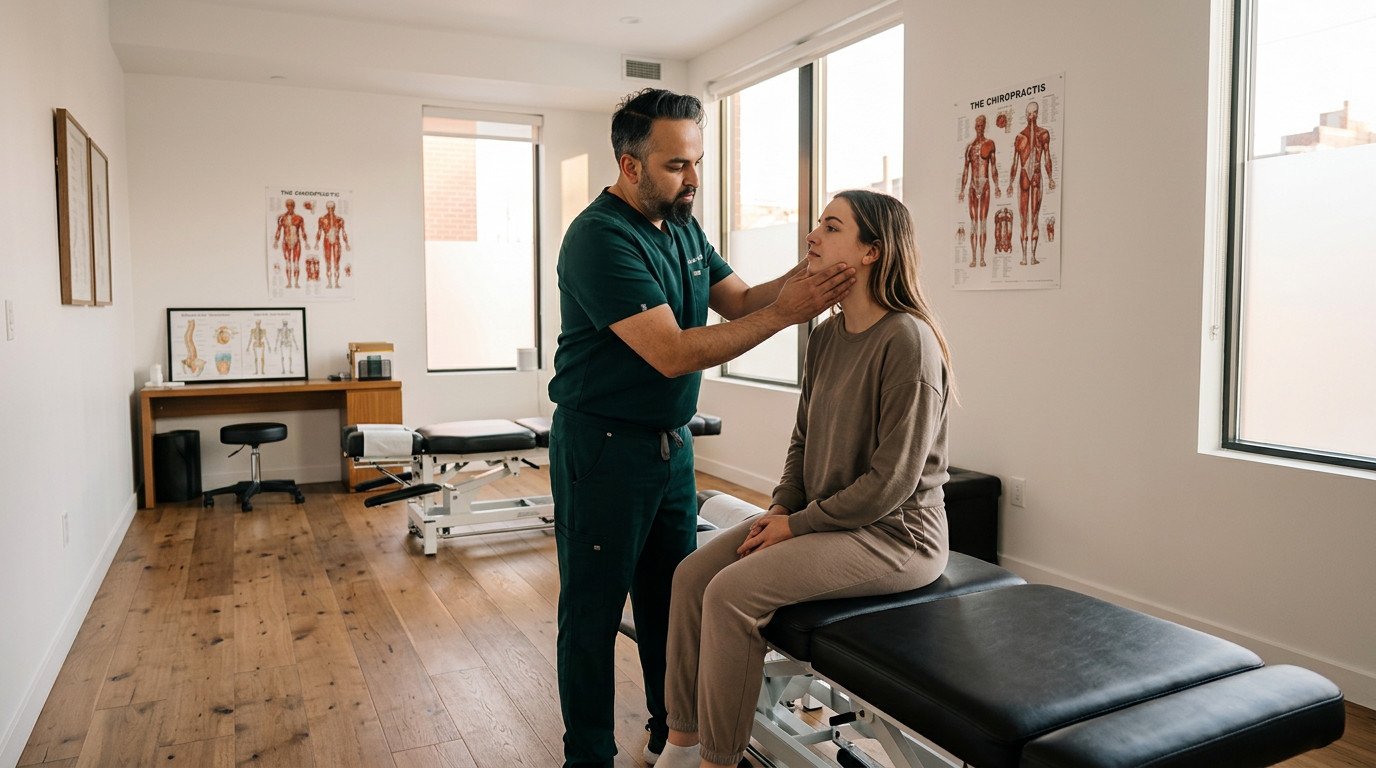
If your jaw aches, clicks, or gets stiff, and the usual advice hasn’t helped, the problem might not be only in your jaw. A lot of jaw pain is tied to the neck. That’s the angle a TMJ chiropractor in Brooklyn works from: treat the cervical spine and the muscles around the jaw, not just the joint itself. For many people, that’s the piece that finally moves the needle.
- TMJ disorders (TMD) affect roughly 1 in 3 adults, and most are muscle-driven, not joint damage.
- Jaw pain and neck pain travel together. TMD is far more common in people with neck pain (about 69%) than in those without (about 45%).
- Chiropractic care helps the cervical and muscular side of TMJ with hands-on treatment, jaw-muscle work, and posture correction.
- See a dentist for dental-origin pain, teeth grinding, or a jaw that locks. Be cautious of anyone selling permanent bite “corrections,” the evidence doesn’t support them.
- Painless clicking with no pain usually needs no treatment at all.
On this page
What Is TMJ (TMD)?
TMJ is the temporomandibular joint, the hinge that connects your jaw to your skull just in front of each ear. When people say “TMJ” they usually mean TMD, a temporomandibular disorder, which is a problem with that joint or the muscles that move it. It’s common. TMD affects roughly 31% of adults.1
Most cases are muscle-driven, not joint damage. The masticatory muscles that clench and chew get overworked and painful, which is the most common type of TMD. A smaller share come from the joint itself. That distinction matters, because muscle-based jaw pain responds well to the hands-on and postural care a chiropractor provides.
Why a TMJ Chiropractor in Brooklyn Looks at Your Neck
Jaw pain and neck pain are deeply linked. A 2025 review found TMD is far more common in people with chronic neck pain, around 69%, than in people without it, around 45%.2 There’s a real anatomical reason. The nerves from your jaw and your upper neck feed into the same processing area in the brainstem, so a cranky upper cervical spine can amplify jaw pain, and tight neck muscles can pull the whole system out of balance.
That’s why treating the jaw in isolation often falls short. As a TMJ chiropractor in Brooklyn, I look at how your neck moves, how your head sits over your shoulders, and how the muscles around your jaw and skull are firing. Fix the upstream problem and the jaw usually calms down. Our neck pain and headache care works on the same system.
How Chiropractic Care Helps TMJ
Chiropractic care for TMJ works on the cervical spine and the jaw muscles, and the evidence backs it up. A 2023 review found that manual therapy applied to the cervical spine reduced orofacial pain and improved jaw function in people with TMD.3 A separate review found manual therapy cut TMD pain by roughly 4 points out of 10 and improved how wide patients could open their mouth, with the best lasting results when it’s paired with jaw exercises.4
Here’s what that looks like in practice. Gentle adjustments and mobilization for the upper neck. Targeted release of the tight chewing and neck muscles. Posture correction for the forward-head position that keeps the whole pattern going. And simple jaw exercises you do at home to hold the gains. It’s conservative, it’s non-invasive, and nothing about it is permanent or irreversible.
What to Expect at Your Visit
Your first visit is an assessment. I check how far and how evenly your jaw opens, listen for clicking, feel the jaw and neck muscles for trigger points, and evaluate your cervical spine and posture. From there we build a plan around what’s actually driving your pain. Most muscle-based TMD improves over a handful of visits, and I’ll give you an honest estimate after the exam. You’ll also leave with a couple of jaw and neck exercises to start on right away.
When to See a Dentist
Chiropractic care handles the neck and muscle side of TMJ. Some jaw pain belongs with a dentist first. See one if your pain traces to a tooth, an abscess, or recent dental work, if you grind your teeth and need a night guard, or if your jaw truly locks open or shut.
One honest caution. The National Institute of Dental and Craniofacial Research points out that a “bad bite” and braces are not supported as causes of TMD, and that permanent bite or orthodontic “corrections” for TMD often don’t help and can make things worse.5 So be wary of any treatment that permanently changes your teeth or jaw. Start with the reversible, conservative options. And if you only have painless clicking with no pain, you likely don’t need treatment at all.6
Can a chiropractor help with TMJ and jaw pain?
Yes, for the neck and muscle side of it. Chiropractic care treats the cervical spine, the jaw muscles, and posture, which has been shown to reduce TMD pain and improve jaw function. It works best for muscle-driven jaw pain and is often paired with simple jaw exercises.
Why does my jaw pain come with neck pain and headaches?
Because they share wiring. The nerves from your jaw and upper neck feed into the same area of the brainstem, so problems in one region amplify the other. That’s why TMD is far more common in people with neck pain, and why treating the neck often relieves the jaw.
Is TMJ treatment at a chiropractor safe?
Yes. The care is conservative and non-invasive, gentle adjustments, muscle work, posture correction, and home exercises. Nothing about it permanently alters your teeth or jaw, which is exactly what dental and health authorities recommend avoiding for TMD.
When should I see a dentist instead?
See a dentist if your jaw pain comes from a tooth or abscess, started after dental work, or you grind your teeth and need a night guard. Also see one if your jaw locks. Be cautious of any dentist recommending permanent bite changes for TMD, since the evidence doesn’t support them.
How long does it take to fix TMJ pain?
Most muscle-based TMD improves over several visits, with the best lasting results when hands-on care is combined with jaw exercises. Your timeline depends on how long the pattern has been building and whether your neck is involved. Dr. Patel gives you an honest estimate after the first exam.
Dealing with jaw pain that won’t quit? Schedule an appointment online, or call (347) 625-1246 to check availability. As an out-of-network office, we can also help you verify your out-of-network benefits. You’ll find us at Brooklyn Chiropractic Care, 112 Greenpoint Ave. STE 1B, Brooklyn, NY 11222.
References
- Chan NHY, et al. Diagnosis and treatment of myogenous temporomandibular disorders: a clinical update. Diagnostics (Basel). 2022. ncbi.nlm.nih.gov/pmc/PMC9776546
- Bizzarri P, et al. Association between temporomandibular disorders and neck pain: a systematic review and meta-analysis. Journal of Clinical Medicine. 2025. pubmed.ncbi.nlm.nih.gov/41517515
- Liberato FMG, et al. Effects of cervical spine manual therapy on temporomandibular disorders: a systematic review and meta-analysis. Journal of Oral & Facial Pain and Headache. 2023. ncbi.nlm.nih.gov/pmc/PMC10627199
- Herrera-Valencia A, et al. Effect of manual therapy on temporomandibular disorders: a systematic review and meta-analysis. Journal of Clinical Medicine. 2020. ncbi.nlm.nih.gov/pmc/PMC7690916
- National Institute of Dental and Craniofacial Research. TMJ Disorders. nidcr.nih.gov/health-info/tmj
- Cleveland Clinic. Temporomandibular Disorders (TMD). my.clevelandclinic.org
Not Sure What's Causing Your Pain?
Take our 60-second pain assessment and get a personalized care recommendation from Dr. Patel.
Take the Assessment