(347) 625-1246
 hello@brooklynchirocare.com
 112 Greenpoint Ave #1B, Brooklyn, NY 11222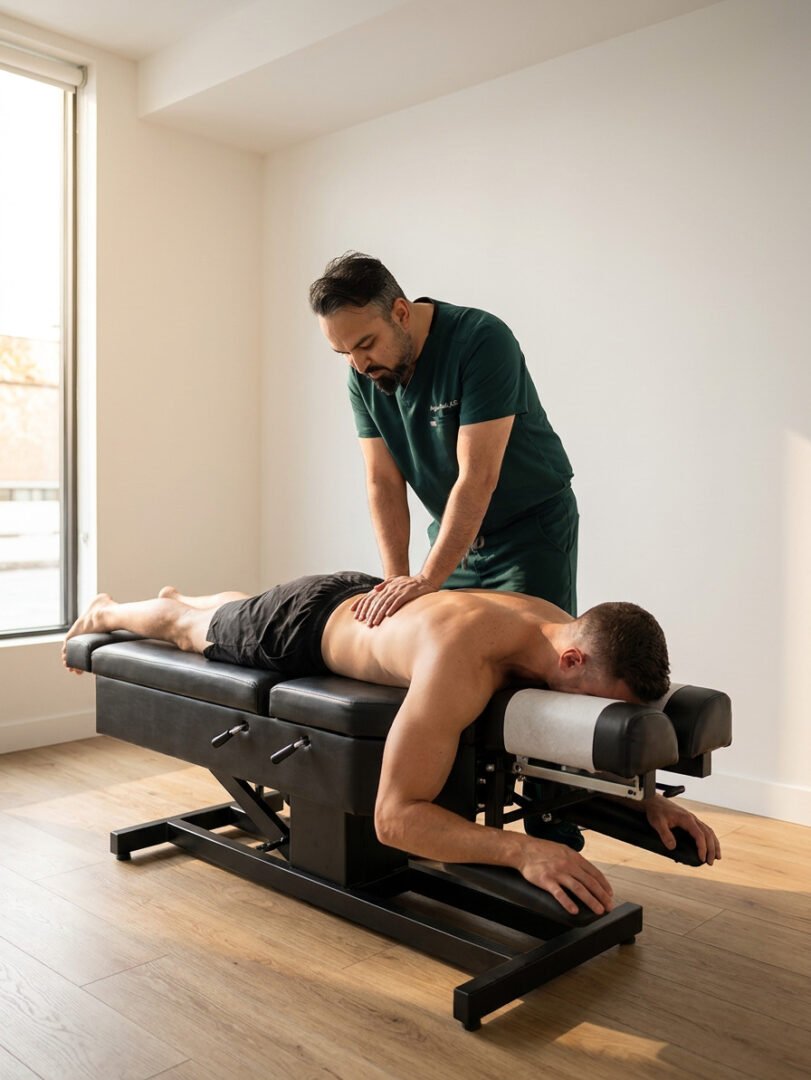
If you train at Vibe Fitness Greenpoint, you know the place pushes you. Three floors of equipment. Power Vibe strength classes. Vibe Ignite HIIT sessions that leave your shirt soaked. A boxing room where you can throw hands until your shoulders give out. It’s one of the most complete gyms in North Brooklyn, and the training demands match. But if you’ve been dealing with back pain from weightlifting that won’t quit, no amount of sauna time or foam rolling is going to fix what’s actually going on.
At Brooklyn Chiropractic Care, we treat Vibe members regularly. Your gym is right here in the neighborhood, and the variety of training it offers, from heavy barbell work to high-intensity circuits to combat sports, creates exactly the kind of spinal stress that benefits from regular chiropractic care.
Key Takeaways
- Back pain from weightlifting usually comes from restricted spinal joints, not torn muscles
- Vibe Fitness Greenpoint’s three-floor gym offers training that loads your spine in multiple directions
- Stretching and sauna help muscles recover, but they can’t restore lost joint motion
- Dr. Patel treats gym athletes with adjustments tailored to your training schedule
- BCC is right in Greenpoint, minutes from Vibe Fitness
In This Article
- What Causes Back Pain from Weightlifting
- What a Week at Vibe Fitness Does to Your Body
- Why the Recovery Room Isn’t Enough
- Common Injuries We See from Gym Athletes
- How Dr. Patel Treats Back Pain from Weightlifting
- The Greenpoint Train-and-Recover Loop
- 5 Things You Can Do Between Visits
- When to See a Chiropractor for Lifting Injuries
- Frequently Asked Questions
What Causes Back Pain from Weightlifting
The most common cause of back pain from weightlifting isn’t a torn muscle. It’s a loss of normal joint motion in your spine.
When you squat, deadlift, or press heavy weight overhead, your spinal joints absorb enormous compressive force. Over weeks and months of consistent training, some of those joints stop moving the way they should. They get “stuck” in a restricted range, and the muscles around them tighten up as a protective response.
You feel stiffness first. Then achiness. Then your warm-up sets start feeling heavier than they should. Sound familiar?
A 2017 systematic review in the British Journal of Sports Medicine found that the lower back is the most commonly injured region among weightlifters and powerlifters, accounting for up to 23% of all reported injuries. Most weren’t from one bad rep. They were overuse patterns that built up over time [1].
That distinction matters. If the problem is mechanical, the solution needs to be mechanical too. Not just rest. Not just ice. An adjustment that restores normal motion to the joint that lost it.
What a Week at Vibe Fitness Greenpoint Does to Your Body
Vibe Fitness isn’t your average gym. It’s a three-floor training facility with dedicated spaces for strength, conditioning, boxing, spin, yoga, and recovery. That variety is part of what makes it great. It’s also why your body needs more than a protein shake to keep up.
Here’s what a typical training week might look like for a Vibe member:
Monday: Power Vibe. Heavy compound lifts. Squats, bench press, deadlifts. Your spine absorbs axial loading through a full range of motion. This is where most back pain from weightlifting starts. Not because the movement is bad, but because the volume accumulates week after week.
Wednesday: Vibe Ignite (HIIT). High-rep explosive movements. Box jumps, kettlebell swings, burpees. Your spine goes from flexion to extension repeatedly under fatigue. When your form slips on rep 15, your lower back picks up the slack your core dropped.
Thursday: Vibe Fight Club. Boxing demands rotational force through your thoracic spine and core. Every hook and cross loads your spine asymmetrically. Stack that on top of Monday’s squats and Wednesday’s HIIT, and your facet joints are under serious cumulative stress.
Saturday: Free weights on the third floor. Your own program. Heavy rows, overhead press, Romanian deadlifts on the turf area. More spinal loading. More compression. More demand on joints that haven’t fully recovered from Monday.
Ever wonder why your back feels fine on Monday but locked up by Saturday? Each session is well-designed. But your spine doesn’t reset between classes. The small joints in your back (called facet joints) gradually lose their normal range, and the muscles around them lock up to compensate. That’s how a productive training week turns into a stiff, achy Sunday morning.
Why the Recovery Room Isn’t Enough
Vibe has some smart recovery options. A sauna. A recovery room with red light therapy. Zen Vibe yoga classes. The Stretch & Restore sessions are excellent programming. You should use all of them.
But here’s what those tools can’t do: restore motion to a spinal joint that’s locked up.
When a joint in your spine loses its normal movement, the muscles around it tighten as a protective response. You can stretch those muscles. You can sit in the sauna. You can foam roll until you’re sore from the foam rolling. They’ll tighten right back up, because the joint underneath still isn’t moving properly.
So why does your back still feel stiff after a 20-minute sauna session? Because muscle recovery and joint mobility are two different things. Vibe’s recovery room handles the first one well. Chiropractic handles the second. They’re not competing. They’re solving different problems.
Common Injuries We See from Gym Athletes
In our Greenpoint clinic, we treat gym athletes from Vibe Fitness and other local facilities regularly. The patterns are predictable, and they map directly to the training styles Vibe offers:
Lower back tightness and pain. The number one issue, and it almost always traces back to heavy squat and deadlift cycles. If your hips don’t have full range of motion, your lumbar spine absorbs the force they should be handling. Power Vibe sessions load this pattern repeatedly. A study in Sports Medicine found that weight-training athletes report lower back injuries more than any other body region, regardless of sport or experience level [2].
Shoulder impingement. Overhead pressing, lateral raises, and heavy bench work demand a lot from your shoulder complex. When your thoracic spine is stiff (and it will be if you sit at a desk before heading to Vibe), your shoulders overwork to compensate. We see this especially in members who combine Power Vibe with Fight Club in the same week.
Midback stiffness. Your thoracic spine should be the most mobile section of your back. Hours at a desk combined with heavy pressing and rowing lock it up. When it does, your overhead position suffers, your bench stalls, and your boxing rotation feels restricted. If your mobility is getting worse despite stretching, a locked thoracic spine is likely why.
Hip and knee pain. Deep squats and lunges require proper hip mechanics. When your sacroiliac joint or hip flexors are restricted, your knees absorb force at angles they shouldn’t. That’s how you end up with patellofemoral pain, especially during high-rep squat circuits in Vibe Ignite.
Tendon overuse injuries. Achilles pain from box jumps and HIIT. Elbow pain from heavy pulling. Plantar fasciitis from all the impact work. These soft-tissue injuries don’t always respond to rest alone. At BCC, we use radial shockwave therapy alongside adjustments for stubborn tendon issues. It sends acoustic waves into the damaged tissue, triggering blood flow and your body’s natural repair response.
Recognize any of these? You’re not alone.
How Dr. Patel Treats Back Pain from Weightlifting
Dr. Patel doesn’t treat gym athletes the same way he’d treat someone with a desk-related stiff neck. The assessment starts with how you move under load.
Your first visit takes about 45 minutes. Here’s what happens:
- Movement screen. We look at your squat depth, overhead reach, hip hinge, and single-leg stability. This tells us where your restrictions are, not just where the pain is.
- Spinal and joint exam. Dr. Patel checks each segment of your spine for motion, tenderness, and alignment. We also check your shoulders, hips, and ankles, because they all affect how your spine functions under a loaded barbell.
- X-rays if needed. For athletes with recurring pain or a history of heavy lifting, diagnostic imaging helps us see what’s going on structurally.
- Adjustment and treatment plan. We adjust the restricted joints, talk about what we found, and build a plan that fits your training schedule. Most gym athletes do well with visits every 2-4 weeks for maintenance once we clear the initial issue.
One pattern we notice with our Brooklyn patients who lift: they wait too long. They try to stretch through it, rest through it, or ignore it. By the time they come in, a simple restriction has turned into a compensation pattern that affects their squat, their bench, and their daily comfort. Don’t be that person.
The Greenpoint Train-and-Recover Loop
One of the best things about training at Vibe Fitness Greenpoint is that your gym, your recovery, and your chiropractor are all in the same neighborhood.
Here’s how chiropractic fits alongside your Vibe schedule:
Before a heavy lifting day. Getting adjusted before Power Vibe can improve your range of motion immediately. Your squat depth might open up. Your overhead press might feel cleaner. If you know heavy deadlifts are programmed, come see us that morning.
After a hard week. If you’ve stacked Power Vibe, Ignite, and Fight Club in the same week, an end-of-week adjustment helps your body reset before your rest days. Think of it as clearing the compression that built up over five sessions.
On your recovery day. Some of our athletes come in between Zen Vibe or Stretch & Restore sessions. Get the adjustment, let your body integrate the changes, and start next week fresh.
Research supports this approach. A 2018 meta-analysis in The Spine Journal found that spinal manipulation produces clinically meaningful improvements in pain and function for chronic low back pain [3]. For athletes, that translates directly to better movement quality in the gym.
Vibe builds the strength. BCC maintains the structure that lets you keep building it.
5 Things You Can Do Between Visits
- Spend 2 minutes on thoracic extension daily. Lie on a foam roller placed horizontally across your midback. Arms overhead. Breathe into it for 10 slow breaths. This is the single best thing you can do for your pressing and overhead position.
- Hip 90/90 stretches before every leg day. Sit on the floor with both legs bent at 90 degrees. Rotate between internal and external rotation for 1 minute each side. Your hips need this range to squat safely under load.
- Dead hangs after every session. Grab a pull-up bar on Vibe’s third floor and hang for 30-60 seconds. This decompresses your spine after all that axial loading. Simple, free, and effective.
- Fix your desk posture. Most gym injuries we see don’t actually start at the gym. They start at your desk, where you sit hunched for 8 hours before heading to Vibe. Fix that, and your training improves.
- Don’t train through sharp pain. Dull muscle soreness after a hard Vibe Ignite session is normal. A sharp, pinching sensation in your back or shoulder during a lift is not. Scale the weight. Talk to your trainer. And come see us if it doesn’t clear up in 48 hours.
When to See a Chiropractor for Lifting Injuries
Not every ache after a workout needs a visit. Muscle soreness from a hard session is normal and goes away on its own within a day or two.
But you should book an appointment if:
- Pain lasts more than 48-72 hours after a workout
- You feel a sharp, catching sensation during any barbell movement
- Your range of motion has gotten noticeably worse over the past few weeks
- You’re compensating on one side during squats, lunges, or presses
- Numbness or tingling runs down your arm or leg
If you’re experiencing numbness, loss of bladder or bowel control, or sudden severe weakness, go to the emergency room. That’s not a chiropractic situation. But for the majority of sports-related pain, chiropractic care is the fastest path back to training.
Frequently Asked Questions
Does back pain from weightlifting mean I should stop lifting?
Usually not. Most back pain from weightlifting comes from restricted spinal joints, not structural damage. Once we restore normal joint motion, most athletes return to their full training program. We may suggest scaling certain movements temporarily while we address the restriction, but the goal is always to keep you training.
Can I lift on the same day as a chiropractic adjustment?
Yes. Most athletes train the same day without issues. If you’re getting adjusted before a Power Vibe session, you might notice improved mobility right away. Just avoid maximal lifts within an hour of your adjustment to let your joints settle.
How often should someone who lifts weights see a chiropractor?
It depends on your training volume. If you train 4-5 times per week at Vibe, every 2-4 weeks is a solid maintenance schedule after the initial issue is addressed. Athletes in a heavy training block may benefit from weekly visits during that period.
Is Vibe Fitness Greenpoint’s red light therapy good for back pain?
Red light therapy can help with muscle recovery and inflammation. It’s a nice complement to chiropractic care, but it works on soft tissue, not joint mobility. Use Vibe’s recovery room for muscle soreness and BCC for joint restrictions. They work well together.
What’s better for gym injuries, a chiropractor or a physical therapist?
A chiropractor focuses on restoring joint motion, especially in the spine. A physical therapist focuses on muscle rehabilitation and movement patterns. They’re different tools for different problems. Dr. Patel often works alongside PTs and personal trainers to get athletes back to full training as quickly as possible.
Does chiropractic help with shoulder pain from bench pressing?
Shoulder impingement from pressing is frequently caused by a stiff thoracic spine, not a shoulder problem. When your upper back can’t extend properly, your shoulders compensate. Adjusting the thoracic spine often relieves the shoulder pain within a few visits.
See our full roundup of post-workout recovery spots in Greenpoint, and how we support members at Crunch Fitness Greenpoint as well.
Ready to find relief? Schedule an appointment online or visit us at Brooklyn Chiropractic Care, 112 Greenpoint Ave. STE 1B, Brooklyn, NY 11222.
References
- Aasa U, Svartholm I, Andersson F, Berglund L. Injuries among weightlifters and powerlifters: a systematic review. British Journal of Sports Medicine. 2017;51(4):211-219. doi:10.1136/bjsports-2015-094585
- Keogh JW, Winwood PW. The Epidemiology of Injuries Across Weight-Training Sports. Sports Medicine. 2017;47(3):479-501. doi:10.1007/s40279-016-0575-0
- Coulter ID, Crawford C, Hurwitz EL, et al. Manipulation and mobilization for treating chronic low back pain: a systematic review and meta-analysis. The Spine Journal. 2018;18(5):866-879. doi:10.1016/j.spinee.2018.01.013
Not Sure What's Causing Your Pain?
Take our 60-second pain assessment and get a personalized care recommendation from Dr. Patel.
Take the Assessment