(347) 625-1246
 hello@brooklynchirocare.com
 112 Greenpoint Ave #1B, Brooklyn, NY 11222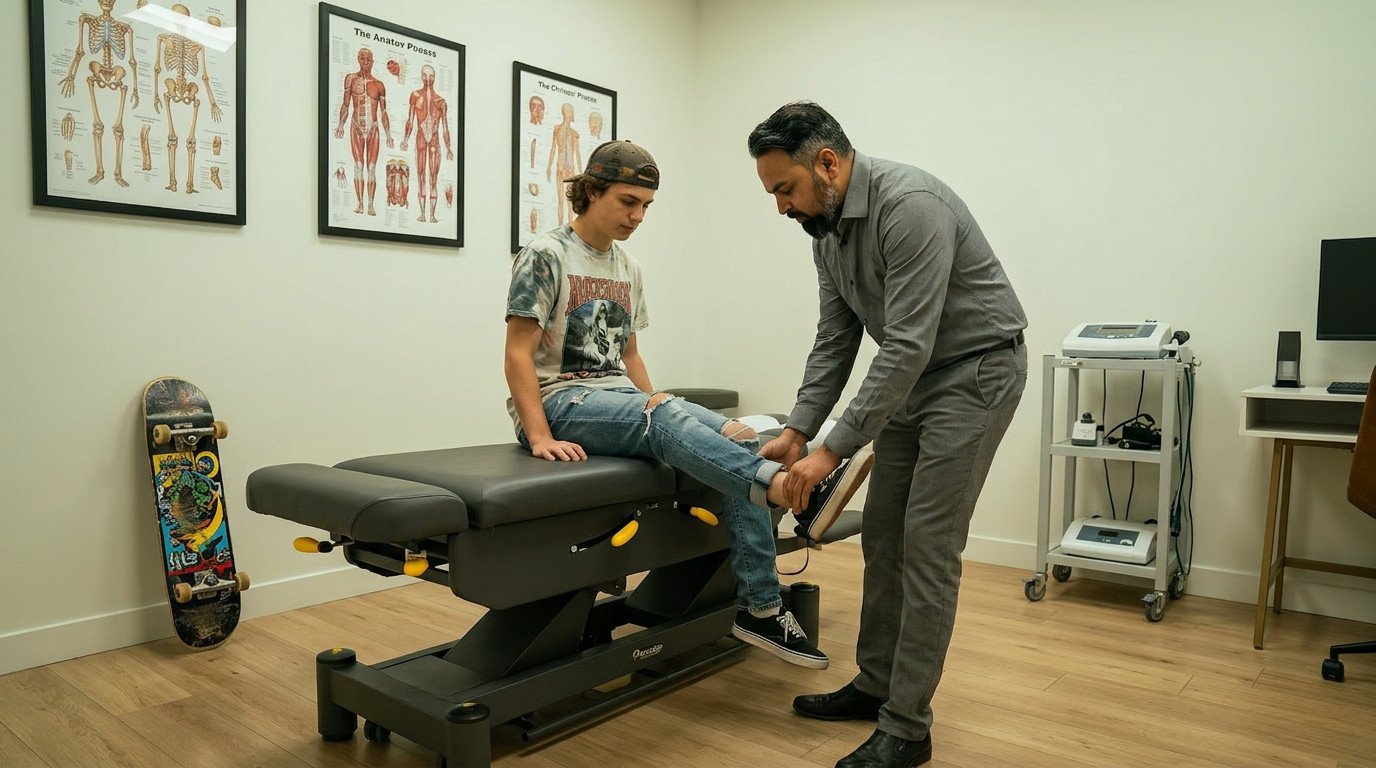
Skateboarding injuries in Brooklyn don’t always look dramatic. Sure, a slammed wrist or rolled ankle gets your attention fast. But the stuff that actually grinds skaters down is quieter. Compression through your spine every time you land a set. Knee pain that creeps in after months of pushing mongo. Lower back stiffness that shows up Tuesday morning from a Sunday session at the park. If you ride with the KCDC Skateshop community or skate anywhere in Williamsburg, this is for you.
KCDC has been the heart of Brooklyn’s skate scene since 2001. Twenty-five years of building community, sponsoring riders, and creating a space where everyone belongs on a board. That longevity matters. It means the riders who shop there aren’t just weekend hobbyists. They’re putting in real hours, real sessions, real wear on their bodies.
And that wear accumulates. A 2021 study in Revista Brasileira de Ortopedia found that 82.8% of active skateboarders reported current musculoskeletal pain, with the knee, ankle, lower back, and foot as the most common sites (Ferreira et al., 2021). That’s not a freak-accident sport. That’s a repetitive-stress sport. And repetitive stress is exactly what chiropractic is built to handle.
Key Takeaways
- Skateboarding loads your spine, ankles, knees, and wrists with repetitive impact that builds up over weeks and months
- 82.8% of active skateboarders report musculoskeletal pain, most commonly in the knee, ankle, and lower back
- Chiropractic adjustments restore joint mobility that stretching and rest can’t fix on their own
- Dr. Patel treats skaters and action-sport athletes at BCC in Greenpoint, about 10 minutes from KCDC’s Williamsburg home base
- Shockwave therapy at BCC speeds recovery for chronic tendon issues like patellar tendinitis and ankle sprains that won’t heal
What Skateboarding Actually Does to Your Body
Every ollie is a small impact event. Your back foot snaps the tail, your front foot slides up, and your entire body absorbs the landing through your ankles, knees, hips, and lumbar spine. Do that 200 times in a session. Now multiply by four sessions a week.
The forces aren’t trivial. Landing a kickflip from a three-stair generates roughly 3-5 times your body weight through your lower extremities. Your spine absorbs a chunk of that. And unlike running, where the motion is predictable, skating adds rotation, lateral force, and asymmetric loading. You push with one foot. You land favoring one side. Your body adapts to that asymmetry, and not in a good way.
I see this pattern constantly. Skater comes in with what they think is a hip problem. Turns out their sacroiliac joint on the push-foot side is locked up from thousands of repetitions. The hip pain is downstream. Real issue is the pelvis.
The Compression Problem
Here’s what most skaters don’t think about. Every landing compresses your intervertebral discs. Those discs are shock absorbers, and they’re good at their job. But they need time to rehydrate and decompress. If you’re skating five days a week and sitting at a desk or behind a counter the rest of the time, those discs never fully recover. That’s how a 25-year-old ends up with disc bulging that usually shows up at 45.
The Asymmetry Problem
Skating is a one-sided sport. You have a push foot and a front foot. You rotate one direction for frontside tricks and the opposite for backside. Over years, this builds real structural imbalance. One hip internally rotates more. One side of your thoracic spine is stiffer. Your body compensates so well that you don’t notice until something breaks down.
Common Skateboarding Injuries in Brooklyn We Treat
A 10-year epidemiological review published in Cureus analyzed over 5,000 skateboarding-related presentations and found that fractures (44%) and upper limb injuries (56%) dominated acute cases, while wrist injuries alone accounted for 57% of upper extremity trauma (Quinn et al., 2024). But the injuries that bring skaters to a chiropractor aren’t usually the acute fractures. They’re the chronic, grinding stuff that builds over months.
Lower back pain from landing compression. The single most common complaint I hear from skaters. It starts as stiffness after a long session. Then it’s stiffness the next morning. Then it’s a deep ache that doesn’t go away. Your lumbar facet joints get jammed from repeated axial loading, and no amount of stretching fixes a joint that’s lost its motion.
Ankle instability and chronic sprains. You roll your ankle, it swells, you ice it, you skate again in two weeks. Problem is, the ligaments healed short and the joint mechanics shifted. Now you’re skating on an ankle that doesn’t dorsiflex properly, which means your knee and hip absorb forces at wrong angles. One sprain that never got treated right turns into a chain of problems up the leg.
Patellar tendinitis. Repetitive ollies and pop shuvits hammer the patellar tendon. If your hips aren’t tracking properly (and if you skate regularly, they probably aren’t), your knee takes lateral force it shouldn’t. That tendon gets inflamed, and it’s stubborn. Rest helps temporarily. Then you skate again and it’s back.
Wrist and forearm pain. Every fall, your hands hit first. Even if nothing breaks, the repetitive impact jams the carpal bones and stiffens the wrist extensors. Over time, that wrist doesn’t extend fully, which changes how you catch yourself, which loads your shoulder differently. Patient last month couldn’t figure out why his shoulder hurt. Turned out his wrist mobility was the root.
Mid and upper back stiffness. This one sneaks up on skaters who also work desk jobs. Eight hours hunched over a laptop, then two hours crouched on a board. Your thoracic spine locks up. Your shoulders round. Your neck compensates. This is the combo that brings in the most Williamsburg skaters I see, people who work in tech or creative jobs and skate after work.
Why KCDC Riders Need Recovery, Not Just Rest
KCDC’s community isn’t casual. When that shop opened in 2001 in a warehouse on North 10th Street, it built something that lasted because the people who ride with KCDC actually ride. They’re not buying a deck for the aesthetic. They’re session skaters, park rats, street riders who put in work. The shop’s team riders like Jessyka Bailey and Reina Lanfield represent what the community is about, a family built around actually being on your board.
That level of commitment is great for progression. But it also means your body doesn’t get the rest it thinks it’s getting. You take a “rest day” but you’re walking around Brooklyn all day on an ankle that’s still compensating from last week’s rolled curb. You sit at your desk and your compressed lumbar spine never decompresses.
Rest alone doesn’t restore joint motion. If a facet joint in your lower back is locked up, it stays locked up whether you’re skating or sitting on your couch. The muscles around it keep guarding. The inflammation cycle keeps running. You need someone to actually move that joint back into its normal range.
That’s what an adjustment does. It’s not magic. It’s specific force applied to a specific joint to restore specific motion. Then your body can actually heal.
How Dr. Patel Treats Skateboarding Injuries in Brooklyn
The approach for skaters is different from someone who tweaked their neck sleeping wrong. Skating injuries involve multiple joints, compensatory patterns, and usually some chronic component that’s been building for months. Dr. Patel starts with how you move, not just where it hurts.
Here’s what a typical treatment plan looks like for a skater:
Joint-by-joint assessment. We check your ankles, knees, hips, SI joints, lumbar spine, thoracic spine, and wrists. Skaters tend to have restrictions in predictable places. Push-side hip. Landing-side ankle. The segment of your lumbar spine that absorbs the most compression. Finding these patterns tells us what’s causing the pain versus what’s just reacting to it.
Spinal adjustments. Targeted chiropractic adjustments to restore motion in the locked segments. For skaters, this usually means the lower lumbar spine, the SI joint, and at least a couple of thoracic segments. Most patients feel immediate improvement in range of motion.
Extremity work. Ankles and wrists need attention too. A restricted ankle changes everything above it. We mobilize the talocrural joint, check subtalar motion, and make sure your foot is actually functioning the way it should when you land.
Shockwave for stubborn tendons. Patellar tendinitis, Achilles tendinopathy, chronic ankle ligament pain. When these issues don’t respond to rest and adjustments alone, radial shockwave therapy can break the cycle. It sends acoustic pressure waves into the damaged tissue, stimulates blood flow, and triggers your body’s repair response. Most skaters notice a real difference within 3-5 sessions.
What to Expect at Your First Visit
Your first appointment at BCC takes about 45 minutes. We’re at 112 Greenpoint Ave, about a 10-minute ride from KCDC’s Williamsburg home turf. Here’s the rundown:
- History and intake. We talk about your skating, your work, your pain. How long you’ve been riding, what tricks you’re working on, which foot you push with, when the pain started, what makes it worse. All of this matters.
- Movement screen. We watch you squat, hinge, balance on one leg, rotate your trunk. This tells us where your restrictions are before we even touch your spine.
- Hands-on exam. We palpate your spine segment by segment, check your joints for motion, and test the areas around your pain. If your ankle hurts, we’re also checking your knee and hip because the problem rarely stays in one place.
- X-rays if needed. For skaters with chronic pain, a history of hard falls, or pain that’s been lingering for months, diagnostic imaging helps us see what’s going on structurally. Not everyone needs them, but sometimes they change the treatment plan.
- First adjustment and plan. We treat you on day one. Then we build a plan. Most skaters do well with visits every 2-3 weeks for maintenance once we clear the acute issue.
5 Things Skaters Can Do Between Sessions
- Dead hangs after every session. Grab a pull-up bar or a ledge and hang for 30-60 seconds. This decompresses your spine after all that landing impact. It’s free, it’s fast, and it counteracts the axial loading your discs just absorbed.
- Ankle alphabet before you skate. Sit down, lift one foot, and trace the alphabet with your big toe. Both feet. Takes 2 minutes. This warms up the 30+ joints in your foot and ankle complex and reduces your sprain risk for that session.
- Hip 90/90 stretches on your rest day. Sit on the floor with both legs bent at 90 degrees. Lean into the front hip, then rotate to lean into the back hip. 1 minute each side. Your push-side hip is tighter than you think, and this is the fastest way to address it.
- Wrist extensions between sessions. Place your palms flat on a table with fingers pointing toward you. Gently lean back until you feel a stretch through your forearms. Hold 20 seconds, repeat 3 times. Every fall loads your wrist extensors, and this keeps them from locking down.
- Don’t skate through sharp joint pain. Muscle soreness after a session is normal and clears in 24-48 hours. A sharp, catching sensation in your knee, ankle, or back during a trick is not normal. That’s a joint telling you something is wrong. Scale back, and come get checked before it becomes a three-month problem.
When a Skate Injury Needs More Than Ice
Not every slam needs a chiropractor. Bruises heal. Muscle soreness resolves. But certain patterns mean you should book an appointment:
- Ankle pain that’s still there two weeks after a roll
- Lower back stiffness that shows up every morning, not just after sessions
- Knee pain that gets worse with stairs or squatting
- Wrist pain that limits how you catch yourself during falls
- Any numbness or tingling running down your arm or leg
- Pain that shifts from one side to the other (your body is compensating)
If you’re experiencing sudden severe weakness, loss of bladder or bowel control, or a visible deformity after a fall, go to the emergency room. That’s beyond chiropractic scope. But for the chronic, grinding, won’t-quite-heal stuff that keeps skaters off their boards, sports chiropractic is the fastest path back.
The Williamsburg-Greenpoint Connection
KCDC put Williamsburg on the map for skating. The shop’s been a hub for Brooklyn’s skate culture through two and a half decades of neighborhood change, from warehouse parties to condo builds. The riders who grew up in that community, and the ones still discovering it through KCDC’s inclusive vibe, are exactly the athletes who benefit from having a chiropractor nearby who actually understands impact sports.
BCC is on Greenpoint Ave, one neighborhood over. If you’re skating the Williamsburg waterfront, McCarren Park, or any of the North Brooklyn spots, we’re a short trip away. Skate your session. Come get put back together. Your body absorbs a lot of force for you. Least you can do is maintain the machine.
Frequently Asked Questions
Can I skate the same day I get adjusted?
Yes. Most skaters feel looser and more mobile immediately after an adjustment. Give it an hour before a hard session so your joints can settle. Light cruising right after is fine.
How often should a skater see a chiropractor?
If you skate 3-5 times a week, every 2-3 weeks works well for maintenance once we’ve cleared your initial issue. During a flare-up or after a hard slam, we might see you weekly for a few visits. It depends on your body and your volume.
Does chiropractic help with skateboarding injuries in Brooklyn specifically?
Skateboarding injuries in Brooklyn respond well to chiropractic care because most of them are repetitive-stress injuries, not acute trauma. Locked facet joints, compressed discs, restricted ankles. These are exactly what adjustments fix. Dr. Patel has treated action-sport athletes for 16 years.
What’s the difference between a chiropractor and a physical therapist for skating injuries?
A chiropractor restores joint motion, especially in the spine. A physical therapist rehabs muscles and movement patterns. They’re complementary. Dr. Patel often co-manages care with PTs when a skater needs both joint work and muscle rehab.
Is shockwave therapy good for patellar tendinitis from skating?
Patellar tendinitis is one of the best-responding conditions for radial shockwave therapy. It works by sending acoustic waves into the damaged tendon, promoting blood flow and tissue repair. Most patients see improvement within 3-5 sessions, and you can skate the same day as treatment.
I skate with the KCDC community. Is BCC close to Williamsburg?
BCC is at 112 Greenpoint Ave in Greenpoint, about 10 minutes from KCDC’s Williamsburg home base. One neighborhood over. Easy ride, easy walk, easy bus. We’re open Mon/Wed/Fri 9am-6pm and Tue/Thu 10am-8pm.
Ready to find relief? Schedule an appointment online or visit us at Brooklyn Chiropractic Care, 112 Greenpoint Ave. STE 1B, Brooklyn, NY 11222.
References
- Ferreira BDA, Marques JJ, Santos TRT. Prevalence and Factors Associated with Pain and History of Musculoskeletal Injuries in Skateboarders. Rev Bras Ortop. 2021;56(5):567-573. doi:10.1055/s-0041-1731655
- Quinn J, Singh M, Bennetto J, Duong E, Tudor F, Platt S. The Epidemiology of Skateboarding Injuries: A 10-Year Review at a Major Australian Centre. Cureus. 2024;16(3):e55624. doi:10.7759/cureus.55624
- Hoveidaei AH, Mosalamiaghili S, Keshtkar A, et al. Orthopaedic Fractures in Skateboard, Scooter, and E-Scooter Injuries. Injury. 2025. PMID: 40328080
- Agarwal A, Saxena S, Flores DV. New Olympic Sports: Surfing and Skateboarding. Semin Musculoskelet Radiol. 2025. PMID: 40669483
Not Sure What's Causing Your Pain?
Take our 60-second pain assessment and get a personalized care recommendation from Dr. Patel.
Take the Assessment