(347) 625-1246
 hello@brooklynchirocare.com
 112 Greenpoint Ave #1B, Brooklyn, NY 11222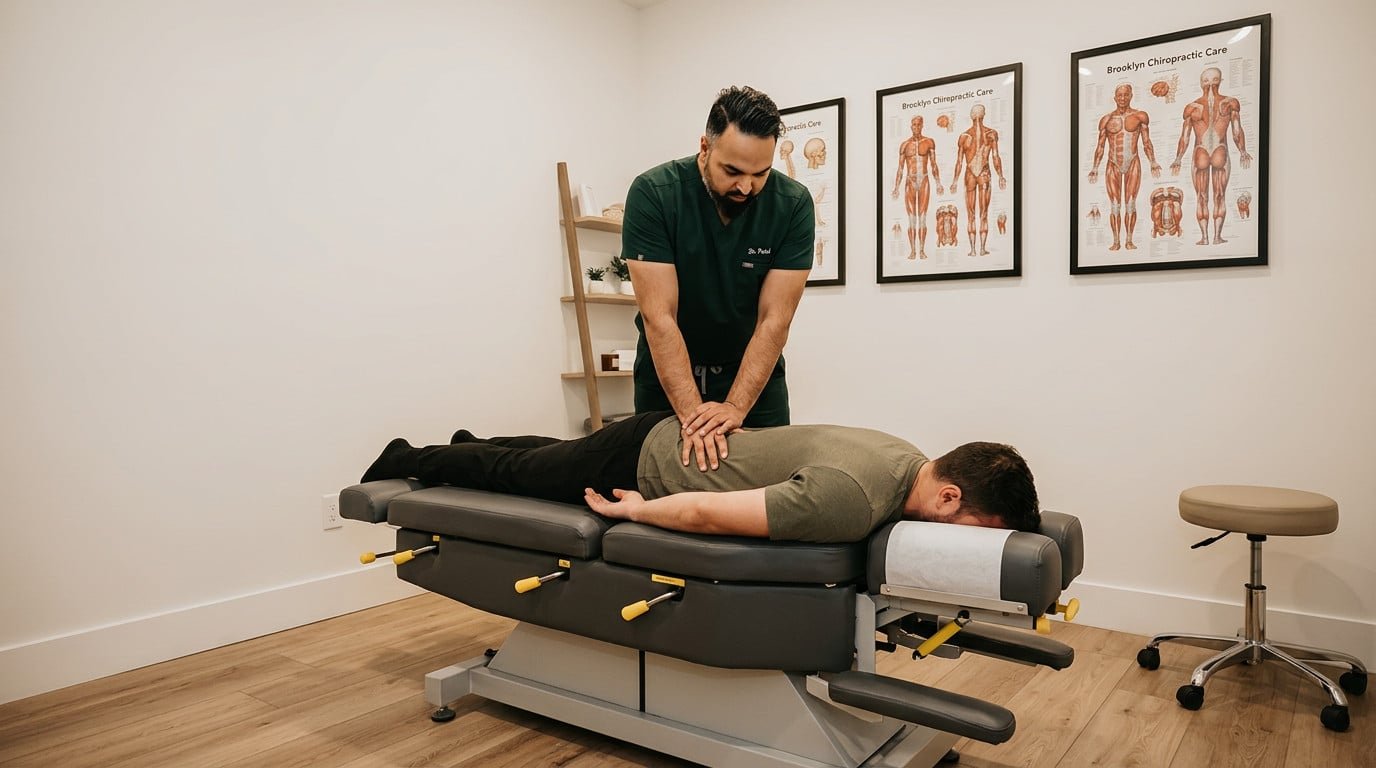
You’ve probably Googled “back realignment near me” at least once. Maybe after a week of waking up stiff, or after sitting through a six-hour flight that left your lower back screaming. Back realignment in Brooklyn is one of the most common things patients ask me about, and I get why the term sticks. It sounds like exactly what you want: someone putting your spine back where it belongs. But what does “realignment” actually mean in a chiropractic office? And is it the same thing as an “adjustment”? I’m going to break down what’s really happening, what you’ll feel, and what to expect if you’ve never been to a chiropractor before.
Key Takeaways
- “Back realignment” and “chiropractic adjustment” describe the same clinical procedure: a high-velocity, low-amplitude thrust to a specific spinal joint.
- The goal isn’t to physically move bones back into place. It’s to restore normal motion to joints that have become restricted.
- Most patients feel relief within the first one to three visits. Some feel better the same day.
- Your first visit at Brooklyn Chiropractic Care includes a full exam, posture assessment, and X-rays if needed, all for $150.
- Spinal manipulation is one of the most researched manual therapies in medicine, with strong evidence for low back pain.
Table of Contents
If ongoing stiffness is what brought you here, our back pain treatment in Brooklyn starts by finding the segment that is not moving, then getting it moving again.
- What Is Back Realignment in Brooklyn?
- Realignment vs Adjustment: Same Thing, Different Words
- What Causes Your Spine to Shift
- How Dr. Patel Approaches Back Realignment in Brooklyn
- What to Expect During Your First Visit
- What You Can Do at Home Between Visits
- Back Realignment: When to See a Doctor Instead
- Frequently Asked Questions
What Is Back Realignment in Brooklyn?
Back realignment is the term most patients use when they mean a chiropractic spinal adjustment. Clinically, it’s a high-velocity, low-amplitude (HVLA) thrust applied to a specific spinal joint that isn’t moving the way it should. The chiropractor identifies the restricted segment, positions you on the table, and delivers a quick, controlled push. That’s it.
The pop you hear? That’s gas releasing from the joint capsule. Same thing that happens when you crack your knuckles. It’s not bones snapping into place, even though it sounds dramatic.
A 2024 systematic review in the Journal of Clinical Medicine examined what actually changes in the spine after an HVLA thrust. The researchers found evidence of immediate improvements in joint gapping (the space between vertebral surfaces) and changes in segmental motion, but not the kind of gross repositioning that the word “realignment” implies. Your vertebrae aren’t sliding around like puzzle pieces. They’re stuck, and the adjustment unsticks them.
I see this confusion constantly at our Greenpoint clinic. Patient walks in saying they need their back “put back in place.” What they actually need is for a locked-up facet joint at L4 or L5 to start moving again. The outcome is the same, the language is just different.
Realignment vs Adjustment: Same Thing, Different Words
“Realignment” is patient language. “Adjustment” is clinician language. “Spinal manipulation” is what you’ll see in the research papers. All three describe the same procedure.
The distinction matters because the word “realignment” can set up the wrong expectation. If you think your spine is physically crooked and a chiropractor is going to straighten it like a bent pipe, you’ll be confused when treatment focuses on mobility and function instead of geometry. Your spine has natural curves. Lordosis in your neck and low back. Kyphosis in your mid-back. Those curves are supposed to be there.
What a chiropractor is looking for are individual segments, specific vertebrae, that have lost their normal range of motion. A 2024 review published in BMC Musculoskeletal Disorders described the primary mechanism of spinal manipulation as restoring arthrokinematic function (joint movement at the surface level) rather than correcting static positional faults. In plain English: it’s about how your joints move, not where they sit on an X-ray.
So when you search “back realignment near me,” you’re looking for the right thing. You’re just using a different word for it.
What Causes Your Spine to Shift
Your spine doesn’t “go out” the way a dislocated shoulder does. What happens is more subtle. Joints lose their normal motion over time due to repetitive stress, poor posture, trauma, or inflammation. Here’s what I see most often in Brooklyn patients:
- Desk work and phone posture. Eight hours hunched over a laptop, then two more hours scrolling on the couch. Your thoracic spine locks into flexion. Your neck compensates. The segments at C5-C6 and T4-T5 stop moving through their full range.
- Subway commuting. Standing on the G train with a 25-pound backpack on one shoulder, bracing through every stop. Your lumbar spine takes asymmetric load every single day.
- Old injuries that never fully healed. That fender bender from three years ago. The ankle sprain from college. Your body compensated, and now your SI joint is paying the price.
- Sleep position. Stomach sleepers, I’m looking at you. Your lumbar spine hyperextends all night. By morning, your facet joints are compressed and irritated.
- Stress and muscle guarding. Your traps live at your ears. The muscles around your cervical spine tighten, and the joints underneath lose mobility because the surrounding tissue won’t let them move.
None of these are emergencies. But they accumulate. And the longer a joint stays restricted, the more the surrounding muscles, ligaments, and nerves adapt to that dysfunction. That’s when you start Googling “back realignment near me” at 2 a.m.
How Dr. Patel Approaches Back Realignment in Brooklyn
Every patient gets a full workup before any adjustment happens. I don’t just crack whatever pops. Here’s the actual process at Brooklyn Chiropractic Care:
Assessment first. I’ll watch you walk, check your posture, test your range of motion in every direction, and palpate (feel with my hands) each segment of your spine. I’m looking for segments that don’t move, segments that move too much, and muscle tone differences side to side.
X-rays when needed. Not every patient needs imaging. But if your history suggests disc involvement, degeneration, or a prior fracture, I’ll take digital X-rays right here in the office. Results in minutes, not days.
The adjustment itself. You’ll lie on a specialized chiropractic table. I’ll position your body to isolate the specific joint, then deliver a quick thrust. The whole thing takes a few seconds per segment. Most patients describe it as a fast pressure followed by an immediate sense of release. Some areas pop. Some don’t. Both are normal.
A 2023 Cochrane-level review confirmed that spinal manipulation produces clinically meaningful improvements in pain and function for acute and chronic low back pain, with effects comparable to recommended first-line treatments like NSAIDs and exercise. It’s not magic. But it works, and the evidence is strong.
For patients with signs of spinal misalignment like uneven shoulders, limited rotation, or recurring headaches, I’ll typically recommend a short course of visits (two to three per week for the first two weeks) and then reassess. Most patients step down to once a week, then maintenance visits as needed.
What to Expect During Your First Visit
Your first visit at Brooklyn Chiropractic Care runs about 45 minutes. Here’s what happens, step by step:
- Intake paperwork. You’ll fill out your health history online before you arrive. Past injuries, surgeries, current medications, what’s bothering you right now.
- Consultation. I’ll ask what brought you in and when it started. “My back feels out of alignment” is a perfectly fine answer. We’ll translate that into clinical terms together.
- Physical exam. Orthopedic tests, neurological screening (reflexes, sensation, muscle strength), range of motion, and palpation of the spine.
- X-rays if indicated. Digital imaging, done on-site. I’ll show you the films and walk you through what I see.
- Your first adjustment. If there’s nothing on the exam that contraindicates it, you’ll get adjusted that same visit. Most patients walk out feeling noticeably different.
The full new-patient visit is $150. That includes the exam, any necessary X-rays, and your first adjustment. Follow-ups run $65 to $150 depending on what’s needed.
What You Can Do at Home Between Visits
- Cat-cow stretches, morning and night. Get on all fours. Arch your back up like a cat (hold 5 seconds), then drop your belly toward the floor (hold 5 seconds). Ten reps. This keeps your thoracic and lumbar segments mobile between adjustments.
- Walk for 20 minutes daily. Walking is the single best thing for spinal health. It loads your discs evenly, activates your core without you thinking about it, and promotes fluid exchange in your joints. Don’t overthink it. Just walk.
- Fix your sleep setup. Side sleepers: pillow between the knees. Back sleepers: pillow under the knees. Stomach sleeping is the one I’d like you to quit. It forces your lumbar spine into extension and your neck into rotation all night.
- Desk check every 60 minutes. Set a phone timer. When it goes off, stand up, roll your shoulders back ten times, and do a chin tuck (pull your head straight back like you’re making a double chin, hold 5 seconds, repeat 5 times). Takes 30 seconds. Prevents hours of accumulated stiffness.
- Ice after a flare-up, not heat. If your back locks up, ice the area for 15 minutes on, 15 off, for the first 48 hours. Heat feels good but increases inflammation in the acute phase. Switch to heat after day two.
Back Realignment: When to See a Doctor Instead
Chiropractic care is appropriate for the vast majority of mechanical back pain. But some symptoms need a medical doctor first. Go to urgent care or an ER if you have:
- Loss of bladder or bowel control (this could indicate cauda equina syndrome, a surgical emergency)
- Numbness in both legs or the saddle area (inner thighs, groin)
- Back pain after a significant fall, car accident, or direct impact, especially if you can’t bear weight
- Unexplained weight loss combined with back pain
- Fever with back pain (possible spinal infection)
- Pain that wakes you from sleep every night and doesn’t change with position
These are rare. But I’d rather you know the red flags than sit on something serious. If anything on this list applies to you, get medical imaging and clearance first. Then come see me.
Frequently Asked Questions About Back Realignment
Is back realignment the same as a chiropractic adjustment?
Yes. “Back realignment” is the everyday term patients use for what chiropractors call a spinal adjustment or spinal manipulation. It’s the same procedure: a controlled thrust to a restricted spinal joint to restore normal movement. The clinical goal is improving joint mobility, not physically repositioning bones.
Does back realignment hurt?
Most patients feel pressure, not pain. The adjustment itself takes a fraction of a second. You might hear a pop (that’s gas releasing from the joint) and feel immediate relief. Some mild soreness in the area is normal for 24 to 48 hours after your first adjustment, similar to what you’d feel after a new workout.
How many sessions does back realignment take?
It depends on how long the problem has been building. Acute issues (a few days or weeks old) often respond within one to three visits. Chronic patterns that have been developing for months or years typically need six to twelve visits over several weeks. I reassess after two weeks and adjust the plan based on how you’re responding.
Can I realign my back at home?
You can improve spinal mobility at home with stretches and exercises like cat-cow, chin tucks, and daily walking. But a self-crack isn’t the same as a targeted adjustment. When you twist and pop your own back, you’re usually mobilizing the segments that already move well, not the ones that are actually stuck. That’s why the relief from self-cracking is temporary.
How much does back realignment cost in Brooklyn?
At Brooklyn Chiropractic Care, a new-patient visit is $150. That covers your full exam, X-rays if needed, and your first adjustment. Follow-up visits range from $65 to $150 depending on what treatment you need. Call (347) 625-1246 to check availability.
Is spinal realignment safe?
Spinal manipulation is one of the most studied manual therapies in healthcare. The National Center for Complementary and Integrative Health notes that temporary effects such as increased pain, stiffness, or headache can occur after spinal manipulation or mobilization. Serious complications have been reported, but they are very rare.
Ready to find relief? Schedule an appointment online or visit us at Brooklyn Chiropractic Care, 112 Greenpoint Ave. STE 1B, Brooklyn, NY 11222.
References
- Gevers-Montoro C, Provencher B, Descarreaux M, Ortega de Mues A, Piché M. Mechanisms of manipulation: a systematic review of the literature on immediate anatomical structural or positional changes in response to manually delivered HVLA spinal manipulation. J Man Manip Ther. 2024;32(5):413-430. PMC11389336
- Rubinstein SM, de Zoete A, van Middelkoop M, Assendelft WJJ, de Boer MR, van Tulder MW. Benefits and harms of spinal manipulative therapy for the treatment of chronic low back pain: systematic review and meta-analysis. BMJ. 2019;364:l689. PubMed: 30867144
- Corso M, Cancelliere C, Engel RM, et al. Chiropractic and spinal manipulation: a review of research trends, evidence gaps, and guideline recommendations. J Clin Med. 2024;13(18):5668. PMC11476883
- Wirth B, Gassner A, de Bruin ED, et al. Effectiveness of spinal manipulation in influencing the autonomic nervous system: a systematic review and meta-analysis. Chiropr Man Therap. 2024;32(1):4. PMC10795624
Not Sure What's Causing Your Pain?
Take our 60-second pain assessment and get a personalized care recommendation from Dr. Patel.
Take the Assessment