(347) 625-1246
 hello@brooklynchirocare.com
 112 Greenpoint Ave #1B, Brooklyn, NY 11222
School’s out and your kid is averaging six hours a day on a phone, tablet, or laptop. Maybe more. You’re not imagining the slouch. Pediatric tech neck in Brooklyn is something I see spike every single summer at our Greenpoint clinic. Kids come in with their parents complaining of headaches, tight shoulders, and a neck that won’t stop hurting. The posture pattern is almost always the same: head dropped forward, chin tucked toward the chest, shoulders rolled in like they’re protecting something.
Key Takeaways
- Kids who spend 3+ hours daily on screens are significantly more likely to develop neck and shoulder pain
- A child’s head creates up to 50 pounds of force on the cervical spine at a 45-degree forward tilt
- Pediatric tech neck responds well to chiropractic care, especially when caught early during growth years
- Simple posture breaks every 20-30 minutes can prevent most screen-related neck problems
- Summer is the highest-risk season because school structure disappears and screen time doubles
Table of Contents
What Is Pediatric Tech Neck?
Tech neck is the forward-head posture that develops from looking down at a screen for hours at a time. In adults, it’s a nuisance that causes stiffness and pain. In kids, it’s a bigger deal because their spines are still developing. The cervical curve hasn’t fully formed yet, and repetitive flexion loading during growth years can actually change the shape of the spine over time.
Here’s what’s happening mechanically. Your kid’s head weighs about 10-12 pounds in a neutral position. Tilt it forward 15 degrees and the effective load on the neck jumps to roughly 27 pounds. At 45 degrees, which is the classic phone-in-the-lap angle, it’s close to 50 pounds. That’s the weight of a carry-on suitcase hanging off your child’s neck for hours every day.
A 2023 case study in Cureus documented a 6-year-old with text neck who was using devices more than 8 hours daily. He came in with 7-out-of-10 pain, cervical rotation limited to 40 degrees (normal is 80+), and visible loss of the natural neck curve on imaging (Chu et al., 2023). Six years old.
Why Summer Makes It Worse for Brooklyn Kids
During the school year, kids get built-in posture breaks. They walk between classes. They look up at a teacher. They move around at recess and lunch. Remove all that structure and you get a kid on a couch from 10am to 6pm, head dropped forward over a screen, barely moving.
A 2025 scoping review in Orthopedic Research and Reviews found that portable device usage jumped 55% post-pandemic. Kids who averaged 2-3 hours of daily screen time before 2020 are now hitting 6-7 hours. And 74% of heavy users in the reviewed studies reported neck and shoulder pain (Sandoval et al., 2025).
Brooklyn apartments don’t help. I see this in Greenpoint constantly. Small living spaces mean the screen is right there. The couch is right there. There’s no backyard to break up the cycle. Parents are working. Kids are inside gaming, watching, scrolling. Not a judgment call. Just the reality of summer in a city.
Signs of Pediatric Tech Neck in Brooklyn Kids
Most kids won’t tell you their neck hurts until it’s been bothering them for weeks. They adapt. They don’t connect the headache at dinner to the 5 hours of YouTube that afternoon. You have to look for the patterns yourself.
Rounded shoulders when standing. Have your kid stand sideways in front of a mirror. If their ear sits forward of their shoulder, that’s forward head posture. It should be directly above.
Complaints that sound like something else. “My head hurts.” “My upper back is sore.” “My arm feels tingly.” Kids don’t say “I have cervicogenic pain.” They say they feel weird. Headaches that consistently show up in the afternoon or evening, after hours of screens, are a red flag.
Jaw clenching or teeth grinding at night. This one surprises parents. Forward head posture changes the mechanics of the jaw joint. If your kid’s dentist mentions grinding, the neck could be involved.
Visible postural changes. You’ll notice it in photos before you notice it in person. Compare a recent picture to one from a year ago. The head drifts forward gradually enough that it sneaks past you, but photos don’t lie.
A meta-analysis of over 15,000 school-aged children found a statistically significant link between mobile phone use and neck pain, with an odds ratio of 1.36. The risk threshold sat around 3 hours of daily device use (Mahdavi et al., 2022).
How Dr. Patel Treats Pediatric Tech Neck in Brooklyn
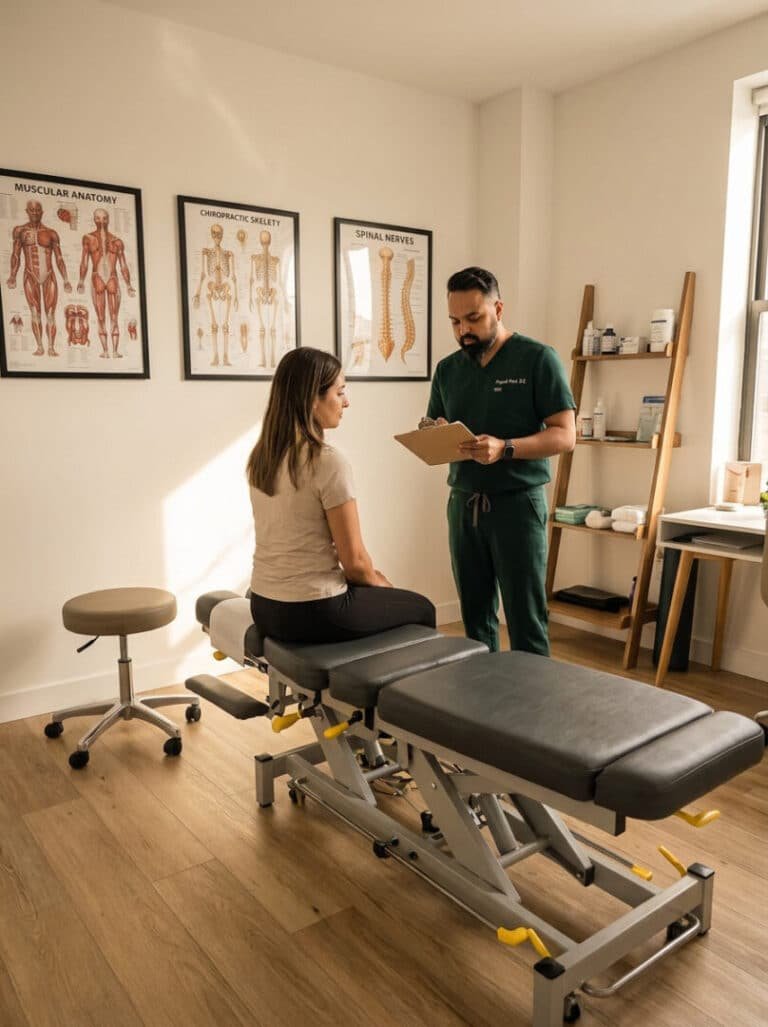
Kids aren’t small adults. I don’t treat them the same way. Pediatric adjustments use lighter force, different positioning, and more patience. A 7-year-old isn’t going to lie perfectly still on command the way a 35-year-old does.
First visit, I’m looking at the whole picture. Posture assessment, range of motion, palpation of the cervical and thoracic spine. I want to know exactly where the restriction is, not guess. If something looks structural, we’ll take imaging. But most summer tech neck cases are functional. The spine is locked up from sustained flexion, not from a disc problem.
Treatment usually involves gentle spinal adjustments to restore normal motion in the upper cervical and mid-thoracic segments. I’ll also work on the surrounding soft tissue, especially the suboccipital muscles at the base of the skull and the upper traps. Those muscles get chronically shortened in kids with forward head posture.
That 6-year-old from the Chu et al. study went from 7/10 pain to 0/10 within one month of care. His cervical curve returned to normal on follow-up X-ray, and a thoracic scoliotic curve improved from 14 degrees to 5. That kind of response is common in kids because their tissues are more adaptable than adults’. Catch it early and the correction can be fast.
I also bring parents into the conversation every time. If the home setup doesn’t change, the neck will go right back to where it started. Family chiropractic at our clinic means we’re treating the problem and coaching the environment together.
5 Home Posture Fixes for Kids on Screens
You’re not going to take the screens away entirely. I know that. But you can change how your kid uses them, and that’s where the real gains are.
- Raise the screen to eye level. This is the single biggest fix. A phone lying flat on a lap creates the worst possible neck angle. Get a tablet stand, a stack of books, anything that brings the screen up so your kid looks straight ahead instead of down. Two minutes of setup. Massive difference.
- Set a 20-minute movement timer. Every 20 minutes, your kid should look up, roll their shoulders back, and move for at least 30 seconds. Use the phone’s own timer. They won’t do it on their own, so you have to build the habit until it sticks.
- Chin tucks before bed. Have your kid stand with their back flat against a wall. Tuck the chin straight back (not down) to create a double chin. Hold for 5 seconds, repeat 10 times. This retrains the deep neck flexors that weaken from forward head posture. Takes 90 seconds. It works.
- No screens in bed. Lying on your stomach propped on elbows with a tablet is one of the worst positions for the cervical spine. The bed is for sleeping. Screens happen sitting upright at a table or desk.
- Get them outside. Not just general wellness advice. When a kid is running, climbing, throwing a ball, looking around at their environment, their neck goes through a full range of motion naturally. An hour at McCarren Park does more for cervical spine health than any stretch I could prescribe.
When to Bring Your Kid In
Some level of screen-related neck stiffness is going to happen. It’s the world we live in. But certain signs mean you shouldn’t wait.
Persistent headaches that don’t respond to hydration and rest. Pain or tingling that radiates down one or both arms. Visible asymmetry in shoulder height or head position. Any neck pain that’s lasted more than two weeks without getting better.
And if your kid’s pediatrician has mentioned scoliosis concerns, get the neck checked too. Forward head posture and early scoliotic curves can feed each other, and catching it while they’re still growing gives you the best window for correction.
If you’re not sure whether it’s serious, bring them in anyway. A posture assessment takes 15 minutes and gives you a clear picture of where things stand. Better to check now than deal with a structural problem in high school.
Frequently Asked Questions About Kids and Tech Neck
At what age can kids see a chiropractor for tech neck?
Kids as young as 4-5 can safely receive pediatric chiropractic care. Adjustments for children use much lighter force than adult techniques. I regularly see elementary-aged kids at our Greenpoint clinic for posture-related neck issues.
How much screen time is too much for my kid’s neck?
Research points to 3 hours of daily device use as the threshold where neck pain risk increases significantly. But the angle matters as much as the duration. A kid using a screen at eye level for 4 hours is better off than one hunched over a phone for 2.
Will my child grow out of tech neck on their own?
Not usually. Forward head posture that develops during growth years can become structural if it’s not addressed. Kids’ spines are adaptable, which cuts both ways. They respond to correction quickly, but they also lock into bad patterns fast.
Is pediatric tech neck in Brooklyn more common than other areas?
Urban kids tend to have higher screen time than suburban or rural kids, partly because outdoor space is limited. Brooklyn families in apartments, especially during summer, see higher rates of screen-related posture problems. The combination of heat, small spaces, and working parents makes it a perfect setup.
What’s the difference between tech neck and regular bad posture?
Tech neck specifically involves forward head posture and cervical flexion from device use. General bad posture can involve the whole spine. The treatment overlaps, but tech neck targets the upper cervical and thoracic spine specifically.
Should I limit my kid’s gaming to prevent neck problems?
Time limits help, but position matters more. A kid gaming on a monitor at desk height is in much better posture than one on a phone lying on the floor. Fix the setup first. Then manage the duration.
Ready to find relief? Schedule an appointment online or visit us at Brooklyn Chiropractic Care, 112 Greenpoint Ave. STE 1B, Brooklyn, NY 11222.
References
- Chu EYT, Mok TKS, Ng GSN, Chu ECP. Pediatric Text Neck Syndrome. Cureus. 2023;15(4):e37055. doi:10.7759/cureus.37055
- Sandoval NE, Pena Martinez MI, Fernandez Cea AB, Hernandez Rincon EH. Effects on Prolonged Screen Time on Postural Health and Visual Health in Children and Adolescents: A Scoping Review. Orthopedic Research and Reviews. 2025;17:1-15. PMC12641052
- Mahdavi SB, Riahi R, Vahdatpour B, Kelishadi R. Sedentary behavior and neck pain in children and adolescents: a systematic review and meta-analysis. Health Promotion Perspectives. 2022;12(3):240-248. doi:10.34172/hpp.2022.31
Not Sure What's Causing Your Pain?
Take our 60-second pain assessment and get a personalized care recommendation from Dr. Patel.
Take the Assessment