(347) 625-1246
 hello@brooklynchirocare.com
 112 Greenpoint Ave #1B, Brooklyn, NY 11222
You spent three hours on your Greenpoint stoop weeding, repotting, and dragging bags of soil up the stairs. Now you can’t stand up straight. Gardening back pain in Brooklyn hits harder than most people expect, especially when your “garden” is a narrow brownstone stoop, a fire escape shelf, or a rooftop container setup that forces you into positions your spine was never built for.
I see this pattern every summer. Patient walks in on a Monday morning, stiff and crooked, swearing they didn’t do anything unusual. Then they mention the weekend garden project. Bend, twist, lift. Repeat fifty times. That’s the recipe.
Key Takeaways
- Gardening back pain in Brooklyn comes from repeated bending and twisting under load, not from one wrong move.
- Stoop and rooftop setups force worse postures than ground-level gardens because you’re working in tight, awkward spaces.
- A hip hinge (bending at the hips, not the waist) cuts spinal compression during every dig, pull, and lift.
- Chiropractic adjustment restores joint motion that locks up after hours of sustained flexion.
- Five simple habit changes can cut your post-gardening soreness by more than half.
Table of Contents
- Why Gardening Wrecks Your Back (It’s Not What You Think)
- The Stoop and Rooftop Problem
- The Bend-Twist-Lift Pattern
- How Dr. Patel Treats Gardening Back Pain in Brooklyn
- How to Bend Without Paying for It Later
- What You Can Do at Home After a Long Garden Day
- When Back Pain After Gardening Means Something More Serious
- FAQ
Why Gardening Wrecks Your Back (It’s Not What You Think)
Most people blame one bad lift. The heavy planter they grabbed wrong, or the bag of soil they twisted with. But that’s rarely the real problem. Gardening back pain comes from accumulation. Dozens of small bends, each one flexing your lumbar spine just past its comfortable range, stacking load on the same discs and ligaments over and over for hours.
A 2017 study in the Annals of Work Exposures and Health found that sustained forward-bent and rotated trunk postures during repetitive horticultural tasks significantly increase the risk of low back musculoskeletal disorders (Park et al., 2017). The researchers tracked vineyard pruners, but the mechanics are identical to what you’re doing on your knees pulling weeds out of a stoop planter.
Your spine can handle flexion. It can handle load. What it can’t handle well is flexion plus load plus rotation, repeated without rest. That combination compresses the posterior disc wall and overloads the facet joints. After two or three hours, the small stabilizing muscles fatigue and your bigger muscles start compensating. That’s when things lock up.
The Stoop and Rooftop Problem
Brooklyn gardening isn’t like having a backyard plot in the suburbs. You’re dealing with constraints that make everything harder on your spine.
Stoop gardens sit on narrow concrete steps. You can’t kneel properly because the stairs are shallow. You end up hunched over at a weird angle, one foot higher than the other, reaching down and across your body. That asymmetric load is worse than straight forward bending because it puts shear force on your lumbar segments.
Rooftop containers are a different problem. You’re hauling soil and water up multiple flights, then bending into deep containers that sit at knee height or lower. Every time you reach into a deep pot, you’re flexing your lumbar spine near end range. And there’s no soft ground to kneel on. Just tar, pavers, or rubber matting.
Fire escape planters might be the worst offender. You’re leaning out through a window frame, twisting your torso, reaching for something you can barely see. I had a patient last spring who herniated an L4-L5 disc reaching through her kitchen window to water a tomato plant. Not deadlifting. Not moving furniture. Watering tomatoes.
The Bend-Twist-Lift Pattern
Every gardening task boils down to three movements: bend, twist, lift. Pulling weeds. Moving pots. Scooping soil. Pruning at ground level. Each one loads your spine differently, but the combination is what does the damage.
- Bending flexes your lumbar spine and stretches the posterior disc fibers. Sustained flexion reduces disc height over time, which is why you feel shorter after a long garden session. (You actually are, temporarily.)
- Twisting loads the facet joints and annular fibers asymmetrically. Your spine can rotate, but it doesn’t like rotating while flexed and loaded.
- Lifting adds compression. A 40-pound bag of soil lifted with a rounded back can put over 700 pounds of compressive force on your L5-S1 disc (Koes et al., 2023).
Stack all three together and you get the gardening trifecta. Most people don’t feel it until they stop moving. You stand up after an hour, your low back seizes, and suddenly you can’t tie your shoes.
How Dr. Patel Treats Gardening Back Pain in Brooklyn
Gardening back pain is mechanical. The joints lock, the muscles spasm around them, and the whole area gets stuck in a protective pattern. Your body is doing what it’s supposed to do. It’s guarding the area. But that guarding creates more stiffness, which creates more pain.
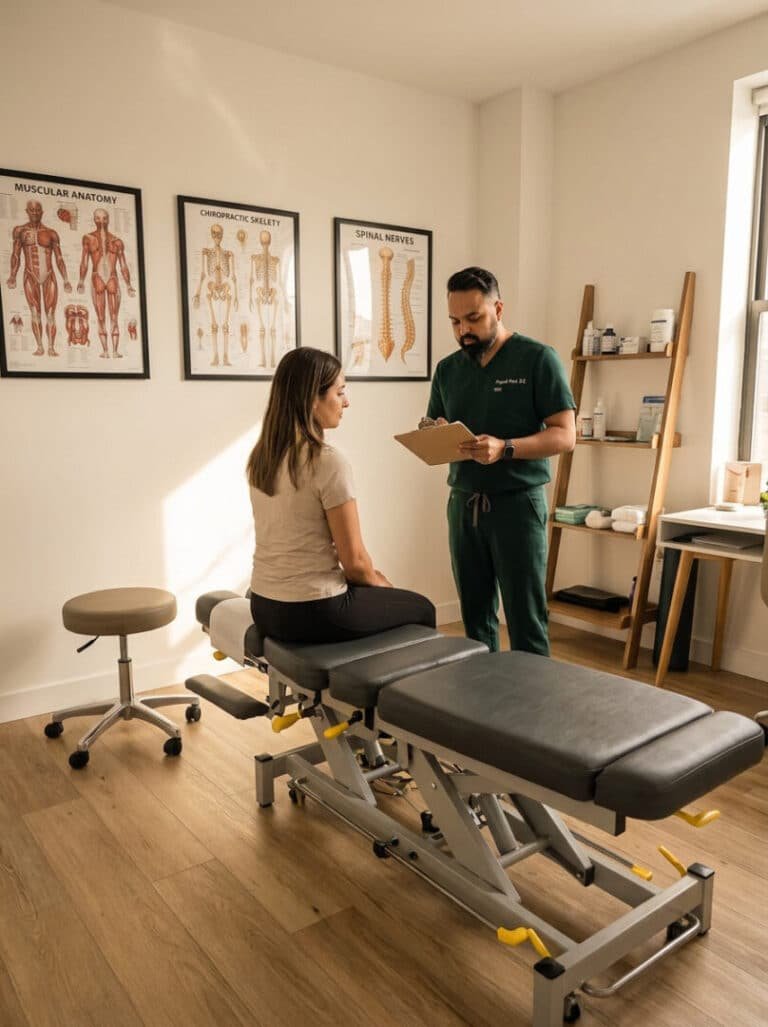
When you come in with post-gardening back pain, here’s what happens. I check your lumbar range of motion first. Usually there’s a clear restriction, either in extension or lateral bending, sometimes both. Then I palpate the segments to find which levels are fixated.
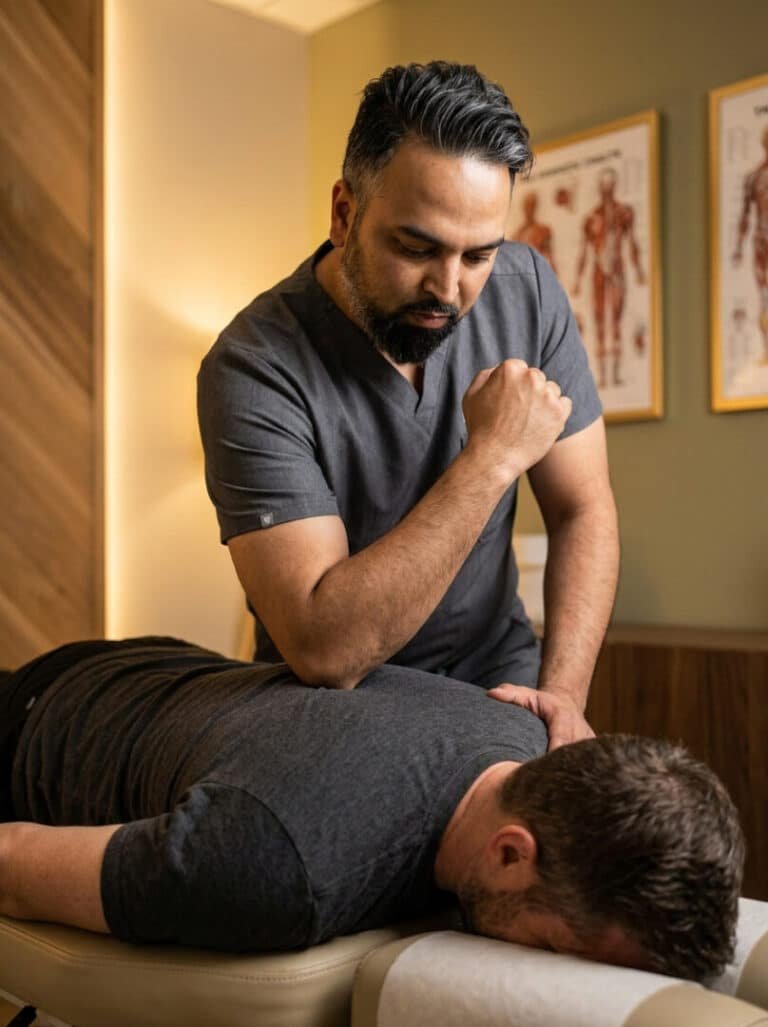
A chiropractic adjustment restores motion to those locked segments. That’s the click you feel. Once the joint moves again, the muscle guarding drops within minutes. Most patients walk out standing straighter than they walked in.
For patients who’ve been gardening hard all season and come in with recurring tightness, I’ll combine the adjustment with soft tissue work to release the paraspinal muscles and quadratus lumborum. Those two muscle groups take the worst beating from repeated bending. A 2017 systematic review in JAMA found that spinal manipulative therapy produces clinically meaningful improvements in pain and function for acute low back pain (Paige et al., 2017).
If you’re dealing with sharp pain that shoots into your glute or down your leg, that’s a different conversation. We’d want to rule out disc involvement before jumping into treatment. But straight-up garden stiffness? That usually responds fast.
How to Bend Without Paying for It Later
You don’t have to stop gardening. You just have to change how you do it. These five adjustments make a real difference.
- Hip hinge, don’t waist bend. Push your hips back like you’re closing a car door with your butt. Your back stays neutral while your hips do the work. A 2021 study confirmed that maintaining a neutral spine through a proper hip hinge significantly reduces lumbar loading during repetitive bending tasks (Antwi-Afari et al., 2021). Practice this inside before you bring it to the stoop.
- Raise your work surface. If your containers are on the ground, put them on cinder blocks, an overturned crate, anything that gets them above knee height. Even six inches of elevation cuts your forward bend angle by 15-20 degrees. On a rooftop, use tall planters or table-height raised beds.
- Switch positions every 15 minutes. Set a timer on your phone. Alternate between kneeling, squatting, sitting on a low stool, and standing. Your spine doesn’t care which position you’re in. It cares how long you stay there. A kneeling pad makes a huge difference on concrete stoops.
- Carry with your legs, not your back. When you’re hauling soil bags up brownstone stairs, hold the bag close to your body and keep your chest up. If the bag is too heavy to carry with a straight back, it’s too heavy to carry alone. Split it into two loads or grab a neighbor.
- Face your work square. This is the one people forget. If your planter is to your right, turn your whole body to face it. Don’t stand facing forward and twist to reach it. Eliminating the twist removes the most dangerous part of the bend-twist-lift pattern.
What You Can Do at Home After a Long Garden Day
- Walk for 10 minutes before you sit down. Your instinct after gardening is to collapse on the couch. Don’t. Walk around the block first. Gentle movement keeps the joints from locking up while the muscles are still warm. Sitting immediately after hours of flexion is the fastest way to stiffen.
- Prone press-ups (McKenzie extension). Lie face down on the floor, place your hands under your shoulders, and press your chest up while keeping your hips on the ground. Hold for 2 seconds, lower, repeat 10 times. This reverses the flexion loading your spine took all day. Do a set right after gardening and another before bed.
- Hip flexor stretch. Kneel on one knee (use a pillow under the knee), push your hips forward until you feel a stretch in the front of the back leg’s hip. Hold 30 seconds each side. Your hip flexors shorten from all that kneeling and squatting, and tight hip flexors pull your pelvis forward, which loads your low back.
- Heat, not ice, for garden stiffness. Unless you have visible swelling or a specific injury, use a heating pad on your low back for 15-20 minutes. Heat relaxes the muscle spasm. Ice makes the muscles tighten more. Save ice for acute injuries with swelling.
- Hydrate before you stiffen. Dehydration accelerates disc height loss and muscle cramping. Drink water throughout your garden session, not just after. Your discs are 80% water. They need it to maintain height and absorb shock.
When Back Pain After Gardening Means Something More Serious
Most post-gardening back pain is muscular and joint-related. It’s uncomfortable, but it’s not dangerous. It should improve noticeably within 3-5 days with the home care steps above.
But some symptoms need professional attention right away:
- Pain that shoots down one or both legs past the knee
- Numbness or tingling in your feet or toes
- Difficulty controlling your bladder or bowels (this is an ER visit, not a wait-and-see)
- Pain that gets worse, not better, over 5-7 days despite rest
- Sharp pain with any cough or sneeze
Any of those could indicate disc herniation, nerve compression, or something that needs imaging. Don’t push through it. Come in for an evaluation so we can figure out what’s going on and whether you need targeted treatment or a referral.
What to Expect at Your First Visit
If you’ve never been to a chiropractor before, here’s how it works. You’ll fill out a short intake form, then I’ll do a physical exam focused on your lumbar spine and hips. Range of motion testing, orthopedic tests, palpation of the segments. Takes about 15 minutes.
If everything checks out and there are no red flags, we’ll do your first adjustment that same visit. Most patients with gardening-related back stiffness feel noticeable relief within one or two visits. If you’ve been dealing with recurring episodes all summer, we might talk about a short course of maintenance care to keep things mobile through the growing season.
I won’t ask you to stop gardening. That’s not realistic, and honestly, gardening is great for you. It’s weight-bearing, it gets you outside, and it’s better for your body than sitting at a desk. You just need to garden smarter.
Frequently Asked Questions
Is gardening actually bad for your back?
Gardening isn’t bad for your back. Poor gardening mechanics are. The repetitive bend-twist-lift pattern causes problems when you stay in one position too long or lift with a rounded spine. Switching positions every 15 minutes and using a hip hinge makes gardening a healthy, low-risk activity.
Should I use ice or heat after gardening?
Heat works better for post-gardening stiffness. A heating pad on your low back for 15-20 minutes relaxes the muscle spasm that builds up from sustained bending. Use ice only if you have visible swelling or a specific acute injury.
How soon should I see a chiropractor for gardening back pain in Brooklyn?
If your stiffness doesn’t improve after 3-5 days of home care, come in for an evaluation. If you have pain shooting down your leg, numbness in your feet, or difficulty standing up straight, don’t wait. Those symptoms respond better when treated early.
Can I garden the day after a chiropractic adjustment?
Yes, in most cases. After an adjustment restores joint motion, light gardening is fine. Just follow the bending mechanics in this guide and keep sessions under an hour for the first week. Your body needs time to adapt to the restored range of motion.
What’s the best position for gardening with a bad back?
Alternate between positions. Kneeling on a pad, sitting on a low garden stool, and standing with elevated planters all reduce sustained spinal flexion. The worst thing you can do is stay in one position for an hour. Set a 15-minute timer and switch.
Do raised garden beds actually help prevent back pain?
Raised beds at waist height cut your forward bending angle dramatically, which reduces lumbar disc loading. Even raising containers 6-12 inches off the ground helps. If you’re building a rooftop garden from scratch, invest in table-height beds. Your spine will thank you every weekend.
Ready to find relief? Schedule an appointment online or visit us at Brooklyn Chiropractic Care, 112 Greenpoint Ave. STE 1B, Brooklyn, NY 11222.
References
- Park, H.S., et al. (2017). Trunk kinematics and low back pain during pruning among vineyard workers. Annals of Work Exposures and Health, 61(7), 805-818. doi:10.1093/annweh/wxx049
- Antwi-Afari, M.F., et al. (2021). Lower back injury prevention and sensitization of hip hinge with neutral spine using wearable sensors during lifting exercises. Sensors, 21(16), 5487. doi:10.3390/s21165487
- Paige, N.M., et al. (2017). Association of spinal manipulative therapy with clinical benefit and harm for acute low back pain: Systematic review and meta-analysis. JAMA, 317(14), 1451-1460. doi:10.1001/jama.2017.3086
- Koes, B.W., et al. (2023). The mechanical loading of the spine in physical activities. European Spine Journal. PubMed: 37166549
Not Sure What's Causing Your Pain?
Take our 60-second pain assessment and get a personalized care recommendation from Dr. Patel.
Take the Assessment