(347) 625-1246
 hello@brooklynchirocare.com
 112 Greenpoint Ave #1B, Brooklyn, NY 11222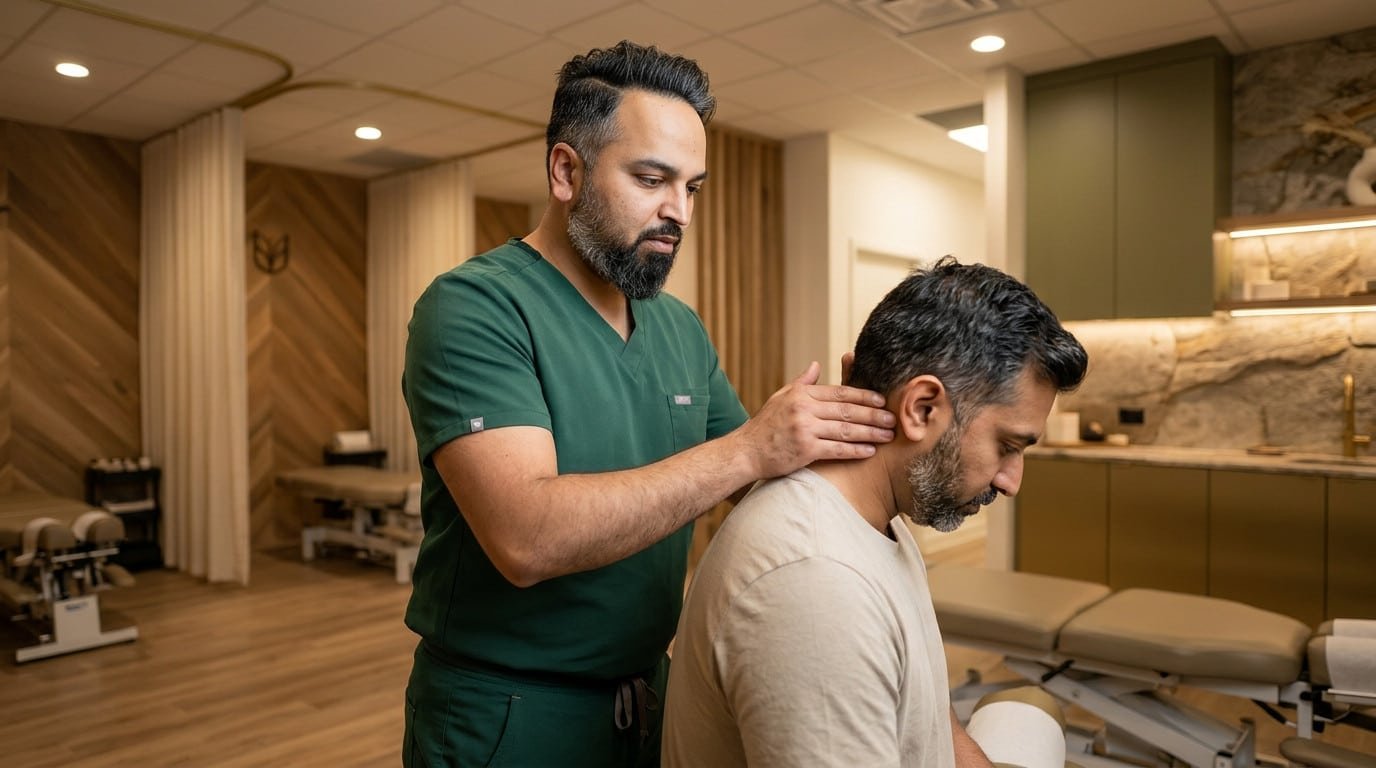
You’ve had the headache for three days. Maybe longer. It starts at the base of your skull, wraps around to your temples, and by 4 PM you’re squinting at your screen wondering if you need new glasses. You’ve tried Advil, you’ve tried water, you’ve tried a nap. Nothing sticks. If you’re dealing with headaches in Greenpoint that keep coming back, your neck might be the actual problem. As a headache chiropractor in Greenpoint, I see this pattern constantly.
Key Takeaways
- Cervicogenic headaches originate from your neck joints and muscles, not your brain
- A 2024 systematic review found that spinal manipulation and targeted exercises significantly reduce cervicogenic headache pain and frequency [1]
- Tension headaches and neck headaches overlap more than most people realize, and both respond to cervical treatment
- Most patients feel a noticeable drop in headache intensity within the first two visits
- Your desk setup, phone posture, and sleep position are probably feeding the cycle
Table of Contents
- What Are Cervicogenic Headaches?
- What Causes Neck-Related Headaches in Greenpoint?
- Tension Headache vs. Cervicogenic Headache
- How Dr. Patel Treats Headaches in Greenpoint
- What to Expect During Your First Visit
- 5 Things You Can Do at Home Right Now
- Headaches: When to See a Doctor
- FAQ: Headache Chiropractor in Greenpoint
What Are Cervicogenic Headaches?
Cervicogenic headache is a headache that starts in your neck. Specifically, it comes from the joints, discs, or muscles in your upper cervical spine (C1, C2, C3). The pain refers upward into your head because the nerves in your upper neck share pathways with the trigeminal nerve, which is the main pain nerve for your face and skull.
So the headache feels like it’s in your head. It is. But the source is downstream, in your neck. That’s why painkillers only dull it temporarily. You’re treating the symptom, not the generator.
Cervicogenic headaches account for roughly 15 to 20% of all chronic headaches, according to research published in the journal Cephalalgia [2]. That’s a significant chunk of people walking around treating a “head problem” when it’s actually a neck problem. I see at least a few of these every week in my Greenpoint clinic.
What Causes Neck-Related Headaches in Greenpoint?
Your upper cervical spine is ridiculously mobile. C1 and C2 handle about 50% of your total neck rotation. That mobility comes at a cost: these joints are vulnerable to misalignment, muscle tightness, and postural strain. Here’s what I see driving headaches in my Brooklyn patients:
- Forward head posture. For every inch your head sits forward, the load on your cervical spine increases by about 10 pounds. Most people I see are 2 to 3 inches forward. That’s 20 to 30 extra pounds of strain on the muscles and joints at the base of your skull. All day. Every day.
- Suboccipital muscle tension. Four small muscles at the base of your skull connect C1 and C2 to your occiput. When these lock up, the pain goes straight into your head. Feels like a vice around your skull.
- C1-C2 joint restriction. If these joints aren’t moving properly, the surrounding muscles compensate. They tighten, they spasm, they refer pain.
- Screen time and phone posture. This one is everywhere in Greenpoint. Remote workers, freelancers, people scrolling on the G train. Your neck doesn’t care why it’s flexed forward for eight hours. It responds the same way.
- Sleep position. Stomach sleeping with your head turned to one side. A pillow that’s too thick or too flat. These keep your cervical spine loaded in a bad position for 7 hours straight. You wake up with a headache and blame the wine from last night.
Patient came in last Tuesday. Software developer, works from her apartment on Java Street. Headaches three to four days a week for two months. She’d been to her primary care doctor, got a CT scan (normal), tried a muscle relaxer (didn’t help much). I palpated C2 on the right side and she said, “That’s exactly where my headaches start.” Restricted joint, locked suboccipitals. Classic cervicogenic pattern.
Tension Headache vs. Cervicogenic Headache
These two get confused all the time, and honestly, there’s overlap. A tension headache feels like a band squeezing around your head. It’s usually both sides. A cervicogenic headache tends to start on one side, at the base of your skull or behind your eye, and it’s triggered or worsened by neck movement or sustained postures.
Here’s the thing nobody talks about: a lot of “tension headaches” have a cervical component. The muscles creating that band-like pressure are attached to your cervical spine. When the upper neck is restricted, those muscles stay tight. You can massage your temples all you want. Won’t matter if C2 isn’t moving.
A 2011 evidence-based guideline for chiropractic treatment of headaches found that spinal manipulation produced results similar to amitriptyline (a prescription medication) for chronic tension-type headaches, without the side effects of dry mouth, drowsiness, and weight gain [3]. That’s a meaningful finding for people who don’t want to be on daily medication.
How Dr. Patel Treats Headaches in Greenpoint
First thing I do is figure out where it’s coming from. Not all headaches are cervicogenic, and I’m not going to adjust your neck if the issue is something else. But when the source is cervical, and it is more often than most people assume, here’s how I approach it:
Upper cervical adjustments. If C1 or C2 is restricted or rotated, a specific chiropractic adjustment restores normal motion. The relief can be fast. I’ve had patients walk in with a headache they’ve had for days and leave 30 minutes later without it. Doesn’t always happen that quickly, but when the joint restriction is the primary driver, the response can be that direct.
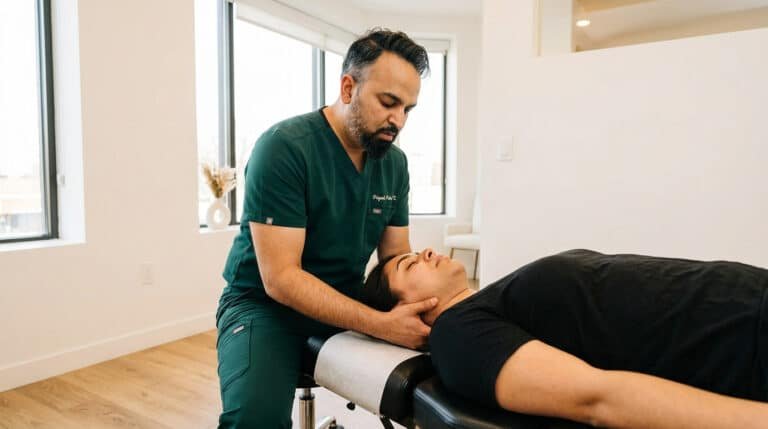
Suboccipital muscle release. I work the four small muscles at the base of your skull manually. Trigger points in these muscles are some of the most reliable headache generators I know. The pressure is intense but most patients say it “hurts in a good way.” You’ll feel the headache start to loosen within a few minutes.
Mid-cervical and thoracic work. The upper neck doesn’t exist in a vacuum. If your mid-back is stiff (and if you sit at a desk, it probably is), your upper cervical spine compensates. I’ll check the full chain. Sometimes fixing T4 does more for your headache than working on C1.
Posture and ergonomic guidance. Adjustments buy you time. But if the posture that created the problem doesn’t change, the headaches come back. I’ll look at your desk setup and give you specific changes. Monitor height, chair height, where your keyboard sits. Small shifts make a big difference.
A 2024 clinical practice guideline published in the Journal of Manipulative and Physiological Therapeutics confirmed that chiropractors can appropriately care for cervicogenic headache patients using spinal manipulation, joint mobilization, and soft tissue techniques [4]. This wasn’t an opinion piece. It was a systematic review of the evidence from 2017 to 2023.
What to Expect During Your First Visit
Your first appointment is about 45 minutes. I’ll ask about your headache pattern: when they started, how often they happen, where exactly the pain sits, what makes it better or worse. I want to know if they’re worse in the morning (sleep position issue) or worse by end of day (posture and fatigue).
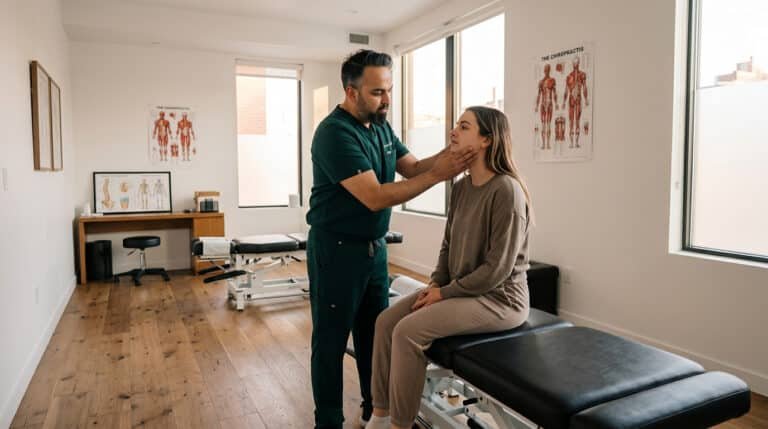
Then I’ll do a physical exam. I’ll check your cervical range of motion, palpate the joints of your upper neck to find restrictions, test the suboccipital muscles and upper traps for trigger points, and assess your posture from the side. That side view tells me a lot. I can usually see the forward head position from across the room.
If I find a cervical component, we start treatment that visit. You’re not coming in just for an evaluation. I want you to feel something change before you leave. If the exam suggests your headaches aren’t cervicogenic, or if I see any red flags, I’ll refer you to the right specialist. That happens occasionally, and it’s the right call when it does.
New-patient visits are $150. That includes the exam, any X-rays if needed, and your first treatment.
5 Things You Can Do at Home Right Now
- Chin tucks. Sit up straight, pull your chin straight back like you’re making a double chin. Hold 5 seconds. Do 10 reps, three times a day. This is the single best exercise for forward head posture and it takes less than two minutes. Do them at your desk, on the subway, waiting for coffee at Cafe Grumpy.
- Suboccipital self-release. Lie on your back with a tennis ball under the base of your skull, right where it meets your neck. Let your head’s weight sink into the ball. Stay there 2 to 3 minutes per side. Uncomfortable at first, but it loosens those muscles that generate headache pain.
- Fix your monitor height. The top of your screen should be at eye level. If you’re on a laptop, get a stand or stack some books under it. Use a separate keyboard. This one change can cut your daily headache frequency in half within a week.
- Check your pillow. Side sleepers need a thicker pillow that fills the gap between your shoulder and ear. Back sleepers need a thinner one. Stomach sleeping puts your neck in maximum rotation for hours. If you can break that habit, do it. If you can’t, at least use the thinnest pillow you can find.
- Move every 45 minutes. Set a timer. Stand up, roll your shoulders, look up at the ceiling for a few seconds, turn your head side to side. Your neck joints need motion. Sitting still for three hours straight is the worst thing you can do for cervicogenic headaches.
Headaches: When to See a Doctor
Most headaches aren’t dangerous. But some are. Go to the ER or see your doctor immediately if you experience any of these:
- A sudden, severe headache that peaks within seconds (“thunderclap” headache). This can indicate a brain bleed.
- Headache with fever, stiff neck, confusion, or sensitivity to light. This combination can signal meningitis.
- Headache after a head injury, especially if it gets worse over hours or days
- New headache pattern after age 50 that you’ve never experienced before
- Headache with vision changes, speech difficulty, or weakness on one side of your body
Chiropractic care is appropriate for recurring musculoskeletal headaches, especially cervicogenic and tension-type headaches. It’s not appropriate for headaches caused by infection, vascular events, or intracranial pressure changes. If anything about your headache pattern feels new or alarming, get it evaluated by your physician first. I’d rather you come see me with a clean workup than skip that step.
FAQ: Headache Chiropractor in Greenpoint
Can a chiropractor really help with headaches?
Yes, especially cervicogenic and tension-type headaches. A 2024 systematic review found that spinal manipulation and targeted exercises significantly reduce headache pain, frequency, and disability when the cervical spine is involved [1]. Most patients I treat for neck pain and headaches see improvement within the first few visits.
How do I know if my headache is coming from my neck?
Cervicogenic headaches usually start on one side at the base of your skull or behind your eye. They get worse with certain neck positions or sustained postures (like looking at a screen for hours). If pressing on the upper neck reproduces your headache, that’s a strong indicator. I test for this during every headache evaluation.
How many visits will I need for headache relief?
Most patients notice a clear reduction in headache intensity within 2 to 3 visits. For chronic headaches that have been going on for months, a typical course is 6 to 8 visits over 4 to 6 weeks. After that, some patients come in for maintenance every few weeks, others don’t need to.
Is chiropractic treatment for headaches safe?
Upper cervical adjustments are safe when performed by a licensed chiropractor. The most common side effect is mild soreness at the adjustment site, which resolves within a day. Serious complications are extremely rare. I screen every patient for contraindications before any cervical work.
What’s the difference between a migraine and a cervicogenic headache?
Migraines typically involve throbbing pain, nausea, light sensitivity, and sometimes visual auras. They’re a neurological event. Cervicogenic headaches are musculoskeletal, driven by joint and muscle dysfunction in the neck. They don’t usually cause nausea or light sensitivity. Some people have both types, and neck treatment can reduce the frequency of migraines too, though the mechanism is different.
Do I need X-rays or an MRI before seeing a chiropractor for headaches?
Not usually. I can diagnose cervicogenic headaches through a physical exam in most cases. If something in your history or exam suggests we need imaging, I’ll take X-rays in the office or refer you for an MRI. You don’t need to bring anything with you except a list of your symptoms and any medications you’re taking.
Ready to find relief? Schedule an appointment online or visit us at Brooklyn Chiropractic Care, 112 Greenpoint Ave. STE 1B, Brooklyn, NY 11222.
References
- Fernández-de-las-Peñas C, et al. “Effectiveness of Nonpharmacological Measures on Improving Headache Score, Strength, Pain, and Quality of Life in Cervicogenic Headaches: A Systematic Review.” J Clin Med. 2024;13(9):2502. PMC 11063809
- Sjaastad O, Bakketeig LS. “Prevalence of cervicogenic headache: Vågå study of headache epidemiology.” Acta Neurol Scand. 2008;117(3):173-180.
- Bryans R, et al. “Evidence-based guidelines for the chiropractic treatment of adults with headache.” J Manipulative Physiol Ther. 2011;34(5):274-289. PubMed 21640251
- Côté P, et al. “Chiropractic Management of Adults with Cervicogenic or Tension-Type Headaches: Development of a Clinical Practice Guideline.” J Manipulative Physiol Ther. 2024. PubMed 41685545
Not Sure What's Causing Your Pain?
Take our 60-second pain assessment and get a personalized care recommendation from Dr. Patel.
Take the Assessment