(347) 625-1246
 hello@brooklynchirocare.com
 112 Greenpoint Ave #1B, Brooklyn, NY 11222
Knee pain has a way of shrinking your world. You stop running, skip the stairs, think twice about a pickup game. Most knee pain treatment in Brooklyn jumps straight to painkillers or talk of surgery, but there’s a lot of room in between. At our Greenpoint clinic, shockwave therapy is the tool I reach for most with stubborn knee pain, paired with the right loading exercises to fix what’s actually driving it.
- Most knee pain is a soft-tissue or joint-loading problem, not something that needs surgery.
- Shockwave therapy is drug-free and non-invasive. The best evidence is for knee osteoarthritis, where it gives moderate short-term pain relief.
- For tendon problems like jumper’s knee, shockwave works best alongside loading exercise, not instead of it.
- Runner’s knee usually responds to hip and knee strengthening, which we build into your plan.
- Red flags like a locking knee, giving way, or a knee that swelled up fast after an injury need imaging first.
On this page
What Causes Knee Pain?
Most knee pain comes from how the joint is loaded, not from something broken inside it. The kneecap tracks poorly, a tendon gets overloaded, or the cartilage wears and the joint gets cranky. Figuring out which one you’re dealing with is the whole game, because the fix is different for each.
The patterns I see most in Brooklyn:
- Runner’s knee (patellofemoral pain). Aching around or under the kneecap, worse with stairs, squats, and long sits. Common in runners and anyone who ramped up mileage fast.
- Jumper’s knee (patellar tendinopathy). Pain right below the kneecap on the tendon, worse with jumping and deceleration. The classic overuse injury in basketball and volleyball players.
- Knee osteoarthritis. Stiff, achy, sometimes swollen knees that are worst in the morning or after activity. More common with age, past injury, or extra load through the joint.
- Acute injuries. A twist, a pop, a fall. Meniscus and ligament injuries need to be ruled in or out before anything else.
How Shockwave Therapy Helps Knee Pain
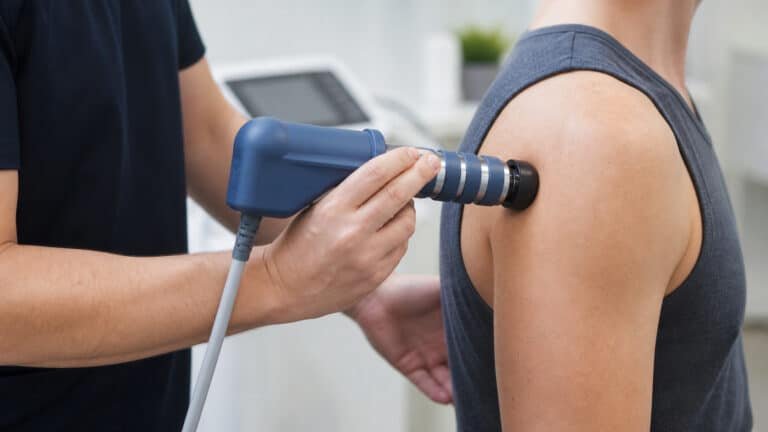
Shockwave therapy sends focused acoustic pulses into an injured tendon or joint to kickstart healing and turn down pain. It’s non-invasive, drug-free, and done in the office in a few minutes. For knee pain, the strongest evidence is in osteoarthritis: a 2020 review of 14 trials found shockwave gave a moderate, short-term reduction in pain and improvement in function for people with knee OA, with minimal side effects.1 That’s why it’s my go-to for arthritic knees that haven’t settled with the usual advice.
I’ll be straight with you about tendons, though. For jumper’s knee, the research is mixed. A 2021 network meta-analysis found shockwave wasn’t clearly better than a dummy treatment on its own, and that loading exercise should stay the foundation.2 A separate 2022 review reached the same cautious conclusion.3 So I use shockwave on tendons as an accelerator, layered on top of the eccentric loading work that actually rebuilds the tendon. It’s not a shortcut around the exercises. Our shockwave therapy page covers the other conditions it treats.
Runner’s Knee, Jumper’s Knee, and Knee OA
Same joint, three different problems, three different plans.
Runner’s knee
For patellofemoral pain, strength beats everything. A high-quality 2018 review found that combined hip and knee strengthening reduced pain and improved activity more than knee work alone.4 So runner’s knee is built around targeted strengthening and load management. Shockwave plays a small role here, if any. The runners we see from McCarren Park usually turn the corner with the right program.
Jumper’s knee
Patellar tendon pain responds to progressive loading, and we add shockwave to speed things along when the tendon is stubborn. This is the pattern in a lot of our pickleball and basketball players.
Knee osteoarthritis
Arthritic knees do best with a combination: shockwave for the short-term pain relief it’s shown to provide, plus a steady exercise program. Land-based exercise reliably improves pain, function, and stiffness in knee OA,5 so we don’t rely on shockwave alone. We keep you moving.
Knee Pain Treatment in Brooklyn: What to Expect
Knee pain treatment in Brooklyn starts with figuring out which knee problem you actually have. I check how your kneecap tracks, test the tendons and ligaments, look at your hips and feet, and watch how you move. Then we build a plan. If shockwave fits, a typical course is a handful of weekly sessions, each just a few minutes. It feels like firm tapping and can be a little tender on the sore spot, but there’s no downtime, you walk out and get on with your day.
Most people notice a shift within the first few sessions, especially with arthritic knees. Tendons take longer because the loading work needs time to rebuild the tissue. I’ll give you an honest timeline after the exam.
When to See a Doctor
Get imaging or a medical opinion first if your knee locks, gives way, swelled up quickly after an injury, or won’t bear weight. Those can signal a meniscus tear, ligament injury, or something that needs a different route before conservative care. Shockwave and rehab are for the overuse and arthritic knees, not for a fresh structural injury that hasn’t been assessed.
Does shockwave therapy work for knee pain?
It depends on the cause. For knee osteoarthritis, shockwave has been shown to give moderate, short-term pain relief and better function. For tendon problems like jumper’s knee, it works best paired with loading exercise rather than on its own. It’s drug-free and non-invasive either way.
Is shockwave therapy for the knee painful?
It’s usually well tolerated. You feel firm, rapid tapping on the treatment area, and it can be tender right on the sore spot, but most people find it manageable. Each session takes only a few minutes and there’s no downtime afterward.
How many shockwave sessions will I need for my knee?
Most plans run a handful of weekly sessions, and the exact number depends on your diagnosis and how you respond. Arthritic knees often feel relief sooner, while tendon injuries take longer because the loading exercises need time to rebuild the tissue.
Can a chiropractor treat knee pain?
Yes. Chiropractic care for the knee focuses on how the joint is loaded, the hips, the feet, and the muscles around the knee, not just the joint itself. Treatment combines shockwave when appropriate with targeted strengthening and movement correction.
Do I need surgery for knee pain?
Most knee pain does not require surgery. Overuse injuries and osteoarthritis usually respond to conservative care like shockwave and exercise. Surgery is reserved for structural injuries or advanced arthritis that hasn’t responded to a solid conservative plan.
Knee pain keeping you off your feet? Schedule an appointment online, or call (347) 625-1246 to check availability. As an out-of-network office, we can also help you verify your out-of-network benefits. You’ll find us at Brooklyn Chiropractic Care, 112 Greenpoint Ave. STE 1B, Brooklyn, NY 11222.
References
- Avendaño-Coy J, et al. Extracorporeal shockwave therapy improves pain and function in subjects with knee osteoarthritis: a systematic review and meta-analysis. International Journal of Surgery. 2020. pubmed.ncbi.nlm.nih.gov/32798759
- Challoumas D, et al. Management of patellar tendinopathy: a systematic review and network meta-analysis. BMJ Open Sport & Exercise Medicine. 2021. pubmed.ncbi.nlm.nih.gov/34900334
- Stania M, et al. Treatment of jumper’s knee with extracorporeal shockwave therapy: a systematic review and meta-analysis. Journal of Human Kinetics. 2022. pubmed.ncbi.nlm.nih.gov/36457482
- Nascimento LR, et al. Hip and knee strengthening is more effective than knee strengthening alone for patellofemoral pain. JOSPT. 2018. pubmed.ncbi.nlm.nih.gov/29034800
- Guo X, et al. A recommended exercise program appropriate for patients with knee osteoarthritis. Frontiers in Physiology. 2022. pubmed.ncbi.nlm.nih.gov/36262252
Not Sure What's Causing Your Pain?
Take our 60-second pain assessment and get a personalized care recommendation from Dr. Patel.
Take the Assessment