(347) 625-1246
 hello@brooklynchirocare.com
 112 Greenpoint Ave #1B, Brooklyn, NY 11222
Meniscus injuries and runner’s knee can feel similar in the first few days, which makes it easy to assume the worst after reading symptom lists online. A careful evaluation helps distinguish joint-line meniscus symptoms from patellofemoral pain without asking readers to diagnose themselves.
Both cause knee pain that flares with stairs, squats, and running. Both can swell a little. But the mechanics behind them are different, and so is what actually helps. This post walks through how the symptoms tend to differ so you know what questions to ask at your evaluation, not so you can self-diagnose from your couch.
Key Takeaways
- Meniscus tears usually cause pain along the joint line, catching, or locking. Runner’s knee (patellofemoral pain) causes a dull ache behind or around the kneecap.
- Twisting injuries point toward the meniscus. Gradual onset from mileage or stairs points toward patellofemoral pain.
- Locking, giving way, or a knee that won’t fully straighten are red flags that need imaging, not a home fix.
- Radial shockwave does not repair a meniscus tear. It’s discussed only when evaluation finds a tendon-related issue like patellar tendinopathy.
- Dr. Patel evaluates knee pain in Greenpoint before recommending any treatment path, including shockwave for knee pain where appropriate.
Table of Contents
- Meniscus Tear vs Runner’s Knee: What Each One Actually Is
- Joint-Line Symptoms: The Meniscus Tear Pattern
- Patellofemoral Patterns: The Runner’s Knee Pattern
- What Causes Each One
- Red Flags That Need Same-Week Evaluation
- How Dr. Patel Evaluates Knee Pain
- Where Shockwave Fits, and Where It Doesn’t
- What to Expect During Your First Visit
- What You Can Do at Home
- Frequently Asked Questions
Meniscus Tear vs Runner’s Knee: What Each One Actually Is
A meniscus tear is damage to one of the two C-shaped cartilage discs that sit between your thigh bone and shin bone, cushioning the joint and helping it absorb load. Runner’s knee, more precisely called patellofemoral pain syndrome, is irritation where the kneecap glides against the groove in the femur. Different structures, different mechanisms, different fixes.
Here’s the confusing part. Both can start after a run. Both can swell. Both hurt going down stairs. I’ve had patients insist they tore something because the pain felt “sharp,” when sharp pain behind the kneecap during stair descent is actually one of the most textbook patellofemoral presentations there is.
A 2018 study in the British Journal of Sports Medicine found that a large share of degenerative meniscal changes show up on MRI in people with zero knee pain at all [1]. So imaging alone isn’t the full story either. Symptom pattern matters, and that’s what we’re breaking down here.
Joint-Line Symptoms: The Meniscus Tear Pattern
Meniscus pain tends to sit right at the joint line, the narrow gap you can feel on the inner or outer edge of your knee when it’s bent. Press along that line and a torn meniscus often reproduces the exact pain. Press the same spot with patellofemoral pain and you usually get nothing, because the kneecap isn’t anywhere near there.
Twisting is the classic trigger. Pivoting on a planted foot, a bad step off a curb, getting up too fast from a deep squat. Patient of mine, mid-40s, twisted her knee getting out of a cab on Franklin Street. Immediate catching sensation, mild swelling within a few hours, and a knee that felt like it wanted to lock at about 20 degrees of bend. That’s a fairly classic meniscus story.
- Pain localized to one side of the joint line, inner or outer, rather than centered under the kneecap
- Catching, clicking, or a sensation that something is briefly stuck
- Locking. The knee genuinely won’t fully straighten or bend for a moment
- Swelling that shows up within hours to a day after a twisting event
- Pain with deep squatting or pivoting more than with stairs alone
Not every meniscus tear announces itself this loudly. Degenerative tears in older adults sometimes develop with almost no trauma at all, just a slow ache that flares with activity. Those are trickier to sort out by symptoms alone, which is part of why evaluation matters more than a home checklist.
Patellofemoral Patterns: The Runner’s Knee Pattern
Runner’s knee shows up differently. The ache sits behind or around the kneecap itself, not off to one side. It builds gradually, over weeks of training, rather than snapping on in one twisting moment. And it responds heavily to position: worse with stairs, worse sitting through a long movie (“theater sign,” we actually call it that), worse squatting.
No locking. No catching. Some people describe a grinding or crunching feeling under the kneecap, which is different from the mechanical “stuck” sensation of a meniscus tear. Swelling, if present at all, is usually mild and diffuse rather than the more focal puffiness you see with a meniscus injury.
A 2024 best practice guide in the British Journal of Sports Medicine identified pain during squatting, stair use, and prolonged sitting as the core diagnostic markers for patellofemoral pain, alongside tenderness around the kneecap rather than at the joint line [2]. That distinction between “around the kneecap” and “at the joint line” is doing most of the diagnostic work here.
Runners who ramp mileage too fast get this constantly, and it’s a big part of why we see so much of it from McCarren Park runners. So do people who just started a stair-climbing habit, switched to a minimalist shoe, or added a lot of lunges to a new program. It’s an overload pattern, not a single-event injury.
What Causes Each One
Meniscus tears come from two very different directions. Traumatic tears happen from a twisting or pivoting load, often in athletic movement, sometimes from something as unremarkable as a deep squat to grab something off a low shelf. Degenerative tears happen from years of joint wear, usually in patients over 40, where the cartilage weakens enough that even normal movement can cause a small tear.
Patellofemoral pain is almost always a load-and-mechanics problem. Weak glutes, especially the glute medius, let the thigh drift inward during a run or squat, which pulls the kneecap off its ideal track. Tight quads or IT band add to the pull. Poor ankle mobility forces the knee to absorb force that should travel down through the foot. None of that is a structural tear. It’s a tracking and control issue.
And, real talk, a lot of the runner’s knee I see at my Greenpoint clinic is training-load related. Someone jumps from 10 miles a week to 25 because they signed up for a fall race. Knee didn’t get the memo.
Red Flags That Need Same-Week Evaluation
Some symptoms move a knee problem out of “watch and see” territory. If any of these apply, get evaluated this week, not next month.
- True locking. The knee gets physically stuck and won’t straighten. This can mean a torn piece of cartilage is caught in the joint.
- Giving way or buckling. The knee feels like it’s about to collapse under normal walking. Could point to meniscus involvement, ligament instability, or both.
- Significant swelling within hours of an injury. Rapid, tense swelling after a twisting event is different from the mild puffiness of overuse pain.
- Inability to bear weight at all. This isn’t a “walk it off” situation.
- Visible deformity, or a knee that looks obviously different from the other side.
- Fever, redness, or warmth around the joint, which can signal infection and needs urgent medical attention, not chiropractic care.
If you’re dealing with any of those, please see a physician or go to urgent care before booking a chiropractic evaluation. Everything else on this list, the more ordinary joint-line ache or the dull kneecap pain, is exactly what an evaluation at our clinic is built to sort out.
How Dr. Patel Evaluates Knee Pain
I don’t guess. The exam starts with a history, when it started, what movement triggered it, whether it was gradual or sudden, because that alone rules out a lot of possibilities. Then hands-on testing: joint-line palpation, McMurray’s test for meniscus involvement, patellar tracking and compression tests for patellofemoral issues, and a check of hip and ankle mobility since those almost always factor in.
I also look up the chain. Hip internal rotation, ankle dorsiflexion, glute activation. A knee rarely misbehaves in isolation. One pattern we notice constantly with our Brooklyn patients is a stiff hip on one side driving compensatory knee stress on the other.
If the exam suggests a structural tear, ligament instability, or anything outside chiropractic scope, I refer out for imaging or an orthopedic consult. Being upfront about that is part of doing this right. Chiropractic care treats mechanical dysfunction well. It doesn’t repair torn cartilage.
Where Shockwave Fits, and Where It Doesn’t
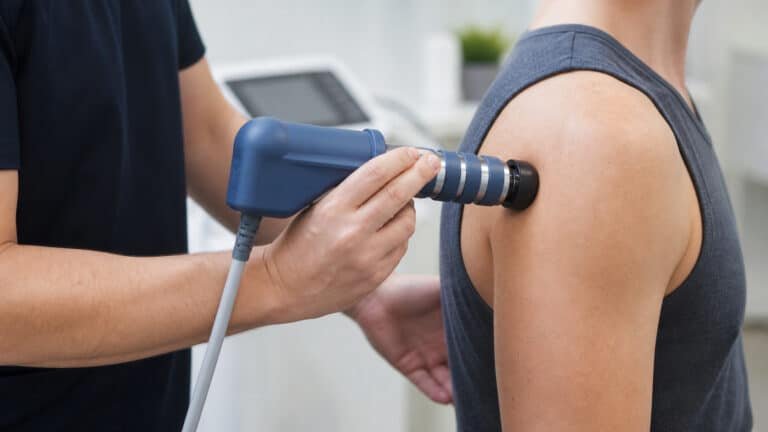
Let’s be direct about this because it gets misunderstood a lot. Radial shockwave therapy does not repair a meniscus tear. It has no mechanism for regrowing or reattaching torn cartilage, and anyone who tells you otherwise is overselling it.
What shockwave actually has evidence for is tendon-related pain, things like patellar tendinopathy (jumper’s knee), where the tendon below the kneecap has degenerated from repetitive load. If your evaluation points to a tendon issue rather than a meniscus tear or a straightforward tracking problem, shockwave can be part of the conversation. It’s one option among several, not a default.
We’ve written more about how shockwave applies to knee conditions specifically on our knee pain treatment page, and about the broader mechanism on our shockwave therapy service page. Worth a read if you want the details, but the short version is: it gets discussed after diagnosis, never before it.
That’s the whole point of doing an evaluation first. You don’t want a treatment recommended for a problem you don’t actually have.
What to Expect During Your First Visit
Your first visit runs about 45 minutes. We start with a conversation about the injury or the ache, when it started, what makes it worse, whether there was a specific twisting moment. Then a hands-on exam of the knee itself plus the hip and ankle on both sides, usually 15 to 20 minutes of orthopedic and movement testing.
If we suspect a meniscus tear or anything structural, I’ll walk you through next steps for imaging and, if needed, an orthopedic referral, same visit. If the pattern points to patellofemoral pain or another mechanical issue within our scope, we build a plan on the spot: manual therapy, targeted exercise, and a timeline for reassessment. You leave knowing what you’re actually dealing with, not more confused than when you walked in.
What You Can Do at Home
A few things help regardless of which pattern you’re leaning toward, and a few things only apply to one or the other. Don’t push through sharp, catching pain hoping it resolves on its own.
- Ease off twisting and deep squatting. If joint-line pain with pivoting is your pattern, skip lunges, deep squats, and pivot-heavy activity for now. Forcing through it risks turning a small tear into a bigger one.
- Ice for 15-20 minutes after activity. Works for both patterns in the acute phase. Do this once or twice a day if there’s visible swelling.
- Cut mileage or stair volume by 30-50% if it’s runner’s knee. Gradual-onset kneecap pain almost always improves faster once training load drops, not stops entirely. Complete rest often makes the eventual return harder. Our sports chiropractic approach builds that return-to-training plan alongside the exam.
- Strengthen the glutes, don’t just stretch the knee. Clamshells, side-lying leg raises, and bridges 2-3 times a week address the hip weakness that drives a lot of patellofemoral pain. This one takes weeks, not days, to show results.
- Track whether symptoms change with position. Note if pain is worse sitting a long time (points patellofemoral) versus worse with a specific twisting motion (points meniscus). Bring those notes to your evaluation. It genuinely speeds up the diagnosis.
Frequently Asked Questions
Can a chiropractor tell the difference between a meniscus tear and runner’s knee?
Yes, through orthopedic testing like McMurray’s test, joint-line palpation, and patellar tracking assessment, a chiropractic exam can differentiate the two patterns with reasonable confidence. When findings are unclear or point toward a structural tear, imaging or an orthopedic referral follows.
Does a meniscus tear always need surgery?
No. A 2018 study in the BMJ found exercise therapy produced comparable outcomes to arthroscopic surgery for degenerative meniscal tears [3]. Traumatic tears in younger, more active patients are more likely to need surgical repair, but degenerative tears often respond to conservative care first.
Why does my knee hurt more going down stairs than up?
Descending stairs loads the patellofemoral joint more heavily than ascending does, which is why pain on the way down is one of the more reliable signs of runner’s knee. Meniscus pain can also flare with stairs, but usually with a more localized joint-line ache rather than a diffuse ache under the kneecap.
Is shockwave therapy a treatment for a torn meniscus?
No. Shockwave has no evidence for repairing torn meniscal cartilage. It’s discussed only for select tendon conditions like patellar tendinopathy, after an evaluation identifies that as the actual pain source.
How long does patellofemoral pain take to improve?
Most patients notice meaningful improvement within 4-6 weeks of reduced load and targeted glute strengthening, though full resolution can take 2-3 months depending on training history and how long the pain went unaddressed.
Should I stop running completely if I think it’s runner’s knee?
Not necessarily. Most patients do better reducing mileage and intensity rather than stopping entirely, since a graded return is usually easier than starting from zero. If pain is sharp, worsening, or comes with locking or swelling, hold off until you’re evaluated.
Not sure which pattern fits your knee? Dr. Patel evaluates knee pain in Greenpoint before recommending any treatment path. Schedule an appointment online or visit us at Brooklyn Chiropractic Care, 112 Greenpoint Ave. STE 1B, Brooklyn, NY 11222.
References
- Culvenor AG, et al. “Prevalence of knee osteoarthritis features on magnetic resonance imaging in asymptomatic uninjured adults: a systematic review and meta-analysis.” British Journal of Sports Medicine, 2018. pubmed.ncbi.nlm.nih.gov/28596247
- Willy RW, et al. “Patellofemoral pain: consensus statement from the 5th International Patellofemoral Pain Research Retreat.” British Journal of Sports Medicine, 2024. pubmed.ncbi.nlm.nih.gov/38071579
- Kise NJ, et al. “Exercise therapy versus arthroscopic partial meniscectomy for degenerative meniscal tear.” BMJ, 2016 (long-term follow-up published 2018). pubmed.ncbi.nlm.nih.gov/29997122
Not Sure What's Causing Your Pain?
Take our 60-second pain assessment and get a personalized care recommendation from Dr. Patel.
Take the Assessment