(347) 625-1246
 hello@brooklynchirocare.com
 112 Greenpoint Ave #1B, Brooklyn, NY 11222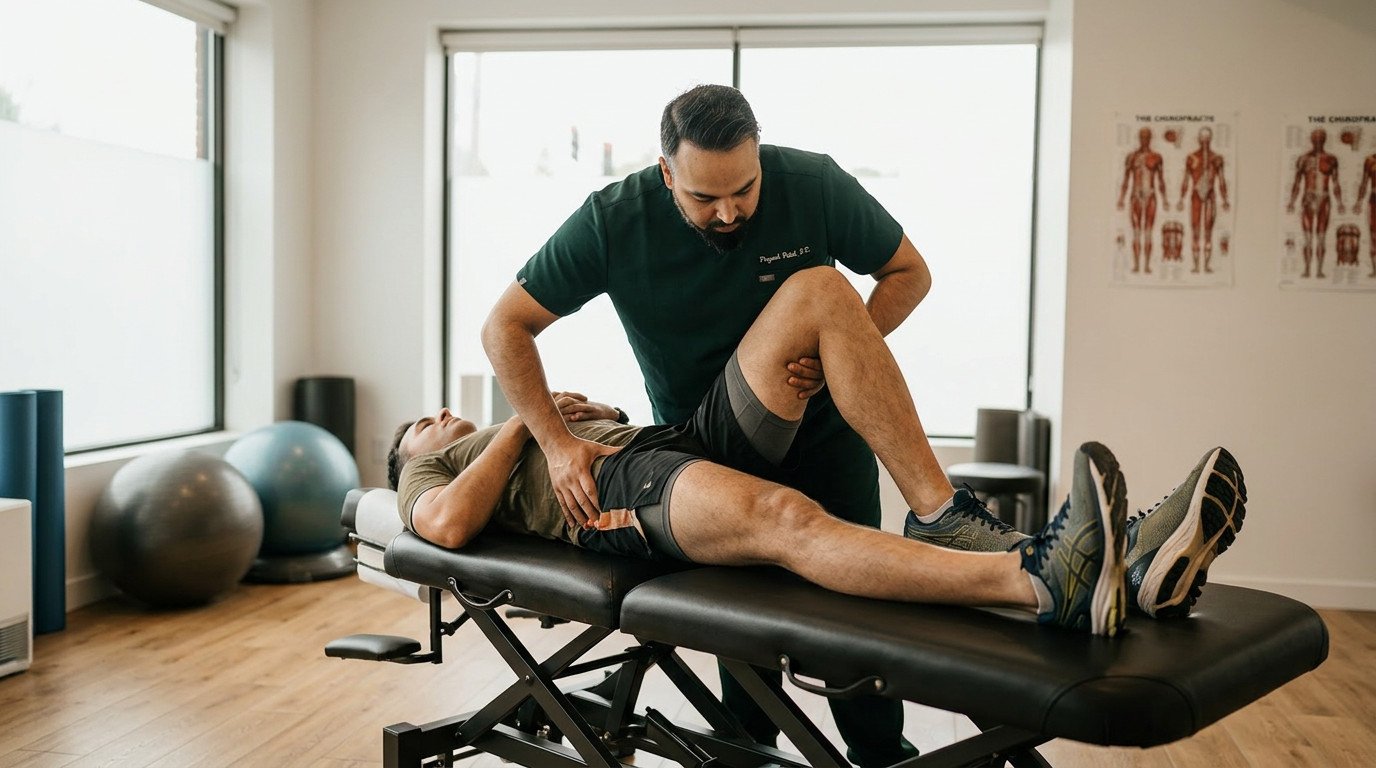
If you run McCarren Park, you’re part of something bigger than a solo workout. Every morning and evening, hundreds of runners circle the track, push through tempo repeats on the Greenpoint waterfront, and log long runs across the bridges of North Brooklyn. You’ve probably crossed paths with North Brooklyn Runners on a Thursday track night or joined a Saturday session with Brooklyn Track Club. What you might not have is a running chiropractor in Brooklyn who understands your sport and the specific injuries it creates.
That’s where Brooklyn Chiropractic Care comes in. We’re right here in Greenpoint, a short walk from the park where you log your miles.
Key Takeaways
- McCarren Park runners face repetitive stress injuries from high weekly mileage on hard surfaces
- The most common running injuries we treat are hip pain, knee pain, plantar fasciitis, and IT band syndrome
- North Brooklyn Runners, Brooklyn Track Club, and Run & Yap all train near our Greenpoint clinic
- Dr. Patel has treated distance runners for over 15 years and understands running biomechanics
- BCC is a short walk from McCarren Park on Greenpoint Ave
Table of Contents
- McCarren Park’s Running Community
- What All Those Miles Do to Your Body
- Common Running Injuries We Treat at BCC
- How a Running Chiropractor in Brooklyn Treats Your Pain
- Your First Visit with a Running Chiropractor in Brooklyn
- 5 Things McCarren Park Runners Can Do Between Visits
- Running Injuries: When to See a Doctor
- Frequently Asked Questions
McCarren Park’s Running Community
McCarren Park isn’t just a park with a track. It’s the center of running culture in North Brooklyn. On any given week, three distinct running communities use the park and the surrounding streets as their home base.
North Brooklyn Runners is the largest group in the area. They run nearly 20 group sessions per week across Williamsburg, Greenpoint, and Bushwick. Their McCarren Park track workouts happen Thursday mornings at 6:45 AM (the “Hellkatz” session) and Thursday evenings at 7:30 PM. Tuesday nights are tempo runs. Sunday mornings feature long runs starting at McCarren Park that stretch anywhere from 10 to 22 miles depending on the training cycle. Every pace level is welcome, from 7-minute miles to 11-minute miles, and volunteer pacers keep each group together.
NBR also organizes the annual McCarren Park 5K and the McCarren Park Track Classic, now in its sixth year. If you’ve raced either one, you know the community shows up.
Brooklyn Track Club takes a more competitive approach. Their structured Wednesday and weekend sessions focus on race preparation, with coaching that targets everything from 5K speed to marathon endurance. Members regularly compete together in NYRR events across the city.
Then there’s Run & Yap, a women’s social running group that meets Saturday mornings at 9 AM near McCarren Park. Their route covers about 2.5 miles through Greenpoint to the waterfront, finishing at a coffee shop in Williamsburg. No pace pressure. No one gets left behind. It’s running as social connection, and it’s exactly the kind of low-key group that gets people who wouldn’t call themselves “runners” out the door on a Saturday morning.
All three groups train within blocks of our clinic. That’s not a coincidence. It’s why we’re here.
What All Those Miles Do to Your Body
Running is one of the most repetitive sports that exists. Every stride sends a force of roughly 2.5 times your body weight through your feet, ankles, knees, hips, and spine. If you weigh 160 pounds, that’s 400 pounds of impact per step. Over a 5-mile run, that adds up to around 40,000 impacts.
Your body is built to handle this. But only when everything is aligned and moving properly.
When a joint in your pelvis, hip, or lower spine loses its normal range of motion, the forces don’t disappear. They get redirected. Your knee absorbs load at an angle it shouldn’t. Your IT band tightens to compensate. Your plantar fascia takes strain because your ankle isn’t dorsiflexing fully. One restricted joint creates a chain reaction that shows up as pain somewhere completely different.
A 2024 prospective cohort study found an injury incidence of 8.1 per 1,000 hours of running, with the knee being the most commonly affected joint at 28.4% of all injuries [1]. A separate systematic review put the overall injury prevalence for recreational runners at roughly 45%, with 70-80% of those injuries classified as overuse [2].
That means nearly half of all recreational runners get hurt every year. And almost none of those injuries happen in one dramatic moment. They build over weeks of training on joints that aren’t moving right.
Common Running Injuries We Treat at BCC
In our Greenpoint clinic, we see injury patterns that map directly to the kind of training McCarren Park runners do. Here are the conditions that walk through our door most often.
Hip pain from running. This is one of the most common complaints we hear from Brooklyn runners, and it’s often the most misunderstood. Your hip flexors shorten from sitting at a desk all day. Then you ask them to power through 6 miles in the evening. The result is a tight, restricted hip that forces your lower back and your knee to pick up the slack. Sacroiliac joint dysfunction, hip flexor tendinopathy, and labral irritation are all on the table. Sound familiar?
Runner’s knee. That dull ache behind or around your kneecap that gets worse going downhill or down stairs. It’s usually not a knee problem at all. It’s a hip and pelvis problem. When your pelvis is rotated or your glutes aren’t firing correctly, your kneecap doesn’t track the way it should. We fix the cause, not just the symptom.
Plantar fasciitis. That stabbing pain in your heel with your first steps in the morning. Runners who train on hard surfaces around McCarren Park are especially prone. We use radial shockwave therapy alongside adjustments for stubborn cases. It sends acoustic waves into the damaged tissue, stimulating blood flow and triggering your body’s natural repair process.
IT band syndrome. The sharp pain on the outside of your knee that appears around mile 3 and gets worse the longer you run. Foam rolling helps temporarily, but the underlying cause is usually a restricted hip joint or weak glute medius. Until you fix the joint, the IT band keeps tightening.
Achilles tendinopathy. That stiffness and tenderness in the back of your ankle, especially after speed work or hills. NBR’s Thursday track sessions and Tuesday tempo runs put serious load on the Achilles. For stubborn cases, shockwave therapy for Achilles tendonitis is often what finally breaks the cycle.
Shin splints. Common in newer runners or anyone who’s ramped up mileage too quickly. The periosteum, the membrane covering your shinbone, gets inflamed from repetitive impact. If it doesn’t resolve with rest, it needs attention before it becomes a stress fracture.
How a Running Chiropractor in Brooklyn Treats Your Pain
Treating a runner is different from treating someone with general back pain. Dr. Patel doesn’t just look at where it hurts. He looks at how you move.
The assessment starts with your gait, single-leg stability, hip mobility, and ankle dorsiflexion. These four things tell us almost everything about where your running mechanics are breaking down.
One pattern we see constantly in our Brooklyn patients: restricted ankle dorsiflexion on one side. You probably don’t notice it while running. But your body does. It compensates by overpronating, which rotates your tibia, which stresses your knee, which tightens your IT band. A single restricted ankle joint can create pain three joints away.
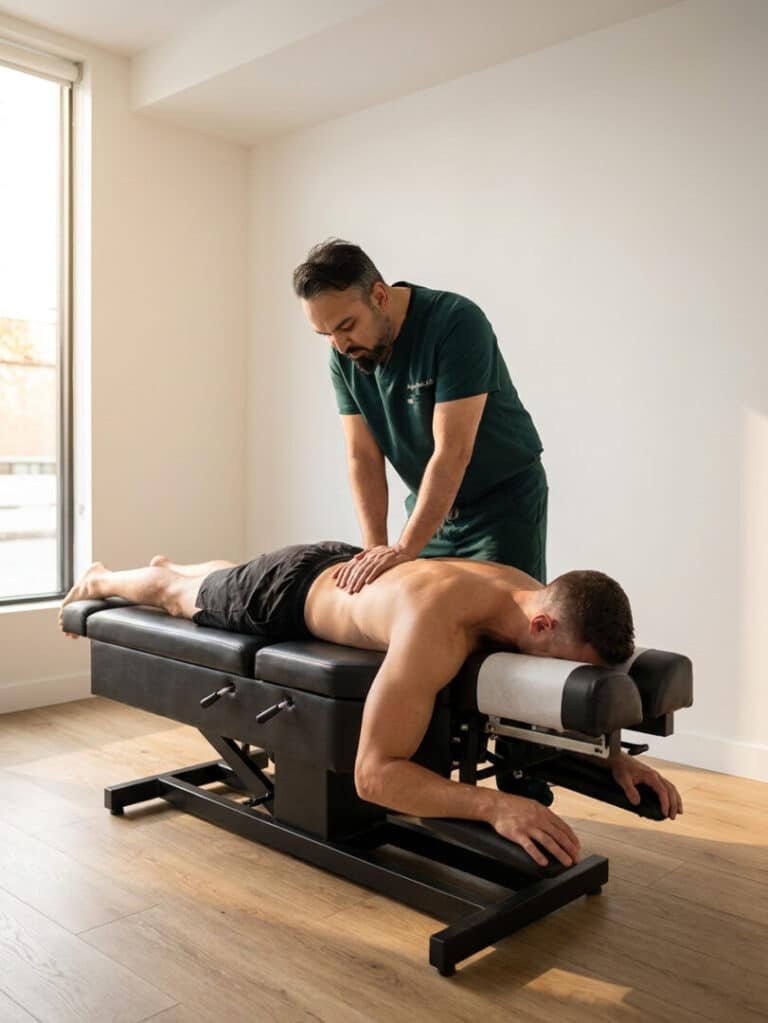
After the movement assessment, Dr. Patel adjusts the specific joints that have lost their normal motion. For runners, that usually means the sacroiliac joints, the lumbar spine, and the ankle or foot. The goal isn’t just pain relief. It’s restoring the joint mechanics that let you run without compensating.
For soft-tissue injuries like plantar fasciitis or Achilles tendinopathy, we combine adjustments with radial shockwave therapy. Most runners notice improvement within 3-5 sessions.
Your First Visit with a Running Chiropractor in Brooklyn
Your first appointment takes about 45 minutes. Here’s what happens:
- Running history and goals. We’ll ask about your weekly mileage, pace, surfaces, training schedule, shoe rotation, and injury history. If you’re training for a specific race (Brooklyn Half, NYC Marathon, McCarren Park 5K), that shapes the treatment plan.
- Movement screen. We test your gait, single-leg squat, hip range of motion, and ankle flexibility. This reveals the compensations your body has been making, sometimes for years.
- Spinal and joint exam. Dr. Patel checks each segment of your spine, pelvis, hips, knees, and ankles for motion and tenderness.
- X-rays if needed. For runners with chronic or recurring pain, diagnostic imaging gives us a clearer picture of what’s happening structurally.
- Adjustment and plan. We treat the restrictions we find and build a plan that works with your training schedule. Most runners do well with visits every 2-4 weeks for maintenance.
5 Things McCarren Park Runners Can Do Between Visits
- Hip flexor stretch after every run. Kneel on one knee, push your hips forward, and hold for 30 seconds each side. Do this within 10 minutes of finishing your run. Your hip flexors shorten during the running stride, and they need to be lengthened afterward. This is especially important if you sit at a desk all day before heading out to McCarren.
- Single-leg calf raises for Achilles health. Stand on one foot, rise up on your toes, then lower slowly over 3 seconds. Do 3 sets of 12 each leg, twice a day. This eccentric loading strengthens the Achilles tendon and is the single best preventive exercise for tendinopathy [3].
- Roll a lacrosse ball under your foot. Before your first step out of bed, roll a lacrosse ball under each foot for 60 seconds with moderate pressure. This breaks up adhesions in the plantar fascia and makes those first morning steps a lot less painful.
- Don’t skip your rest day. NBR runs almost every day of the week. That doesn’t mean you should run every day. Your tissues need 48 hours to repair after hard efforts. If you ran Thursday track, take Friday easy or off entirely.
- Check your shoes. Running shoes lose their shock absorption after 300-500 miles. If you’re running 30 miles per week, that’s a new pair every 10-17 weeks. Worn-out shoes are one of the most common and most preventable causes of running injuries we see.
Running Injuries: When to See a Doctor
Not every ache needs a visit. Muscle soreness after a hard tempo run or a long Sunday session is normal and resolves on its own within 48 hours.
But you should book an appointment if:
- Pain doesn’t improve after 3-4 days of rest
- Pain changes your running form or makes you limp
- You feel sharp, localized pain in a bone (shin, foot, hip) during impact
- Swelling or warmth appears around a joint that wasn’t there before
- Hip pain from running that’s getting progressively worse each week
- Numbness or tingling in your foot or leg
If you’re experiencing sudden severe pain, inability to bear weight, or numbness with loss of bladder or bowel control, go to the emergency room. That’s not a chiropractic situation. But for the vast majority of sports-related running injuries, chiropractic care is the fastest path back to training.
Frequently Asked Questions
Can I run on the same day I get a chiropractic adjustment?
Yes. Most runners train the same day without issues. If you’re getting adjusted before a run, you might notice better hip or ankle mobility right away. After a hard run, an adjustment helps your body recover faster. Just avoid a max-effort workout within an hour of your adjustment to let your joints settle.
How often should a runner see a chiropractor?
It depends on your weekly mileage and injury history. If you’re running 25-40 miles per week, every 2-4 weeks is a good maintenance schedule after the initial issue is resolved. Runners in marathon training blocks may benefit from weekly visits during peak mileage weeks.
Do I need a running chiropractor in Brooklyn, or will any chiropractor work?
Any licensed chiropractor can treat joint restrictions. But a chiropractor who works with runners regularly understands running biomechanics, gait patterns, and the specific demands of training. That means faster diagnosis and a treatment plan that works around your running schedule, not against it.
What’s the difference between a chiropractor and a physical therapist for running injuries?
A chiropractor focuses on restoring joint motion, particularly in the spine, pelvis, and extremities. A physical therapist focuses on muscle rehabilitation and movement retraining. They work well together. Dr. Patel regularly co-manages care with physical therapists and running coaches to get athletes back to full training.
Is hip pain from running something I should worry about?
Mild muscle soreness in your hips after a hard run can be normal. But recurring hip pain that shows up every time you run, or pain that wakes you up at night, is a sign that something isn’t moving properly. It usually means a joint in your pelvis or hip is restricted, and the surrounding muscles are compensating. The sooner you get it checked, the faster it resolves.
Ready to find relief? Schedule an appointment online or visit us at Brooklyn Chiropractic Care, 112 Greenpoint Ave. STE 1B, Brooklyn, NY 11222.
References
- Incidence and biomechanical risk factors for running-related injuries: A prospective cohort study. Journal of Clinical Orthopaedics and Trauma. 2024;57:102515. doi:10.1016/j.jcot.2024.102515
- Kakouris N, Yener N, Fong DTP. A systematic review of running-related musculoskeletal injuries in runners. Journal of Sport and Health Science. 2021;10(5):513-522. doi:10.1016/j.jshs.2021.04.001
- Lopes AD, Hespanhol LC, Yeung SS, Costa LOP. What are the main running-related musculoskeletal injuries? A systematic review. Sports Medicine. 2012;42(10):891-905. doi:10.1007/BF03262301
Not Sure What's Causing Your Pain?
Take our 60-second pain assessment and get a personalized care recommendation from Dr. Patel.
Take the Assessment