(347) 625-1246
 hello@brooklynchirocare.com
 112 Greenpoint Ave #1B, Brooklyn, NY 11222
Your shoulder has been hurting for months. You’ve rested it, iced it, maybe even tried a cortisone shot. Still wakes you up at night when you roll onto that side. You’re stuck between “just give it more time” and “maybe I need surgery,” and neither option feels great. Shockwave therapy for shoulder pain in Brooklyn is the middle path I keep recommending to patients in exactly this spot. It’s non-invasive, backed by solid clinical data, and it works on the three shoulder conditions I see most often in our Greenpoint clinic: rotator cuff tendinopathy, calcific tendonitis, and frozen shoulder.
Key Takeaways
- Shockwave therapy uses acoustic pressure waves to restart healing in damaged shoulder tendons
- Calcific tendonitis responds best, with up to 91% of patients showing improvement and complete calcium resorption in many cases
- Rotator cuff tendinopathy and frozen shoulder both respond well when conservative stretching and rest haven’t worked
- A typical plan is 6 to 8 visits, usually spaced about one week apart, with each visit lasting about 10 to 15 minutes
- No anesthesia, no incision, no downtime. You walk out and go back to your day
Table of Contents
What Is Shockwave Therapy for Shoulder Pain?
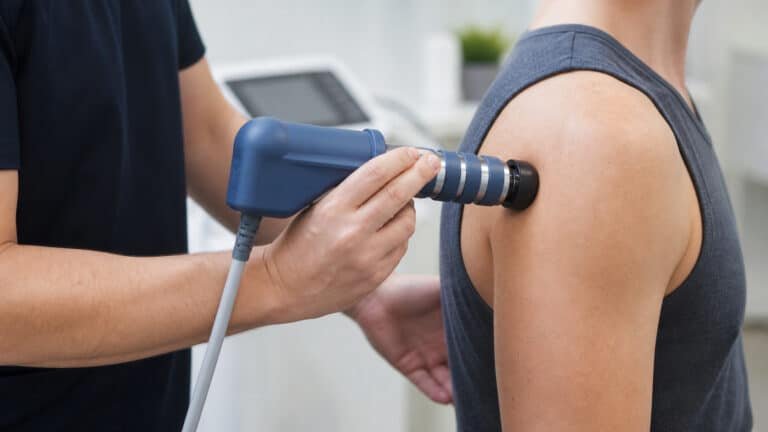
Extracorporeal shockwave therapy (ESWT) sends focused acoustic pressure waves into damaged shoulder tissue. “Extracorporeal” just means from outside the body. The device looks like a wand, it presses against your skin over the injured area, and it delivers rapid pulses of energy into the tendon or capsule underneath.
Those pressure waves do a few things at the tissue level. They increase blood flow to areas that don’t get much on their own (tendons are notoriously low-blood-supply structures). They break up calcium deposits when they’re present. And they trigger your body’s inflammatory repair response, essentially telling your nervous system to pay attention to a spot it’s been ignoring.
At our Greenpoint clinic, I use radial shockwave therapy for shoulders. It’s the same technology I use for plantar fasciitis, tennis elbow, and Achilles tendonitis. The shoulder is just the latest body part where the evidence has really stacked up.
Which Shoulder Conditions Respond to Shockwave?
Not every shoulder problem is a shockwave candidate. I’m specific about which patients I recommend it for.
Rotator Cuff Tendinopathy
This is the most common shoulder condition I treat. The tendons that stabilize your shoulder joint get irritated from repetitive overhead motion, poor posture, or just accumulated wear. You feel it reaching for something on a high shelf or when you put your arm behind your back. A 2024 systematic review and meta-analysis in BMC Musculoskeletal Disorders found that ESWT provided better pain relief and functional recovery compared to control groups for rotator cuff tendinopathy.
I see this constantly in Brooklyn patients who commute with heavy bags, work overhead (painters, electricians, warehouse workers), or do a lot of pressing movements at the gym. The tendon gets stuck in a cycle where it’s damaged but not inflamed enough for your body to repair it. Shockwave kicks that repair process back into gear.
Calcific Tendonitis
This is the one where shockwave really shines. Calcium deposits form inside a rotator cuff tendon, usually the supraspinatus. They hurt. A lot. Sometimes they get so painful that patients can’t sleep on that side at all.
A retrospective study of individualized radial shockwave therapy found a one-year success rate of 91% with only 7% recurrence. A 2025 clinical trial took it further: ultrasound-guided ESWT achieved successful outcomes in 91% of patients at six months, with complete calcium resorption in 66% of cases. Those are better numbers than cortisone injections, and without the tendon-weakening side effects.
Patient came in last month with a calcium deposit the size of a pea in her supraspinatus. Couldn’t lift her arm past 90 degrees. After five shockwave sessions the deposit had broken up on follow-up imaging and she was reaching overhead again. That’s not unusual for calcific tendonitis.
Frozen Shoulder (Adhesive Capsulitis)
Frozen shoulder is a different beast. The capsule around your shoulder joint thickens and tightens, restricting motion in every direction. It typically goes through three stages: freezing (painful), frozen (stiff), and thawing (gradual return of motion). The whole cycle can take one to three years without intervention.
Shockwave doesn’t replace physical therapy and stretching for frozen shoulder. But it speeds things up. A systematic review and meta-analysis in the American Journal of Sports Medicine found that ESWT improved short-term pain and range of motion when combined with physical therapy and home exercises. I use it as an add-on, not a standalone treatment for adhesive capsulitis.
How Shockwave Therapy for Shoulder Pain in Brooklyn Works at BCC
I’ll walk you through what a session actually looks like at our 112 Greenpoint Ave clinic, because knowing what to expect makes a difference.
First, I find the exact spot. For rotator cuff issues, I palpate the tendon insertion on the greater tuberosity. For calcific tendonitis, prior imaging (X-ray or ultrasound) tells me exactly where the deposit sits. For frozen shoulder, I target the anterior and posterior capsule. Precision matters. Missing the target by even a centimeter means the energy goes into the wrong tissue.
I apply gel to the area (same kind used for ultrasound) and press the shockwave handpiece against your skin. Then we start. You’ll feel a rapid tapping sensation, like someone flicking your shoulder with their finger at high speed. Some spots are more sensitive than others. I adjust the intensity based on what you’re feeling.
Each session delivers between 2,000 and 3,000 pulses. Takes about 10 to 15 minutes for the shoulder. You might feel some soreness afterward, like a deep bruise. That’s normal and usually fades within 24 to 48 hours.
I typically combine shockwave with chiropractic adjustments to the thoracic spine and shoulder complex. Your shoulder doesn’t work in isolation. If your mid-back is locked up, your shoulder blade can’t move properly, and that keeps dumping stress on the rotator cuff. Fixing the mechanics alongside the tissue gives better results than either approach alone.
What to Expect During Your First Shockwave Session
Your first visit includes the evaluation, not just the shockwave. I need to know exactly what’s going on before I aim acoustic energy at your shoulder.
I’ll test your range of motion in every plane. Internal rotation, external rotation, flexion, abduction. Specific tests for impingement, rotator cuff integrity, and capsular restriction. If you have imaging (X-rays, MRI, or ultrasound), bring it. If you don’t and I suspect calcific tendonitis, we can take in-house X-rays that day to confirm.
Once I’m confident about the diagnosis, we’ll do the first shockwave session in that same visit. The whole appointment runs about 30 to 40 minutes. You don’t need to change into anything special. Just wear a shirt you can pull down past your shoulder.
After the session, you can go back to work. No restrictions. Just avoid heavy overhead lifting for 24 hours and skip the ice. The inflammatory response shockwave triggers is the point, and icing suppresses it. This is one of the few times I tell patients NOT to ice.
Most treatment plans run four to six sessions, one per week. Some patients feel a difference after two sessions. Calcific tendonitis patients often see the biggest changes between sessions three and five as the deposit starts breaking apart.
Home Care Between Sessions
- Pendulum exercises. Lean forward with your good hand on a table. Let your affected arm hang straight down and swing it gently in small circles. Clockwise for 30 seconds, then counterclockwise. Do this three times a day. It keeps the joint moving without loading the injured tendon.
- Doorframe stretch for the anterior capsule. Stand in a doorway with your arm at 90 degrees and your forearm against the frame. Step through gently until you feel a stretch across the front of your shoulder. Hold 20 seconds. Three reps, twice daily. This is particularly important for frozen shoulder patients.
- External rotation with a towel roll. Lie on your back with your elbow bent 90 degrees and a rolled towel between your elbow and your ribs. Slowly rotate your forearm outward. Hold 5 seconds at the end range. Ten reps. This works the infraspinatus and teres minor without stressing the supraspinatus.
- Scapular squeezes. Sit or stand with your arms at your sides. Squeeze your shoulder blades together and down (like you’re putting them in your back pockets). Hold 5 seconds, release. Fifteen reps. Do these throughout your day, especially if you sit at a desk. Your shoulder blade position affects everything above it.
- No ice after shockwave. I know it’s tempting. The soreness after a session makes you want to reach for the ice pack. Don’t. The controlled inflammation is doing the work. Heat is fine if the area feels stiff. Ice actively undermines the treatment mechanism.
When Shockwave Isn’t Enough
I’m honest about the limits. Shockwave therapy doesn’t fix everything.
Full-thickness rotator cuff tears don’t respond to shockwave. If the tendon is completely torn through, no amount of acoustic energy will reconnect it. You need an orthopedic consult and likely surgical repair. Partial tears are a different story. Those often respond well, especially when combined with rehab.
If you’ve had four to six sessions with zero improvement in pain or range of motion, we need to reassess. Maybe the diagnosis needs refining. Maybe there’s an underlying instability or labral issue that imaging didn’t catch initially. I’ll send you for an MRI or refer you to an orthopedic surgeon I trust for a second opinion. No ego about it.
Red flags that skip the shockwave conversation entirely:
- Sudden loss of ability to raise your arm after a fall or impact (acute full-thickness tear)
- Shoulder pain with fever, redness, and swelling (possible infection)
- Shoulder pain with shortness of breath or chest pressure (cardiac, not musculoskeletal)
- Shoulder pain after significant trauma with visible deformity (possible fracture or dislocation)
Any of those warrant an ER visit, not a chiropractic appointment.
Frequently Asked Questions
Does shockwave therapy hurt?
Most patients describe it as uncomfortable but tolerable, like a deep tapping or rubber-band snap. The intensity is adjustable. I start lower and increase based on your feedback. The discomfort lasts only during the 10 to 15 minutes of treatment. Soreness afterward feels like a deep bruise and usually fades within a day or two.
How many shockwave sessions will I need for my shoulder?
Four to six sessions is typical, spaced one week apart. Calcific tendonitis patients sometimes see significant improvement in as few as three sessions. Rotator cuff tendinopathy and frozen shoulder usually take the full course. I reassess after every session and adjust the plan based on your progress.
Can I still work out while getting shockwave therapy?
Yes, with modifications. Avoid heavy overhead pressing and anything that reproduces your pain for 24 hours after each session. Lower body work, cardio, and light upper body exercises that don’t load the affected shoulder are fine. I’ll give you specific guidance based on your training.
Is shockwave therapy better than cortisone injections for shoulder pain?
For calcific tendonitis, the evidence favors shockwave. A 91% success rate at one year beats cortisone’s typical 6 to 12 week window, and shockwave doesn’t weaken the tendon the way repeated cortisone injections can. For other shoulder conditions, both have a role. I’ll recommend whichever makes more sense for your specific diagnosis.
How much does shockwave therapy for shoulder pain cost at BCC?
Check our shockwave therapy pricing FAQ for current session rates. Visits are $120 each and cash-pay, with no separate evaluation fee or package commitment. Call (347) 625-1246 to check today’s availability.
What’s the difference between shockwave therapy and ultrasound therapy?
Shockwave delivers high-energy acoustic pulses that create mechanical stress in the tissue, triggering a repair response and breaking up calcium deposits. Therapeutic ultrasound uses continuous low-energy sound waves that mainly produce heat. Shockwave is more intense, more targeted, and has stronger clinical evidence for tendon conditions. They’re different tools for different problems.
Ready to find relief? Schedule an appointment online or visit us at Brooklyn Chiropractic Care, 112 Greenpoint Ave. STE 1B, Brooklyn, NY 11222.
References
- Li W, Wu Y, Liu Y, et al. “Effect of extracorporeal shockwave therapy for rotator cuff tendinopathy: a systematic review and meta-analysis.” BMC Musculoskeletal Disorders. 2024;25:369. PMC11069249
- Louwerens JKG, Veltman ES, van Noort A, van den Bekerom MPJ. “Individualised radial extracorporeal shock wave therapy (rESWT) for symptomatic calcific shoulder tendinopathy: a retrospective clinical study.” BMC Musculoskeletal Disorders. 2017;18(1):513. PMC5718020
- Elsawy AA, Shafshak NE, Alshehri MA, et al. “Ultrasound-Guided Versus Landmark-Based Extracorporeal Shock Wave Therapy for Calcific Shoulder Tendinopathy: An Interventional Clinical Trial.” 2025. PMC12071427
- Zhang R, Wang Z, Liu R, et al. “Extracorporeal Shockwave Therapy as an Adjunctive Therapy for Frozen Shoulder: A Systematic Review and Meta-analysis.” American Journal of Sports Medicine. 2022;50(9):2561-2571. PMC8819773
Not Sure What's Causing Your Pain?
Take our 60-second pain assessment and get a personalized care recommendation from Dr. Patel.
Take the Assessment