(347) 625-1246
 hello@brooklynchirocare.com
 112 Greenpoint Ave #1B, Brooklyn, NY 11222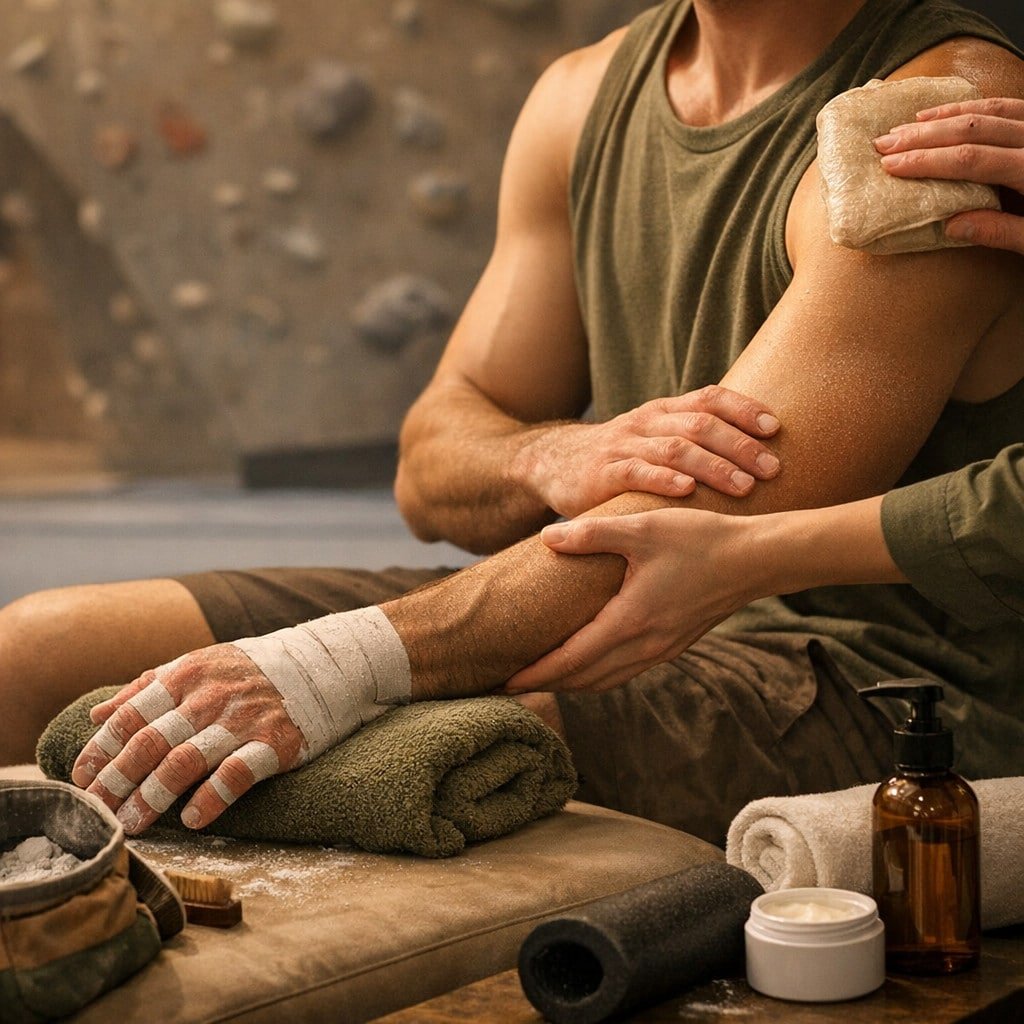
If you climb at VITAL Climbing Gym on North 14th Street, you already know the place has a different energy. Boutique feel, hand-crafted walls, rooftop bouldering when the weather’s right, and the kind of 24/7 access that turns climbing into an actual habit instead of a scheduled workout. That’s a lot of volume on your fingers, shoulders, and spine. Finding a good climbing chiropractor in Brooklyn matters more than most VITAL members realize, because bouldering loads your body in ways no other sport does.
Dr. Patel has been treating climbers at Brooklyn Chiropractic Care for over 15 years. We’re a ten-minute walk from VITAL Brooklyn, right here in Greenpoint.
Key Takeaways
- Bouldering loads your fingers, shoulders, and thoracic spine harder than most people expect
- VITAL’s 24/7 access means higher session frequency, which raises overuse injury risk if recovery lags
- Most climbing injuries we treat are chronic overuse, not acute falls
- Dr. Patel combines adjustments, soft-tissue work, and shockwave therapy for stubborn climber’s elbow and finger issues
- BCC is a 10-minute walk from VITAL Brooklyn at 221 North 14th Street
On This Page
- What a Week of Bouldering at VITAL Does to Your Body
- Climbing Injuries a Brooklyn Chiropractor Sees Most Often
- How Dr. Patel Treats Climbers at Brooklyn Chiropractic Care
- What to Expect at Your First Visit
- The Greenpoint Climb-and-Recover Loop
- 5 Things VITAL Members Can Do Between Visits
- When a Climbing Chiropractor in Brooklyn Is the Right Call
- Frequently Asked Questions
What a Week of Bouldering at VITAL Does to Your Body
Bouldering beats up your body in ways that don’t feel dramatic in the moment. You’re not lifting 300 pounds off the floor. You’re not running 10 miles. But you are hanging your entire body weight off two to four fingers, repeatedly, for an hour or two, often several times a week.
That loading pattern is unique. In a typical session at VITAL, you’ll pull hundreds of crimps, pinches, and slopers. Your shoulders fire overhead on almost every move. Your thoracic spine rotates and extends constantly. Your lats do absurd amounts of work. Your core has to stabilize while your hips throw heel hooks and flag out.
Then you step off, walk around for two minutes, and do it again.
VITAL’s 24/7 access is amazing for community and flexibility. It’s also a recipe for overtraining if you’re not careful. Climbers who could only get in three sessions a week at a gym with fixed hours often ramp to five or six once they have round-the-clock access. The tissue adapts more slowly than the psyche does.
A large survey of climbers found that over 50% reported a chronic overuse injury in the past year, with fingers, elbows, and shoulders the most common sites [1]. Translation: climbing injuries rarely happen on one dramatic move. They build up over months of small irritations that never fully resolved.
Climbing Injuries a Brooklyn Chiropractor Sees Most Often
In our Greenpoint clinic, climbers walk in with a predictable set of patterns. Here’s what shows up most:
Finger pulley strains. The A2 and A4 pulleys hold your flexor tendons against the bone in each finger. Crimping hard (especially full-crimp with the thumb wrapped) puts massive load on these pulleys. A partial tear feels like a sudden pop and bruising at the base of the finger. A strain feels like achy, puffy fingers that won’t loosen up. Graded pulley injury classification and management is well-established in the climbing medicine literature [2]. We work with you on load management and treat the surrounding soft tissue while the pulley heals.
Climber’s elbow. Medial epicondylitis, sometimes called golfer’s elbow, shows up as a burning ache on the inside of the elbow. Caused by repeated flexor strain from gripping. It’s the injury most likely to keep you off the wall for months if you don’t address it early. This is where radial shockwave therapy shines. Acoustic pressure waves stimulate blood flow into the stubborn tendon tissue and trigger healing. Most climbers we treat see real change in 3 to 5 sessions.
Shoulder impingement and labral irritation. Big overhead reaches, dead hangs, and dynos load the shoulder joint repeatedly. When your thoracic spine is stiff (and it will be if you sit at a desk before climbing), your shoulders overwork to get your arms overhead. Over time, the rotator cuff gets pinched and the labrum gets cranky.
Wrist tendonitis. Slopers and mantles load your wrist extensors hard. Climbers who also type all day are doubly exposed. The pain usually sits on the thumb side or the back of the wrist.
Lower back tightness. Heel hooks, drop knees, and compression moves crank your hips and lumbar spine in strange directions. If your SI joint is restricted or your hip mobility is off, your lower back picks up the slack. Real issue is usually upstream. A client came in last month thinking he’d tweaked his back on a slab. Actual cause was a locked-up right SI joint that showed up the second we tested his single-leg balance. For the underlying mechanics, see our guide on back pain in Brooklyn.
Thoracic spine stiffness. Your mid-back should be the most mobile segment. Desk life plus pulling-dominant sport equals locked up. When it locks, your overhead range drops and your shoulders pay for it. Every climber I see has this to some degree.
Neck tension. Looking up at problems for an hour pinches the base of your skull and stiffens the upper traps. Belayer’s neck is a real thing for sport climbers, and bouldering spotting has a milder version of the same pattern. If it’s bad enough to give you headaches, our neck pain and headaches page covers the full workup.
How Dr. Patel Treats Climbers at Brooklyn Chiropractic Care
Climbing is a hand-and-arm-dominant sport layered on top of whole-body mechanics. Treating climbers like generic back pain patients misses the point. Dr. Patel’s approach with climbers is different.
The first thing we look at is how the whole kinetic chain is moving. Your fingers might hurt, but your shoulder and thoracic spine are probably contributing. Your elbow might be flaring up, but your wrist and neck might be driving it. Real issue is almost always upstream or downstream of where it hurts.
Treatment usually combines:
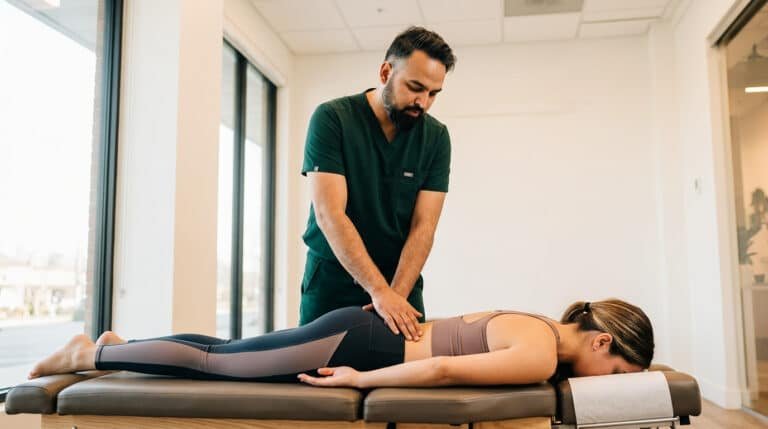
- Spinal adjustments to restore motion in the thoracic spine, neck, and SI joint. This alone often opens up overhead range in one session.
- Soft-tissue work on the forearms, lats, pecs, and upper traps. Climbers are short everywhere that pulls.
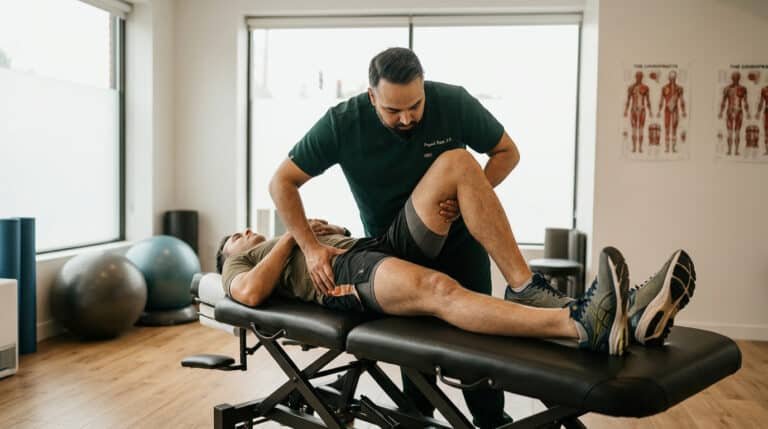
- Extremity work on the shoulder, elbow, and wrist joints. These get overlooked by generalist chiropractors. We don’t skip them.
- Shockwave therapy for chronic tendon pain. Most useful for climber’s elbow, wrist tendonitis, and occasionally finger flexors that aren’t healing on their own.
- Load-management advice specific to your training. If you’re pushing through pain on crimps, we’ll talk about why that’s going to end badly.
For climbers dealing with acute injuries from a fall or dyno gone wrong, we treat it as a sports chiropractic case with a full movement workup and imaging if needed.
What to Expect at Your First Visit
Your first visit runs about 45 minutes. Here’s how it breaks down:
- Intake and history. We want to know what you climb (V-grade or sport), how often, what’s hurting, and what you’ve already tried. If you train on a hangboard or do pulling volume outside VITAL, tell us. That matters.
- Movement screen. Shoulder range of motion, thoracic rotation, hip mobility, wrist flexion and extension, grip strength. We watch how you move, not just where you point.
- Joint-by-joint exam. Spine, shoulders, elbows, wrists, fingers if relevant. We check each segment for motion, tenderness, and alignment.
- Imaging if needed. For suspected pulley tears, persistent elbow pain, or shoulder issues that aren’t improving, we order diagnostic imaging to see what’s actually going on.
- Treatment and plan. We adjust what needs adjusting, treat the soft tissue, and map out a return-to-climbing plan. Most climbers feel noticeably different walking out.
The Greenpoint Climb-and-Recover Loop
One of the underrated perks of climbing at VITAL Brooklyn: your recovery is one neighborhood away. We’re at 112 Greenpoint Avenue, about a ten-minute walk from 221 North 14th. You can crush a session, shower, grab coffee, and be on our table before your forearms stop pumping.
Here’s how chiropractic fits alongside a VITAL training week:
Before a project session. Getting adjusted before a hard send attempt can open up your thoracic spine and shoulders. Guys working on projects at the edge of their grade notice the difference in overhead reach and hip flexibility immediately. Book the day before, not the morning of.
After a high-volume week. If you’ve been climbing four or five sessions at VITAL, an end-of-week visit resets things before your rest days. Much more productive recovery than just sitting on the couch hoping the pump goes down.
When something starts to nag. This is the most important one. The elbow that’s been twinging for two weeks. The finger that feels puffy in the morning. The shoulder that catches on mantles. Come in before it becomes a six-month layoff.
Climbers who get ahead of small things stay on the wall. Climbers who push through them don’t.
5 Things VITAL Members Can Do Between Visits
- Foam roll your thoracic spine for 2 minutes daily. Lie back on a foam roller placed horizontally across your mid-back, arms overhead, breathe into it. Best single thing you can do for shoulder health as a climber. Do it after every session or before bed.
- Pronator and wrist extensor stretches after every climb. Extend your arm, palm up, pull your fingers back gently with your other hand. Hold 30 seconds. Flip to palm down and repeat. Forearms get shredded when you climb. Give them actual downtime.
- Reverse wrist curls with a light dumbbell. Climbers are crushingly strong in flexion and weak in extension. Two sets of 15 with a 5-pound weight, twice a week, helps prevent climber’s elbow more than almost anything else.
- Hang from a bar for 30 to 60 seconds daily. Sounds silly. Works. Passive hangs decompress the spine and open the shoulders. If you can’t hang a full minute, start with 15 seconds and build up.
- Don’t climb through sharp pain. Deep pump is fine. Dull ache after a hard session is fine. Sharp, pinching, or popping sensations are not. That’s your body telling you to back off a grade or take a rest day. Listen to it. The best climbers I treat are also the best at respecting rest.
Desk workers who climb have an extra layer of problem. Eight hours of keyboard time plus two hours of crimping is brutal on the forearms and thoracic spine. Our desk exercises guide has the routine we send home with most of our WFH patients.
When a Climbing Chiropractor in Brooklyn Is the Right Call
Not every pump or sore muscle needs a visit. But book one if:
- Finger or forearm pain has lasted more than a week
- Elbow pain is burning during or after climbing
- Shoulder pinches at the top of overhead moves
- You feel a sharp pop during any move (especially fingers)
- Your back or neck hasn’t loosened up since your last hard session
- You’re compensating (always favoring one side, skipping certain moves)
Go to an ER instead if you have sudden weakness, loss of bladder or bowel function, numbness in the saddle area, or a fall with serious head impact. Those aren’t chiropractic situations.
For everything else, a climbing chiropractor in Brooklyn is your best bet for getting back on the wall fast. Waiting it out with rest alone almost never works for overuse injuries. The tissue needs movement, load management, and sometimes direct treatment to heal.
Frequently Asked Questions
Can I climb on the same day I see a chiropractor?
Yes, usually. Light sessions are fine. If you’re working on a project or doing high-intensity bouldering, wait 24 hours after an adjustment to let things settle. Avoid max hangboard work the same day. Your shoulders and spine just got a reset and need a beat before peak load.
How often should a climber see a chiropractor?
Depends on volume. If you’re climbing 2 to 3 times a week, every 3 to 4 weeks is a reasonable maintenance schedule once any initial issues clear up. If you’re climbing 5+ times a week or training for a competition, every 2 weeks makes more sense. Acute injuries may need twice-weekly visits for the first couple of weeks.
Will shockwave therapy help my climber’s elbow?
For most cases, yes. Radial shockwave has strong evidence for chronic medial and lateral epicondylitis, plantar fasciitis, and Achilles tendinopathy. Climbers with elbow pain that’s lasted more than 6 weeks tend to respond well. Most see meaningful change in 3 to 5 sessions. You can climb lightly between sessions, but avoid max grip the day of treatment.
Does chiropractic help with finger pulley injuries?
We don’t adjust the pulley itself, but chiropractic care helps the surrounding tissue and the whole upper kinetic chain. A pulley strain often comes with tight lats, stiff thoracic spine, and forearm overuse. We treat all of it while the pulley heals. For graded partial tears, we coordinate with a hand specialist.
I’m new to VITAL and bouldering. Should I see a chiropractor before I start?
Smart move. A baseline assessment identifies restrictions before they become injuries. If your shoulders don’t get fully overhead, if your thoracic spine is locked, if your hips are tight, climbing will find those problems fast. Fixing them first means you climb better and stay on the wall longer.
Is a climbing chiropractor in Brooklyn going to understand my sport?
Dr. Patel has treated climbers, CrossFitters, boxers, and weightlifters for over 15 years. The movement patterns in climbing are specific and they matter. We don’t treat climbers with a generic neck-and-back protocol. If you want context on similar athlete-focused work, see our posts on CrossFit athletes at Greenpoint Athletics or boxers at BOX ST.
Ready to find relief? Schedule an appointment online or visit us at Brooklyn Chiropractic Care, 112 Greenpoint Ave. STE 1B, Brooklyn, NY 11222.
References
- Grønhaug G. Self-reported chronic injuries in climbing: who gets injured when? BMJ Open Sport & Exercise Medicine. 2018;4(1):e000406. doi:10.1136/bmjsem-2018-000406
- Schöffl V, Popp D, Küpper T, Schöffl I. Injury trends in rock climbers: evaluation of a case series of 911 injuries between 2009 and 2012. Wilderness & Environmental Medicine. 2015;26(1):62-67. doi:10.1016/j.wem.2014.08.013
- Jones G, Asghar A, Llewellyn DJ. The epidemiology of rock-climbing injuries. British Journal of Sports Medicine. 2008;42(9):773-778. doi:10.1136/bjsm.2007.037978
Not Sure What's Causing Your Pain?
Take our 60-second pain assessment and get a personalized care recommendation from Dr. Patel.
Take the Assessment