(347) 625-1246
 hello@brooklynchirocare.com
 112 Greenpoint Ave #1B, Brooklyn, NY 11222
Knee pain in Greenpoint is one of those things people try to walk off for months before they do anything about it. You limp through your morning run at McCarren Park, pop ibuprofen before your shift, and convince yourself it’s just wear and tear. Then it gets worse. I see patients every week at my Brooklyn clinic who waited too long on a knee problem that started small and turned into something that genuinely limits their life. Most of them are surprised when I tell them the problem isn’t always in the knee itself.
That’s the part people miss. Your knee is a hinge. It does what the hip above and the ankle below tell it to do. When those joints aren’t moving right, the knee absorbs the stress. A patellofemoral pain chiropractor looks at the full picture, not just the joint that hurts.
Key Takeaways
- Most knee pain starts somewhere other than the knee, usually the hip or ankle
- Patellofemoral pain syndrome is the #1 knee complaint in runners and active adults under 50
- Chiropractic treatment targets the joint restrictions and muscle imbalances that cause knee pain to keep coming back
- A 2017 systematic review found that manual therapy combined with exercise improves both pain and function in patellofemoral patients
- Dr. Patel evaluates and treats knee pain at Brooklyn Chiropractic Care, 112 Greenpoint Ave.
Table of Contents
- What’s Behind Most Knee Pain in Greenpoint
- Common Causes of Knee Pain (and the Ones People Ignore)
- Patellofemoral Pain: The Runner’s Knee Nobody Explains Well
- How Dr. Patel Treats Knee Pain
- Your First Visit for Knee Pain
- What You Can Do at Home
- Knee Pain: When to See a Doctor
- Frequently Asked Questions
What’s Behind Most Knee Pain in Greenpoint
The knee joint is simpler than people think. It bends and straightens. That’s basically it. It doesn’t rotate much, doesn’t have a ton of lateral play. So when the knee starts hurting, the question I always ask is: what’s making the knee do a job it wasn’t designed for?
Usually it’s one of two things. The hip is restricted and can’t internally rotate properly, so the knee compensates. Or the ankle is stiff (really common in runners), and the knee absorbs force that should be dispersed through the foot and calf. Sometimes both.
Patient came in last month. Mid-30s, runs 3-4 times a week on the McCarren track, pain behind the kneecap that started as a dull ache during cooldowns and turned into something she felt going up and down subway stairs. Her knee looked fine on imaging. But her left hip had almost no internal rotation, and her right ankle dorsiflexion was limited. Once I addressed those two joints, the knee pain dropped by about 70% in three visits.
That’s not unusual. A 2021 review in the Journal of the Canadian Chiropractic Association noted that chiropractors are well-positioned to manage knee osteoarthritis using multimodal approaches that include joint manipulation, soft tissue work, and exercise prescription [1]. The principle applies to most mechanical knee pain, not just arthritis.
Common Causes of Knee Pain (and the Ones People Ignore)
Knee pain in Brooklyn 11222 breaks down into a few patterns I see constantly:
Patellofemoral pain syndrome. Front-of-knee pain, worse going up stairs or sitting for long periods. The kneecap isn’t tracking properly in its groove because the muscles and joints around it aren’t balanced. This is the most common knee complaint in active adults under 50 and the one I treat the most.
IT band tension. Pain on the outside of the knee. Runners and cyclists get this a lot. The iliotibial band is tight, pulling the patella laterally. People foam roll it obsessively, which helps for about 20 minutes. Real fix is upstream, in the hip and glute.
Meniscus irritation. Sharp catching or locking sensation. Worse with twisting. Not every meniscus issue needs surgery. A 2018 study in BMJ found that exercise therapy produced comparable outcomes to arthroscopic surgery for degenerative meniscal tears [2]. That’s worth knowing before someone tells you to get scoped.
Ligament sprains from awkward steps or sport. Tendinitis from overtraining. And the one most people ignore: referred pain from a stiff lumbar spine or restricted SI joint. I’ve had patients come in for “knee pain” that was actually L4-L5 nerve irritation. The knee itself was perfectly healthy.
Patellofemoral Pain: The Runner’s Knee Nobody Explains Well
If you’re a runner in the McCarren Park area and your knee aches during or after your run, there’s a good chance it’s patellofemoral pain syndrome (PFPS). The medical community has been studying this one heavily.
A 2024 best practice guide published in the British Journal of Sports Medicine recommended exercise therapy and patient education as the primary interventions for PFPS, with manual therapy as a supporting treatment tailored to individual needs [3]. What that means in practice: strengthening alone isn’t enough if the joint isn’t moving properly, and manual therapy alone isn’t enough without building strength to maintain the correction.
PFPS happens when the patella doesn’t glide smoothly in the femoral groove. That’s the symptom. The cause is usually some combination of weak glutes (especially glute med), tight quads, restricted hip mobility, or poor ankle dorsiflexion. Your kneecap is getting pulled off-track by forces above and below.
I hear this constantly: “I was told to just do quad strengthening.” Quad work matters. But if your hip can’t internally rotate, strengthening the quads without addressing the hip just loads a misaligned system harder. You have to fix what’s upstream first.
How Dr. Patel Treats Knee Pain in Greenpoint
I don’t start with the knee. I start with the full chain.
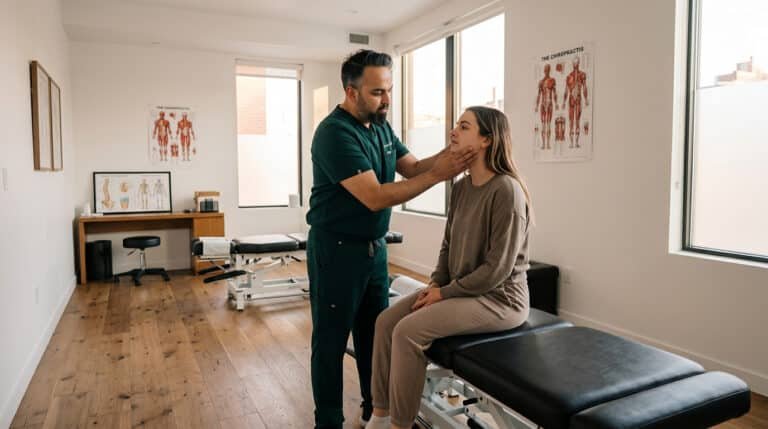
When someone walks in with knee pain, I’m looking at how they walk, how their pelvis moves, what their ankle does during a squat. The exam takes 15-20 minutes and tells me more than an MRI in most mechanical cases.
Joint mobilization. If the hip, ankle, or the knee itself is restricted, I restore motion with a targeted chiropractic adjustment. For the knee specifically, I’ll work the tibiofemoral and patellofemoral joints. For the hip, I’m looking at internal rotation and extension. Ankle dorsiflexion almost always needs attention in runners.
Soft tissue release. The quad, IT band, calf, and hip rotators are almost always involved. I use manual techniques and instrument-assisted methods to break up adhesions and restore tissue pliability. This isn’t a spa massage. It’s targeted and sometimes uncomfortable, but it works.
Corrective exercise. This is what keeps the pain from coming back. I prescribe specific exercises based on what your exam shows, not a generic handout. If your glute med is weak, you’re getting clamshells and lateral band walks. If your ankle is stiff, you’re getting wall dorsiflexion drills. You’ll know exactly what to do, how many reps, and how often.
For chronic or stubborn cases, shockwave therapy can help. Patellar tendinitis and IT band syndrome both respond well to radial pressure wave treatment when combined with manual therapy.
A systematic review in PMC found that manual therapy combined with exercise therapy improved both pain and function in PFPS patients, with particular benefit when applied to the full kinetic chain [4]. That’s exactly what I do. Treat the chain, not just the link that hurts.
Your First Visit for Knee Pain
Your first appointment at Brooklyn Chiropractic Care runs about 45 minutes. We start by talking. I want to know when the pain started, what makes it worse, what you’ve tried already, and what your daily life looks like. Runners, cyclists, people who sit all day at a desk, and warehouse workers all get knee pain for different reasons. The story matters.
Then I examine you. Range of motion in the knee, hip, and ankle. Orthopedic tests to rule out ligament or meniscus damage. Palpation of the soft tissue around the knee to find where the tension is. Functional movement screening, things like a single-leg squat, to see how the whole chain performs under load.
If I think imaging is needed, I’ll tell you. Most mechanical knee pain doesn’t require an MRI to start treatment. But if there’s a red flag, catching or locking, significant swelling, or a traumatic injury, we’ll get the imaging first.
Most patients get their first treatment the same visit. You’ll know the plan before you leave: how many visits I expect you’ll need, what exercises to start at home, and what to avoid while you’re healing. No guessing.
What You Can Do at Home for Knee Pain
- Wall ankle dorsiflexion stretch. Stand facing a wall, one foot forward. Push your front knee toward the wall while keeping your heel flat. Hold 30 seconds, 3 reps per side, twice daily. Stiff ankles are behind more knee pain than people realize.
- Side-lying clamshells. Lie on your side with knees bent at 45 degrees. Keep feet together and lift the top knee. 3 sets of 15 per side. Use a resistance band around your knees once bodyweight gets easy. This targets the glute medius, which is the muscle most responsible for keeping your kneecap tracking straight.
- Straight-leg raises. Lie on your back, one knee bent with foot flat, the other leg straight. Raise the straight leg to about 45 degrees and hold 5 seconds. 3 sets of 10 per side. Builds quad strength without loading the kneecap.
- Ice after activity, not before. 15 minutes max, with a thin cloth between the ice and your skin. Don’t ice constantly throughout the day. After a run, after a long walk, or after stairs, that’s when it helps.
- Stop pushing through sharp pain. Dull aches during exercise that warm up and fade are usually OK to work through. Sharp, catching, or worsening pain during movement is your body telling you to stop. Listen to it.
Knee Pain: When to See a Doctor
Most knee pain responds to conservative care. But not all of it should be treated in a chiropractic office. You need to see a physician or go to urgent care if you experience:
- Sudden swelling within hours of an injury (could indicate an ACL tear or fracture)
- Inability to bear weight at all on the affected leg
- Visible deformity, the knee looks bent or shifted out of place
- Fever with a hot, red, swollen knee (possible joint infection)
- Knee that locks completely and won’t straighten
- Pain that wakes you at night consistently and isn’t related to a position change
If your knee pain is mechanical, aching during activity, stiff in the morning, worse going up stairs, that’s exactly what chiropractic care is built for. Most patients respond well within 4-6 weeks of treatment. If you’re not improving in that window, I’ll refer you for imaging or to an orthopedist. No ego about it.
Frequently Asked Questions About Knee Pain
Can a chiropractor really help with knee pain?
Yes. Chiropractors treat the musculoskeletal causes of knee pain, including joint restrictions in the hip, ankle, and knee, muscle imbalances, and biomechanical problems. A systematic review found that manual therapy plus exercise improves both pain and function in patellofemoral patients [4]. For mechanical knee pain, it’s one of the most effective conservative approaches.
How many visits will I need for knee pain?
Most patients with mechanical knee pain feel significant improvement within 4-6 visits over 2-4 weeks. Chronic cases or post-injury rehab may take 6-8 weeks. You’ll know the expected timeline after your first visit.
Is knee pain from running normal?
Common, but not normal. Running shouldn’t hurt your knees if your joints and muscles are functioning correctly. Persistent knee pain from running usually points to a hip mobility issue, weak glutes, or stiff ankles, all of which are treatable. Don’t accept it as part of the sport.
Should I get an MRI for knee pain?
Not necessarily. Most mechanical knee pain doesn’t require imaging to begin treatment. I’ll recommend an MRI if your exam shows signs of ligament damage, a significant meniscal tear, or if you’re not responding to conservative treatment within 4-6 weeks. For aching, activity-related knee pain, starting with a clinical exam is the right move.
What’s the difference between a chiropractor and an orthopedist for knee pain?
An orthopedist specializes in surgical and medical management of joint problems. A chiropractor specializes in conservative, hands-on treatment of musculoskeletal issues. For most mechanical knee pain, conservative care should be tried first. If you need surgery, I’ll tell you directly and refer you to a specialist I trust.
Ready to find relief? Schedule an appointment online or visit us at Brooklyn Chiropractic Care, 112 Greenpoint Ave. STE 1B, Brooklyn, NY 11222.
References
- Decary S, et al. “Management of knee and hip osteoarthritis: an opportunity for the Canadian chiropractic profession.” Journal of the Canadian Chiropractic Association. 2021;65(1):8-23.
- Kise NJ, et al. “Exercise therapy versus arthroscopic partial meniscectomy for degenerative meniscal tear in middle aged patients.” BMJ. 2016;354:i3740. (Updated follow-up 2018)
- Barton CJ, et al. “Best practice guide for patellofemoral pain based on synthesis of a systematic review, the patient voice and expert clinical reasoning.” British Journal of Sports Medicine. 2024;58(20):1187-1200.
- Brantingham JW, et al. “Effectiveness of Manual Therapy Combined With Physical Therapy in Treatment of Patellofemoral Pain Syndrome: Systematic Review.” Journal of Chiropractic Medicine. 2017;16(2):128-138.
Not Sure What's Causing Your Pain?
Take our 60-second pain assessment and get a personalized care recommendation from Dr. Patel.
Take the Assessment