(347) 625-1246
 hello@brooklynchirocare.com
 112 Greenpoint Ave #1B, Brooklyn, NY 11222
Your shoulder didn’t go out all at once. It crept up on you. Maybe it started as a dull ache when you reached for something on a high shelf. Then one morning you couldn’t hook your bra strap or grab your MetroCard from your back pocket. Now you’re lying awake at night because rolling onto that side sends a sharp bolt through your whole arm. If you’re dealing with frozen shoulder in Brooklyn, you’re not imagining it, and you’re not just “tight.” Your shoulder capsule is inflamed and thickening, and it won’t fix itself with rest alone.
Key Takeaways
- Frozen shoulder (adhesive capsulitis) progresses through three stages: freezing, frozen, and thawing. Each stage responds to different treatment approaches.
- Without treatment, full recovery can take 1 to 3 years. Early intervention during the freezing stage can cut that timeline significantly.
- Chiropractic adjustments to the shoulder and upper spine restore joint mechanics that stretching alone can’t reach.
- A 2014 trial found extracorporeal shockwave therapy produced significant pain reduction and improved range of motion in adhesive capsulitis patients.
- Dr. Patel combines manual mobilization, assisted stretching, and shockwave therapy based on which stage you’re in.
Table of Contents
- What Is Frozen Shoulder in Brooklyn (and Why Does It Happen)?
- The Three Stages of Frozen Shoulder
- What Causes Your Shoulder to Freeze Up
- How Dr. Patel Treats Frozen Shoulder in Brooklyn
- What to Expect at Your First Visit
- What You Can Do at Home
- When Frozen Shoulder Needs More Than Chiropractic
- Frequently Asked Questions
What Is Frozen Shoulder in Brooklyn (and Why Does It Happen)?
Adhesive capsulitis is the clinical name. Your shoulder joint is wrapped in a capsule of connective tissue. When that capsule gets inflamed, it starts to thicken and tighten. Scar-like adhesions form. The joint space shrinks. And your brain starts guarding the shoulder by limiting how far you’ll move it, which makes the stiffness worse.
It affects roughly 2 to 5% of the general population, but that number jumps to 10 to 20% in people with diabetes. Women get it more often than men. It peaks between ages 40 and 60. I see it regularly at our Greenpoint clinic, and the pattern is almost always the same: patient ignored a “minor” shoulder ache for a few months, then woke up one day and couldn’t lift their arm past 90 degrees.
The frustrating part is that frozen shoulder doesn’t show up on a standard X-ray. There’s no fracture. No obvious tear. So patients get told “it’s just inflammation” or “give it time.” Time alone can mean 18 to 30 months of restricted motion.
The Three Stages of Frozen Shoulder
Frozen shoulder isn’t one condition. It’s three phases stacked on top of each other, and treatment that works in one stage can backfire in another.
Stage 1: Freezing (6 to 9 Months)
Pain comes first. It builds gradually, usually worst at night. You start avoiding movements that provoke it. Reaching overhead gets harder week by week. Internal rotation goes early, so things like tucking in a shirt or clasping your hands behind your back become genuinely difficult. This is the stage where most patients first show up.
The capsule is actively inflaming. Aggressive stretching at this point can make things worse because you’re fighting an inflammatory process. Gentle mobilization and pain control matter most here.
Stage 2: Frozen (4 to 6 Months)
The good news in this stage is the intense pain starts to back off. The bad news is the stiffness peaks. Your shoulder feels locked in place. Range of motion sits at maybe 50 to 60% of normal. Daily life gets genuinely awkward. Washing your hair, putting on a coat, reaching for a seatbelt. All of it is a project.
This is when structured mobilization and assisted stretching can make the biggest difference. The inflammation is settling down, so the joint tolerates being worked.
Stage 3: Thawing (6 to 24 Months)
Range of motion gradually returns. How much and how fast depends on what you did during stages 1 and 2. Patients who got early treatment often move through thawing in 3 to 6 months. Patients who waited can be stuck in this stage for over a year, sometimes with permanent loss of 10 to 15% of their range.
What Causes Your Shoulder to Freeze Up
Diabetes. This is the big one. A 2023 review in the Journal of Orthopaedic Surgery and Research confirmed that diabetic patients have significantly higher rates of adhesive capsulitis and respond more slowly to conservative care. If you have Type 1 or Type 2 diabetes and your shoulder is stiffening, don’t wait.
Immobilization after injury or surgery. Broke your collarbone? Had rotator cuff surgery? Wore a sling for six weeks? That forced immobility can trigger the capsule to tighten. Patient came in last month, four months post-shoulder surgery, couldn’t raise her arm above waist height. Classic post-surgical adhesive capsulitis.
Thyroid disorders. Both hypothyroidism and hyperthyroidism increase your risk. Autoimmune conditions in general seem to prime the capsule for this kind of reaction.
Prolonged desk posture plays a role too. Rounded shoulders and a forward head position change the biomechanics of the glenohumeral joint. The capsule doesn’t sit evenly. The rotator cuff muscles get imbalanced. It’s not the sole cause, but it sets the stage.
How Dr. Patel Treats Frozen Shoulder in Brooklyn
Treatment depends entirely on which stage you’re in. I don’t use the same approach for a freezing shoulder as I do for a frozen one. Getting this wrong is the most common mistake I see from patients who’ve already tried PT or chiropractic elsewhere.
Stage-Specific Manual Therapy
During the freezing stage, I focus on gentle glenohumeral mobilization. Grade I and II joint mobilizations that stay within your pain-free range. The goal isn’t to force range. It’s to prevent further adhesion while the inflammation settles. I also adjust the thoracic spine and first rib, because a stiff upper back forces your shoulder to compensate, and that compensation accelerates the freeze.
Once you’re in the frozen stage, we can push harder. Grade III and IV mobilizations. End-range stretching. This is where assisted stretching at BCC becomes a real asset. PNF (proprioceptive neuromuscular facilitation) stretching uses your own muscle contractions to trick the nervous system into releasing the capsule further than passive stretching can reach.
Shockwave Therapy for Adhesive Capsulitis
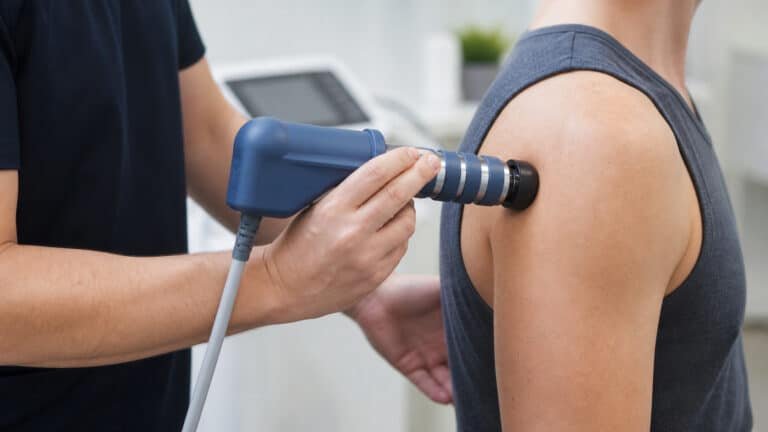
I use radial shockwave therapy on frozen shoulders that have moved past the acute inflammatory stage. A randomized controlled trial published in the Journal of Physical Therapy Science found that ESWT produced significant improvements in pain scores and shoulder function compared to conventional physical therapy alone.
Shockwave works by driving acoustic pressure waves into the adhesions. It stimulates blood flow, triggers a local healing response, and breaks down some of the fibrous tissue that’s binding the capsule. I typically run 4 to 6 sessions, one per week, during the frozen or early thawing stage. It pairs well with manual mobilization because the tissue is more pliable immediately after treatment. If you want a deeper look at how shockwave applies to shoulder conditions specifically, I wrote about that in detail here.
Upper Spine and Rib Adjustments
Your shoulder doesn’t operate in isolation. The scapula rides on the ribcage. The thoracic spine dictates how the scapula moves. If T3 through T7 are locked up, your scapula can’t rotate properly, and your shoulder has to pick up the slack. I adjust the upper thoracic spine and check the AC joint and first rib at every frozen shoulder visit. Patients are always surprised how much shoulder range returns just from getting the upper back moving again.
What to Expect at Your First Visit
I start with a full shoulder exam. Range of motion testing in all planes: flexion, abduction, external rotation, internal rotation. Orthopedic tests to rule out rotator cuff tears, labral issues, or cervical radiculopathy that can mimic frozen shoulder. If your history warrants it, I’ll order imaging, but most frozen shoulders are diagnosed clinically.
I’ll ask about your medical history. Diabetes, thyroid conditions, recent surgeries, medications. These matter because they change the prognosis and the treatment timeline. A diabetic frozen shoulder needs a more cautious early approach and a longer treatment plan.
Once I have a clear picture, I’ll tell you which stage you’re in and lay out a plan. Most patients start with two visits per week for the first three to four weeks. We taper to once a week as range improves. The full treatment course runs 8 to 16 weeks depending on the stage at entry. Early-stage cases respond faster. Patients who’ve been frozen for six months or more take longer, but they still get significant gains.
First visit takes about 45 minutes. Follow-ups run 20 to 30 minutes.
What You Can Do at Home
- Pendulum exercises (Codman’s). Lean forward with your affected arm hanging straight down. Swing it gently in small circles, front to back, side to side. Two minutes, three times a day. This keeps the joint moving without loading the capsule. Do it after a warm shower when the tissue is most relaxed.
- Towel stretch for internal rotation. Hold a towel behind your back with both hands. Use your good arm to gently pull the affected arm upward. Hold 15 to 20 seconds. Three reps. Stop if pain is sharp. A dull stretch is fine.
- Cross-body reach. Use your good arm to lift your affected arm at the elbow and bring it across your body. Hold 15 to 20 seconds. This targets the posterior capsule, which is often the tightest part. Three reps, twice daily.
- Heat before, ice after. Apply a heating pad to the shoulder for 10 to 15 minutes before doing your stretches. Ice for 10 minutes afterward if it feels sore. Heat increases tissue extensibility. Ice manages any irritation from the stretching.
- Sleep position adjustment. Sleeping on the affected side compresses the joint and makes morning stiffness worse. If you’re a side sleeper, switch to the opposite side and hug a pillow to support the arm. Back sleepers do well with a small pillow under the affected arm’s elbow.
When Frozen Shoulder Needs More Than Chiropractic
Most frozen shoulders respond well to conservative care. But there are situations where I refer patients out or co-manage with an orthopedist.
If your range of motion hasn’t improved at all after 6 to 8 weeks of consistent treatment, we need to consider whether something else is going on. An MRI can identify a rotator cuff tear that’s hiding behind the stiffness, or a labral tear that’s contributing to the mechanical block.
Diabetic patients with severe capsular restriction sometimes benefit from a manipulation under anesthesia or a hydrodilatation procedure, where fluid is injected into the joint capsule to stretch it. These aren’t first-line treatments, but they’re worth discussing if conservative care plateaus.
If you have sudden onset shoulder pain with no history of gradual stiffness, that’s not a frozen shoulder pattern. Sudden loss of motion with severe pain could indicate a fracture, dislocation, or acute rotator cuff tear. Get it evaluated immediately.
Frequently Asked Questions About Frozen Shoulder in Brooklyn
How long does frozen shoulder last without treatment?
Without treatment, frozen shoulder typically resolves in 1 to 3 years, though some patients retain permanent stiffness. A 2023 clinical review noted that early intervention during the freezing stage can reduce total recovery time to 3 to 9 months with structured mobilization and manual therapy.
Can I still exercise with a frozen shoulder?
Yes, but you need to modify. Avoid overhead pressing, pull-ups, and any movement that forces the shoulder past its current range. Lower body work, walking, cycling, and core exercises are all fine. Your shoulder needs controlled movement, not complete rest. Complete immobilization actually makes adhesive capsulitis worse.
Does shockwave therapy help frozen shoulder?
Clinical trials show that extracorporeal shockwave therapy improves pain and function in adhesive capsulitis patients, especially when combined with manual therapy and stretching. It works best during the frozen and early thawing stages, not during active inflammation in the freezing phase.
Is frozen shoulder the same as a rotator cuff tear?
No. A rotator cuff tear is a muscle or tendon injury. Frozen shoulder is a capsular condition. They can coexist, and the symptoms overlap (pain, restricted motion), but the treatment is different. Dr. Patel differentiates them during your exam using specific orthopedic tests for each condition.
Why does frozen shoulder get worse at night?
Two reasons. First, inflammatory chemicals peak at night due to your body’s circadian rhythm. Second, lying down changes the position of your shoulder joint. The humeral head shifts in the socket, and the inflamed capsule gets compressed or stretched depending on your sleep position. A pillow supporting the arm takes pressure off the joint and helps with nighttime pain.
Will frozen shoulder come back after treatment?
Recurrence in the same shoulder is rare, affecting roughly 5 to 10% of patients. But developing it in the opposite shoulder happens in about 20 to 30% of cases within five years. Patients with diabetes or thyroid conditions have a higher risk of bilateral involvement. Regular mobility work after recovery reduces that risk.
Ready to find relief? Schedule an appointment online or visit us at Brooklyn Chiropractic Care, 112 Greenpoint Ave. STE 1B, Brooklyn, NY 11222.
References
- StatPearls. Adhesive Capsulitis (Frozen Shoulder). NCBI Bookshelf. ncbi.nlm.nih.gov/books/NBK532955
- Abdelaal AM, et al. Adhesive capsulitis: the importance of early diagnosis and treatment. J Orthop Surg Res. 2024. pubmed.ncbi.nlm.nih.gov/38844748
- Park C, et al. The effects of extracorporeal shock wave therapy on frozen shoulder patients’ pain and functions. J Phys Ther Sci. 2015;27(12):3681-3684. doi:10.1589/jpts.27.3681
- Vahdatpour B, et al. Efficacy of extracorporeal shockwave therapy in frozen shoulder. Int J Prev Med. 2014;5(7):875-881. PMC4124565
- Frozen Shoulder (Adhesive Capsulitis). American Academy of Orthopaedic Surgeons (AAOS). OrthoInfo. orthoinfo.aaos.org
Not Sure What's Causing Your Pain?
Take our 60-second pain assessment and get a personalized care recommendation from Dr. Patel.
Take the Assessment