(347) 625-1246
 hello@brooklynchirocare.com
 112 Greenpoint Ave #1B, Brooklyn, NY 11222
You lift, load, and push pallets across concrete for eight hours straight. Then you do it again tomorrow. If you’ve got warehouse back pain that won’t quit, you’re not alone. Nearly one in four warehouse workers deals with low back pain at any given time [1]. I see it constantly at our Greenpoint clinic. Guy walks in after his shift, can barely bend over to untie his boots. He’s been popping ibuprofen for months and it stopped working three weeks ago. That’s usually when people find us.
North Brooklyn is full of warehouse and logistics operations. Distribution centers along the waterfront, light industrial buildings on McGuinness, fulfillment hubs that run double shifts. These jobs demand a lot from your body. And your body keeps score.
Key Takeaways
- Warehouse workers have some of the highest rates of back injury across all occupations
- Repetitive lifting and twisting cause more damage than any single heavy load
- Chiropractic adjustments fix joint restrictions that painkillers and stretching can’t reach
- Workers’ comp covers chiropractic in New York, and you pick your own doctor
- Most patients feel real improvement within 2-4 weeks of consistent treatment
Table of Contents
Why Warehouse Work Wrecks Your Back
Your spine wasn’t built for what warehouse work asks it to do. Picking up 40-pound boxes from floor level hundreds of times per shift puts repeated compression on your lumbar discs. Add in twisting while you carry, and you’ve got the setup for a disc bulge or facet joint irritation.
Concrete floors make everything worse. Zero shock absorption, all day long. The impact travels from your feet straight up into your lower back and hips. Workers in refrigerated sections get hit even harder. Cold tightens your muscles and they lose the elasticity they need to protect your joints.
Here’s what surprises people: it’s not always the heaviest loads that do the damage. A 2023 cross-sectional study of 204 warehouse workers found that those performing separation tasks, the repeated bending and sorting, had higher rates of low back pain than workers handling heavier but less repetitive jobs [1]. Repetition wears you down faster than any single heavy lift.
And then there’s the time pressure. Nobody on a warehouse floor is thinking about hip hinge form when they’re trying to hit quota. Form degrades as fatigue sets in. By hour six, you’re rounding your back on every lift and you don’t even realize it.
The Most Common Warehouse Back Pain Patterns
I could list these with my eyes closed. They walk through the door in a pretty predictable order.
Lower back strain that won’t go away. You pulled something three weeks ago. Felt like it healed. Came back. Probably came back because it wasn’t a muscle strain in the first place. A restricted SI joint or mild disc irritation mimics a strain perfectly. Your body compensates, the compensation creates a new problem, and now you’ve got two issues instead of one. I wrote about this pattern in more detail in my post on back pain treatment in Brooklyn.
Sciatica from disc pressure. Sharp pain shooting into one leg, maybe numbness in the foot. This happens when a lumbar disc pushes against a nerve root. Heavy lifting with a rounded back is the classic trigger. Warehouse work is basically a sciatica factory if your form breaks down.
Mid-back stiffness that wraps around your ribs. This one catches people off guard. Carrying boxes in front of your body for hours locks up your thoracic spine. Pain between the shoulder blades, sometimes wrapping around to your chest. Patients come in thinking it’s cardiac. Usually it’s a stuck thoracic segment that needs mobilization.
Forklift operators get their own pattern entirely. Sitting with constant vibration and repeated head turning creates neck and upper back issues that warehouse floor workers don’t get. Different mechanism, same result: joints that aren’t moving right.
How Dr. Patel Treats Warehouse Back Pain
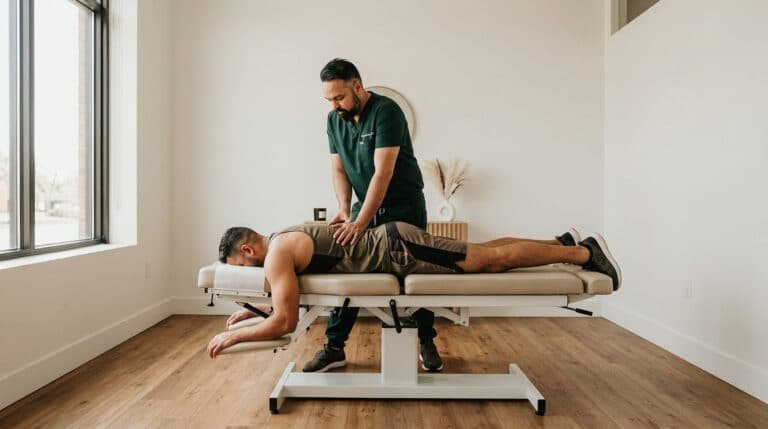
First thing I do is figure out what’s actually wrong. Not what you think is wrong, but what the exam shows. A lot of warehouse workers walk in self-diagnosed with “I pulled a muscle.” Sometimes that’s accurate. More often it’s a joint restriction or disc irritation that needs a completely different approach.
Chiropractic adjustments restore normal motion to joints that have locked up under repetitive stress. The clinical evidence backs this up. A 2024 review published in the American Journal of Medicine, covering five decades of research, found that 90% of clinical practice guidelines recommend spinal manipulation for low back pain treatment. For chronic low back pain specifically, that number is 100% [2].
But adjustments alone aren’t enough for most warehouse injuries. Soft tissue work, including therapeutic massage, breaks up adhesions in your paraspinal muscles and hip flexors that have been tightening for months. Corrective exercises retrain your movement patterns so the same lifting injury doesn’t keep cycling back every few weeks.
For workers dealing with disc problems, I use flexion-distraction therapy. It creates gentle negative pressure in the disc space, pulling the bulge away from the nerve without any cracking or twisting. Most of my warehouse patients with disc issues respond well within a few sessions.
What to Expect at Your First Visit
You’ll fill out paperwork about your injury history and what your job actually involves. The physical demands of your specific role matter. A picker has different stress patterns than a forklift operator or a dock loader.
The exam itself takes about 30 minutes. I check your range of motion, test reflexes, palpate your spine for restrictions, and run orthopedic tests to pinpoint exactly where the problem lives. If I suspect a disc issue, I might order imaging. Most people don’t need it on day one.
If your case is straightforward, you get your first adjustment that same visit. New patient visits are $150, which covers the full exam and treatment.
Most warehouse workers I treat start with 2-3 visits per week, tapering as things improve. A typical case resolves in 4-8 weeks. Some guys stick with maintenance visits every few weeks after that because the job doesn’t change. Regular adjustments keep the same problems from building back up.
What You Can Do Between Shifts
These are specific to the demands of warehouse work. Not the generic advice you’ve already been ignoring.
- Cat-cow stretches before every shift. Hands and knees, arch up like a cat, then let your belly drop toward the floor. 10 reps, slow. Takes 90 seconds and primes your lumbar spine for the flexion and extension it’s about to handle all day.
- Hip flexor stretch at lunch. Kneel on one knee, push your hips forward until you feel a stretch in the front of your back hip. Hold 30 seconds each side. Your hip flexors shorten from all the bending and squatting throughout your shift. When they’re tight, they pull your pelvis forward and compress your lower back. This single stretch makes a bigger difference than most people expect.
- Glute bridges every evening. Lie on your back, knees bent, squeeze your glutes and lift your hips. 3 sets of 15. Your glutes are the primary shock absorbers for your lower back, and if they’re weak your spine takes the force instead.
- Set a phone timer for every 90 minutes during your shift. When it goes off, consciously reset your lifting form. Knees bent? Load close? Back neutral? After four hours of fatigue, form breaks down and you don’t notice until something pops.
- Ice after your shift, not heat. 15 minutes on your lower back when you get home. Ice reduces inflammation in irritated joints and discs. Save heat for chronic stiffness on your days off.
Workers’ Comp Covers Chiropractic in New York
This is the part a lot of warehouse workers don’t know. If you got hurt on the job, workers’ compensation covers your chiropractic care at zero out-of-pocket cost. In New York, you have the legal right to choose your own doctor. Your employer can’t force you to see their preferred provider.
We handle workers’ comp cases regularly at Brooklyn Chiropractic Care. We know the paperwork, we know the timelines, and we deal directly with your claims adjuster so you can focus on recovering instead of fighting with forms.
You don’t need your employer’s permission to start. File a C-3 form with the Workers’ Compensation Board, see your doctor, and the process begins. Not sure how to get started? Call us at (347) 625-1246 and we’ll walk you through it.
When to See a Doctor
Chiropractic handles most warehouse back pain well. But some symptoms mean you need an emergency room, not our office.
Go to the ER if you notice:
- Loss of bladder or bowel control
- Numbness in both legs at the same time
- Weakness in your legs that’s getting progressively worse over hours
- Severe pain after a fall from height or a crushing injury
These could indicate cauda equina syndrome or a serious spinal cord injury that needs immediate medical intervention.
For everything else, recurring low back pain, sciatica that comes and goes, stiffness that’s been building for months, chiropractic is a solid starting point. If your situation needs a different specialist, I’ll tell you.
Frequently Asked Questions
Can I see a chiropractor for a warehouse injury without filing workers’ comp?
Yes. Many warehouse workers pay out of pocket or use their health plan. A new patient visit is $150 and includes a full exam plus your first treatment.
How quickly does warehouse back pain improve with chiropractic?
Most patients notice relief within 1-3 visits. Full resolution of a warehouse lifting injury typically takes 4-8 weeks depending on severity. Chronic issues that have built up over months take longer to fully correct.
Is it safe to get adjusted with a disc herniation from lifting?
Yes, when performed correctly. I use low-force techniques like flexion-distraction for disc patients. I won’t do a high-velocity adjustment on an acute herniated disc.
Do I need to take time off work for treatment?
Usually not. Follow-up visits run 15-20 minutes. We have evening hours on Tuesdays and Thursdays until 8 PM, which works well for warehouse workers finishing afternoon or swing shifts.
What’s the difference between a chiropractor and a physical therapist for a lifting injury?
Both can help, but from different angles. Chiropractic addresses joint restrictions and spinal alignment first. Physical therapy focuses on exercise rehab. For warehouse injuries, the joint restriction usually needs fixing before rehab exercises will hold. I refer to PT when a patient needs a structured program beyond what we handle in-clinic.
Ready to find relief? Schedule an appointment online or visit us at Brooklyn Chiropractic Care, 112 Greenpoint Ave. STE 1B, Brooklyn, NY 11222.
References
- Callegari B, et al. Prevalence and factors associated with low back pain in warehouse workers: A cross-sectional study. J Occup Rehabil. 2023;33(3):580-588.
- Corcoran KL, et al. Chiropractic and spinal manipulation: A review of research trends, evidence gaps, and guideline recommendations. Am J Med. 2024.
- Bureau of Labor Statistics. Nonfatal occupational injuries and illnesses requiring days away from work. U.S. Department of Labor. 2024.
Not Sure What's Causing Your Pain?
Take our 60-second pain assessment and get a personalized care recommendation from Dr. Patel.
Take the Assessment